At long last, a line is drawn against the excesses of celebrity
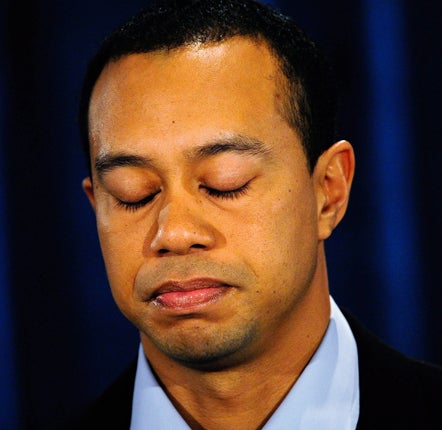
Tiger Woods offered more than atonement when he faced the world for the first time since his world collapsed beneath the weight of squalid sexual scandal.
He set himself the most difficult challenge any man can face – the challenge of creating a new life for himself and new values.
When he did so – while plainly fighting back the emotion which has been building over the months – many may have concluded that he was, from the bitterness of his own experience, throwing a new light on the pitfalls of a celebrity culture where a confession of personal guilt and responsibility is rarely offered.
In Britain, few will be able to resist the comparison with the recent problems of the former England football captain John Terry in facing up to similar revelations about his private life.
Woods yesterday accepted his responsibility for all of his problems, quite profoundly, and also made clear his determination to fight against his submission to the temptations of fame and wealth.
The world's best golfer – and arguably still the most charismatic figure in all of sport – spent 13 minutes soul-baring and apologising before a small gathering in Florida and a huge world-wide television audience. But he also gave an undertaking that will stretch, he seemed to recognise, every fibre of his resolve. He said he would attempt to remake himself. Naturally his self-flagellation inspired considerable cynicism around the world, not least from Britain's Sir Nick Faldo who criticised Woods for not naming the date he will return to the golf course.
However, there was another reaction to Tiger's confessional. It was one that recognised that he had done much, much more than deliver the predictable platitudes of a man attempting to wriggle out of a disaster of his own making.
Woods took every available morsel of blame for the implosion of the most stunning career in the history of his game and all of sport. He said he had let down everybody, his wife, his children, his late father, his friends, and all those around the world who had become his fans.
When he said that his life needed balance, and that he had strayed wilfully beyond the values imposed upon him by his father, a former colonel in the American army, and his Buddhist mother Kultida, whom he embraced at the end of his scripted but highly emotional statement, he was, at least to some, eloquently drawing a line against a celebrity culture where almost anything goes.
The key admission was that in his sexual adventures, in his submission to many available "temptations", he had felt "entitled". He had done the work, won the prizes, and his reward was to do whatever he chose.
"For all that I've done, I'm so sorry," he declared. He said he was the guilty one, and entirely so. His wife had not hit him, as was widely reported after the car crash near his home which began the unravelling of his life, not on the fateful night, not ever.
His more obdurate critics claimed afterwards that he should have invited questions and that his decision to face the world on a day which would distract attention from a golf tournament sponsored by the company who first dropped him in the wake of the revelation, was an act of petty malice.
They said that beneath the veneer of repentance it was the same old Tiger, arrogant, self-obsessed and still jealous of all his old status and privileges.
Yet what, you had to wonder, would questions have elicited, beyond the guilt and sense of grievous responsibility for behaviour destructive to all those around him as well as himself that he had expressed so emotionally?
Yes, perhaps he might have been invited to revisit the cocktail waitresses and the nightclub hostesses with whom he had spent so much of his time away from the golf course. He could have submitted himself to a trial of minute detail.
But what answers could he have provided of greater depth than his voluntary conclusion that he had behaved shamefully, thrown away half a lifetime of superb achievement? Students of addiction would have seen something of a pattern in the words of Tiger, a classic statement of the first priority of anyone locked into such a situation.
It is reappraisal of oneself, a willingness to put aside all the excuses and face up to the reality of your own behaviour.
Against these possibilities some of the headlines and blogs gushing forth in America, one carrying the headline, 'Hey, Tiger, apology not accepted,' seemed vengeful at best.
Certainly it was hard to dispute the weight of Woods's feeling when he said: "It's up to me to start living a life of integrity. I believe now it's not what you achieve that is important, but what you overcome."
Woods could not have set himself a more demanding challenge, and he suggested that along with the therapy he has received in an addiction, he will also seek the guidance of his Thai mother's Buddhism. "It teaches me," he said, "to stop following my impulses."
What was clear enough was that, despite the allegations of his critics, Woods was seeking no easy route back to the grandeur of his old life. There was no hedging in his statement of guilt and regret.
He said he was on the first stages of a long road to recovery – and in this he sought the help of those closest to him and all those who had cheered him on a winning fairway.
No, it wasn't any ordinary atonement. It was a man saying he had done wrong and wanted to do better.
Join our commenting forum
Join thought-provoking conversations, follow other Independent readers and see their replies
Comments