Cabinet reshuffle in Cuba as Raul does it his way
President comes out from Fidel's shadow to put his stamp on government
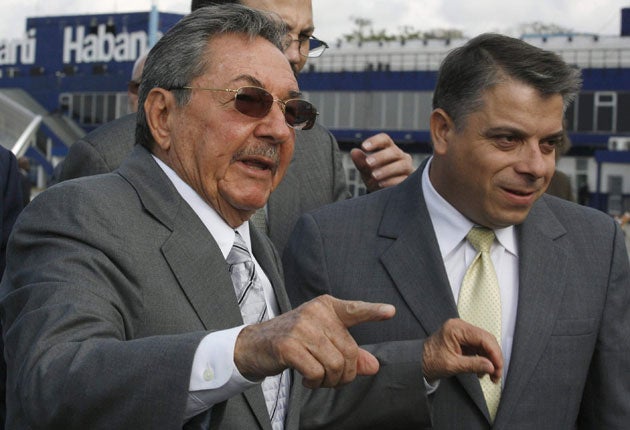
President Raul Castro cast aside prominent figures linked to his older brother, Fidel, as he replaced eight ministers yesterday in a shake-up that firmly put his stamp on the Cuban government after a year in power. The reshuffle was billed as a move toward more efficiency in Cuba's communist system, but also dealt a blow to the island's two best-known younger leaders as Mr Castro consolidated his grip on government.
The changes did not appear to signal a sharp turn in policy by Mr Castro, 77, but might make it easier for him to modernise the state-run economy, analysts said. The Foreign Minister, Felipe Perez Roque, 43, was the biggest name to lose his post, and Carlos Lage was replaced as chief cabinet minister by a senior military official, Jose Amado Ricardo Guerra. Mr Lage, 57, was considered by many to be an economic reformer.
The ouster of Mr Perez Roque, a former personal secretary to Fidel Castro and one of the most visible members of the government, comes despite recent foreign policy successes and amid expectations that the US President, Barack Obama, will ease the 47-year-old US trade embargo against Cuba. Mr Perez Roque had been a firm proponent of maintaining Cuban socialism and in recent months strengthened or patched up Cuba's relations across the globe, also winning strong support from Latin America in a campaign against the US embargo.
But he also recently spoke in unusually positive terms about the hope for better relations with the United States. His deputy, Bruno Rodriguez, was named to replace him.
Mr Lage, a Fidel Castro protégé who led economic changes in the 1990s when the collapse of the Soviet Union plunged Cuba into a deep crisis, was removed from the top cabinet job but apparently retained his position as a vice-president on the Council of State, Cuba's top policy-making body.
Among others put aside were Raul de la Nuez, Minister of Foreign Trade, and Jose Luis Rodriguez Garcia, the longtime Minister of Economy and Planning. The ministries of fishing and food production were combined, as were the ministries of foreign investment and foreign trade, according to an announcement read on state-run television. The statement suggested more changes lie ahead "with the objective of gradually reducing" the government's size.
Phil Peters, an expert on Cuba at the Lexington Institute in Virginia, said the changes mean "Raul Castro is streamlining the government and putting some of his own people, including some from the military, in key positions". Mr Castro has talked about making government more efficient and the changes were "modest", Dr Peters said. "I see no implications for relations with the US."
Bert Hoffmann, a Latin America expert at the German Institute of Global and Area Studies in Hamburg, said the changes sent "signals of uncertainty" about Mr Castro's plans for the Cuban economy. But he said they also may clear the way, by removing potential opponents, for him to speed whatever reforms he has in mind.
Raul Castro took over in February 2008 when the National Assembly voted him President to succeed Fidel who stepped down due to health problems after ruling Cuba since taking power in a 1959 revolution. Fidel, 82, continues to play a behind-the-scenes role, but has not been seen in public since undergoing intestinal surgery in July 2006. He occasionally surfaces in photographs and videos with visiting foreign leaders.
Join our commenting forum
Join thought-provoking conversations, follow other Independent readers and see their replies
Comments