Chavez threatens to invade as Honduran army stages coup
Venezuelan leader vows to 'act militarily' after leftist ally Manuel Zelaya is overthrown and exiled to Costa Rica
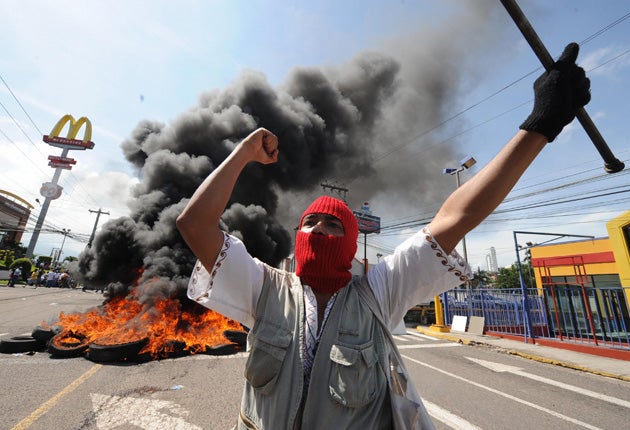
Honduras was plunged into a political crisis that threatened to spill across the region hours after President Manuel Zelaya was thrown out by the army and exiled to Costa Rica prompting his leftist ally in Venezuela, President Hugo Chavez, to threaten military intervention.
In the first successful military coup in Central America since the end of the Cold War, the army sent masked soldiers into the presidential palace before dawn. The President, who was in dispute with his military about a planned constitutional referendum, was then escorted to a military plane which took him into exile.
Mr Chavez went on state television later in the day claiming that the coup leaders had taken away the Cuban ambassador to Honduras and left the Venezuelan ambassador by the road in the capital, Tegucigalpa, after beating him. He said that if troops enter his embassy "that military junta would be entering a de facto state of war," and "we would have to act militarily".
The Congress in Honduras said later that it had received a letter of resignation from Mr Zelaya, purportedly signed on Friday. In a show of hands, representatives accepted that he had stepped down from office.
The country's Supreme Court said it supported the coup. The court had been opposed to the non-binding referendum which was an effort to legitimise a re-writing of the constitution to allow Mr Zelaya to overcome term limits and seek re-election as president. Mr Chavez and the leaders of Bolivia and Ecuador have similarly moved to end restrictions on how long they can stay in office.
The Honduran ambassador to the Organisation of American States said the military was planning to swear in the Congressional President, Roberto Micheletti, next in line to the presidency according to the constitution, to replace Mr Zelaya, who came into office in 2006 and would have had to stand down in 2010 under the existing constitution.
Speaking from Costa Rica, Mr Zelaya denied he had written a resignation letter calling it "totally false". Insisting he was still the president, he said there was "no way to justify an interruption of democracy, a coup d'etat." He added: "This kidnapping is an extortion of the Honduran democratic system."
Under the government of Mr Zelaya, Honduras was member of Alba, a coalition of leftist Latin American countries that includes Bolivia, Cuba, Ecuador and Nicaragua and which is led by Mr Chavez. The organisation was rushing to arrange a summit in Nicaragua to discuss what action to take after the coup.
"We will bring them down. We will bring them down, I tell you," Mr Chavez vowed during yesterday's broadcast, saying, "I have put the armed forces in Venezuela on high alert".
Experts noted, however, that Mr Chavez has a track record of threatening military action but not following through with it. He deployed troops to his border with Colombia last year after that country took action against terrorist bases just inside Ecuador. That crisis eased after a few days, however.
Mr Zelaya said he first realised a coup was under way when he was woken by gunshots inside his palace grounds. He described leaping from his bed and avoiding bullets by hiding, still in his pyjamas, behind an air conditioning unit. He said the palace guard held the soldiers off for more than 20 minutes before he was taken into custody and escorted by eight or nine masked soldiers to the waiting plane.
The streets of Tegucigalpa were reportedly mostly calm last night although main avenues were filled with army tanks in a strong show of force. Roughly 100 supporters of Mr Zelaya had gathered by mid-morning outside the gates to the palace. Some threw stones at hundreds of soldiers surrounding the palace and shouted "Traitors! Traitors!" in protest.
"They kidnapped him like cowards" yelled Melissa Gaitan, 21, who works at the government television station. "We have to rally the people to defend our president."
In Washington, President Barack Obama said he was "deeply concerned" by news of the coup while the Secretary of State, Hillary Clinton, said his expulsion from the country should be condemned. "I call on all political and social actors in Honduras to respect democratic norms, the rule of law and the tenets of the Inter-American Democratic Charter," Mr Obama said in a statement released by the White House.
Manuel Zelaya: President in exile
*With his moustache and taste for cowboy hats, Manuel Zelaya won the 2005 presidential election in Honduras by a margin of barely 70,000 votes, as a long-time member of the centre-right Liberal Party.
Once in office, however, Zelaya tracked left and moved the country away from its traditional close alliance with the US, forging links instead with Hugo Chavez, the leftist president of Venezuela.
Though he had campaigned on a law-and-order ticket, his country has increasingly been seen as a transit point for drugs to the US, with rising criminal violence and street gangs. He has urged Washington to legalise drugs as the best solution to the problem.
Two years ago, in a dispute with the US about imported Honduran melons that were deemed unsafe, Zelaya went on CNN and ate one on air.
Frustrated by what he considered unfair coverage of his government by Honduran television and radio, he issued an order in 2007 that all stations should carry two hours of government propaganda every day.
Join our commenting forum
Join thought-provoking conversations, follow other Independent readers and see their replies
Comments