
The latest headlines from our reporters across the US sent straight to your inbox each weekday
Your briefing on the latest headlines from across the US
They are the last survivors: all that's left of a once-vibrant civilisation which created its own religion and language, and gave special names to everything from the creatures of the rainforest to the stars of the night sky.
Just five people represent the entire remaining population of the Akuntsu, an ancient Amazonian tribe which a generation ago boasted several hundred members, but has been destroyed by a tragic mixture of hostility and neglect.
The indigenous community, which spent thousands of years in uncontacted seclusion, recently took an unwelcome step closer to extinction, with the death of its sixth last member, an elderly woman called Ururú.
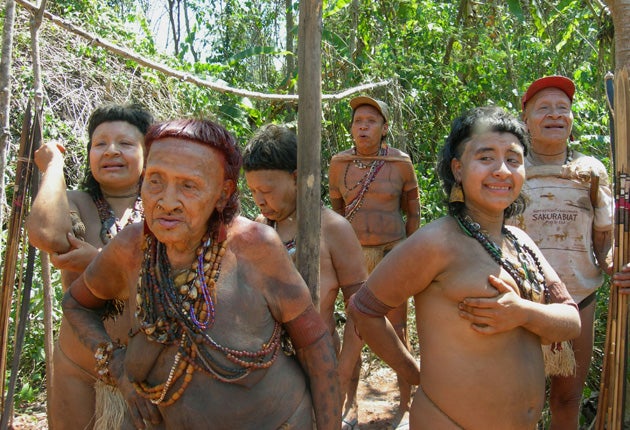
Considered the matriarch of the Akuntsu, and shown in these pictures (which were taken in 2006, and are the most recent images of the tribe), Ururú died of old age, in a hut built from straw and leaves, on 1 October. News of her death emerged last week, when the tribe was visited by human rights campaigners, who have spent the past decade campaigning to preserve their homeland from deforestation.
"I followed the funeral," says Altair Algayer, a local representative of Funai, the Brazilian government agency which protects Indian territories. "She died in a small house. We heard weeping and rushed over, but she had already died." Ururú's death means the entire population of the Akuntsu now consists of just three women and two men. All of them are either close family relations, or no longer of child-bearing age – meaning that the tribe's eventual disappearance is now inevitable.
The slow death of this indigenous community is far more than an unfortunate accident, however. Instead, it represents the long-planned realisation of one of the most successful acts of genocide in human history. And the fate of the Akuntsu is seen by lobby groups as an object lesson in the physical and cultural dangers faced by undiscovered tribes at so-called "first contact".
Much of the Akuntsus' story is – for obvious reasons – undocumented. For millennia, they lived in obscurity, deep in the rainforest of Rondonia state, a remote region of western Brazil near the Bolivian border. They hunted wild pig, agoutis and tapir, and had small gardens in their villages, where they would grow manioc (or cassava) and corn.
Then, in the 1980s, their death warrant was effectively signed: farmers and loggers were invited to begin exploring the region, cutting roads deep into the forest, and turning the once verdant wilderness into lucrative soya fields and cattle ranches.
Fiercely industrious, the new migrant workers knew that one thing might prevent them from creating profitable homesteads from the rainforest: the discovery of uncontacted tribes, whose land is protected from development under the Brazilian constitution.
As a result, frontiersmen who first came across the Akuntsu in the mid-1980s made a simple calculation. The only way to prevent the government finding out about this indigenous community was to wipe them off the map.
At some point, believed to be around 1990, scores of Akuntsu were massacred at a site roughly five hours' drive from the town of Vilhena. Only seven members of the tribe escaped, retreating deeper into the wilderness to survive.
Those seven were not formally "contacted" until 1995, when Funai investigators finally made it to the region and were able to have a 26,000-hectare area of forest protected for them. They included the late Ururú, who was the sister of the tribe's chief and shaman, Konibú.
"We know little of what Ururú's life was like," says Mr Algayer, who was among the Funai team that first discovered the tribe. "In the 14 years that we have been with her, she was a happy, spontaneous person ... She recounts that she had four children who were all shot dead during the massacre. We don't know who her husband was or how he died."
One other member of the group of seven, known as Babakyhp, was killed in a freak accident in 2000, when a tree blew over in a storm and landed on her hut. The others, who still survive, are Pugapía, Konibú's wife, who is roughly 50 years old, their daughters, Nãnoi and Enotéi, who are around 35 and 25 respectively, and a cousin, Pupak, who is in her forties.
Evidence of their suffering is visible in bullet wounds which both Konibú and Pupak showed to cameramen making a documentary about their struggle – Corumbiara: they shoot Indians, don't they? – that was filmed over the last 20 years and has just been released in Brazil.
It is also evident in a simple fact: on its own, the Akuntsu gene pool cannot allow it to survive another generation. Since tribal custom will apparently not allow outsiders to marry in, it is therefore effectively doomed.
The Akuntsu story is not unique. Even if they escape persecution, communities that have never encountered the outside world often face tragedy. Typically they lose between 50 and 80 per cent of their population in a matter of months, since they have no immunity to common diseases.
Ancient ways of life are also frequently corrupted by the arrival of outsiders. Though indigenous tribes rarely have much interest in material possessions, and often don't understand the concept of money, their traditional clothes and rituals are vulnerable to change.
Campaigners now hope the fate of the tribe, which will be publicly highlighted by Ururú's death, will persuade the Brazilian people to further strengthen government protections for indigenous people.
Stephen Corry of Survival International, a human rights organisation that has been working with Funai, said: "The "Akuntsu are at the end of the road. In a few decades this once vibrant and self-sufficient people will cease to exist and the world will have lost yet another piece of our astonishing human diversity.
"Their genocide is a terrible reminder that in the 21st century there are still uncontacted tribes in several continents who face annihilation as their lands are invaded, plundered and stolen. Yet this situation can be reversed if governments uphold their land rights in accordance with international law.
"Public opinion is crucial – the more people speak up for tribal rights, the greater the chance that tribes like the Akuntsu will in future survive."
Subscribe to Independent Premium to bookmark this article
Want to bookmark your favourite articles and stories to read or reference later? Start your Independent Premium subscription today.
Join our commenting forum
Join thought-provoking conversations, follow other Independent readers and see their replies