Discovered by Columbus, built by France – and wrecked by dictators
He ended years of brutal regime. Now an exiled ex-president wants to be the saviour again.

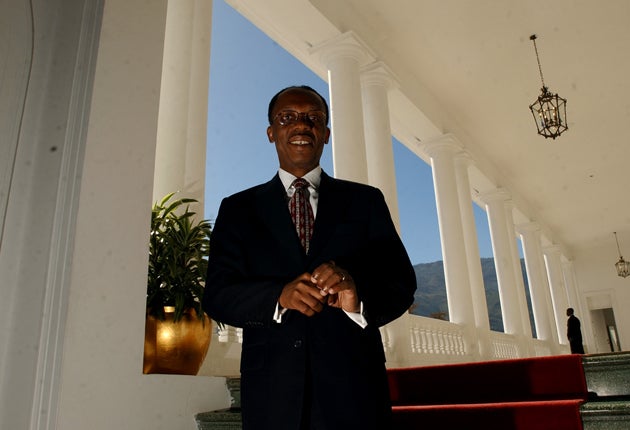
Haiti's former president, a man twice forced into exile but whose name has long been whispered like a prayer among the country's poorest citizens, is again trying to make his mark on his country.
Jean-Bertrand Aristide, ousted by coups that received backing from the US, said he was ready to return to Haiti from South Africa in a jet filled with emergency supplies. "We feel deeply that we should be there, in Haiti, with them, trying our best to prevent death," Mr Aristide told reporters in Johannesburg.
Six years ago, the priest-turned-president was bundled out of the country as a small rag-bag force of former soldiers advanced on the capital, Port-au-Prince. He was driven to the airport in the early hours by US marines and diplomats; a chartered jet was waiting. They gave him little option. "Come with us or stay. Live or die," they said.
The forced exile of Mr Aristide plunged Haiti into fresh turmoil as an interim government imposed by the US, France and Canada oversaw two traumatic years, when supporters of the former president were attacked and killed, or summarily jailed.
But his enforced exile, first to the Central African Republic and then to South Africa, was just the latest in a series of crises – both natural and man-made – to befall the former French colony, which by the time Aristide was first elected in 1990 was already notorious as the poorest country in the western hemisphere. Indeed, on almost every scale used to measure quality of life – income, health, literacy and child mortality – only a handful of countries in sub-Saharan Africa were worse. Tens of thousands set sail in makeshift vessels to escape to a better life in the US.
It might, and ought, to have been quite different. Together with the neighbouring Dominican Republic, Haiti constitutes the island of Hispaniola discovered by Christopher Columbus in 1492. During the 18th Century, the island, divided between the Spanish and French, was a major source of the world's sugar, but conditions for the slaves, who were imported from Africa, were utterly brutal. A series of uprisings culminated in 1804 with the declaration of independence by Jean-Jacques Dessalines, a leader of the rebellion who, went on to become Haiti's first president.
The action was revolutionary. At that moment, Haiti became the first independent nation in Latin America, the first post-colonial black country anywhere in the world, and the only nation whose citizens were overwhelmingly former slaves.
In his history of the country, Avengers of the New World: The Story of the Haitian Revolution, Laurent Dubois writes: "[The revolution was] a dramatic challenge to the world as it then was."
Yet even at its birth, the seeds of hardship that would hold back and even cripple the country were being sown. As Bill Quigley, a veteran US-based Haiti democracy activist, recalled this week, the first response by France to its former colony was to enact a military blockade and force the new Haitian authorities to pay reparations – 150 million francs – in exchange for its freedom. From the start, Haiti was bankrupted. Up to 80 per cent of the country's budget went to pay off this debt. The US, which had secured its own independence in 1776, refused to recognise it [and actually invaded and occupied Haiti between 1915 and 1934.]
In a 2004 article in the London Review of Books, Paul Farmer, an agronomist who has spent several decades working to boost Haiti's agricultural sector, noted that the reparations to France – which, with no small irony, yesterday contacted other members of the so-called Paris Club of creditors to speed up cancelling Haiti's current debt – continued until well after the Second World War. Indeed, many supporters of Mr Aristide believe that his repeated demand to France that it pay back $21bn, the amount that he calculated was owed to Haiti for the reparations paid between 1825 and 1947, was a factor in France's support, at least tacitly, for those behind the 2004 coup.
Yet even after the reparations to France stopped, things barely got better. Between 1957 and 1986, the country was ruled by the ruthless dictators François "Papa Doc" Duvalier and his son Jean-Claude. The years were stable but brutal. Haiti styled itself as an exotic Caribbean destination for celebrities ranging from Jackie Onassis to Truman Capote, who joined other guests to sip Barbancourt rum cocktails on the veranda of the Hotel Oloffson, but the Duvaliers accepted no dissent. The notorious Tonton Macoutes militia, used to carry out intimidation and killings, reported directly to the senior Duvalier. Indeed, Peter Hallward, author of Damming the Flood: Haiti, Aristide and the Politics of Containment, has estimated that up to 50,000 people lost their lives during these years.
It was against this backdrop of violence, an economy in which three-quarters of Haitians lived on less than two dollars a day, and a country where hope had vanished, that Mr Aristide emerged in the Port-au-Prince slum of La Saline. Preaching a mix of political empowerment and liberation theology from his pulpit in Saint John Bosco's church, he gradually built up so much popular support that his opponents felt threatened enough to firebomb his chapel during mass, with the loss of 12 lives.
"In a dark corner of our little world I take up my pen to write to you," Aristide would later write to his supporters. "The light I set by my side to illuminate my task is a faint light but it will grow stronger as I write because it is the light of solidarity."
Aristide was elected with a landslide in a 1990 election, but his tenure did not last long. His opponents, covertly supported by the CIA, carried out a coup the following year. The exiled leader would be reinstalled by the Clinton administration and then re-elected for a second term in 2000.
He remained highly popular among the Creole-speaking poor, but his policies calling for higher wages and resisting demands to liberalise the economy continued to anger Haiti's elite as well as powerful elements in Washington.
Loans worth $500m were blocked, and when his enemies turned on him a second time no-one was prepared to help. Indeed, there is evidence the Bush administration prevented additional private security guards, contracted to Aristide's government, from reaching Haiti. When René Préval, Haiti's current president, was elected in 2006, he said there was nothing preventing Aristide from returning to Haiti, though it is likely that a tacit understanding between the US and Aristide's opponents in Port-au-Prince has kept him in South Africa.
Aristide was not unblemished. There is evidence, for instance, that during his second term his supporters resorted to violence to silence his opponents. Yet were he to be given the opportunity to place his hands once more on the tiller of his country's history, it is likely he would receive a hero's welcome among those currently suffering the most.
Kevin Pina, a US filmmaker who was in Port-au-Prince two weeks ago, said. "If he were to return, people would mobilise. Tens of thousands would mobilise like that. With just picks and shovels they would clean up the mess in just a month. They still love him that much."
Join our commenting forum
Join thought-provoking conversations, follow other Independent readers and see their replies
Comments