FBI asks public to help crack code in murder case
The bureau admits it has got nowhere in deciphering messages found on a dead man
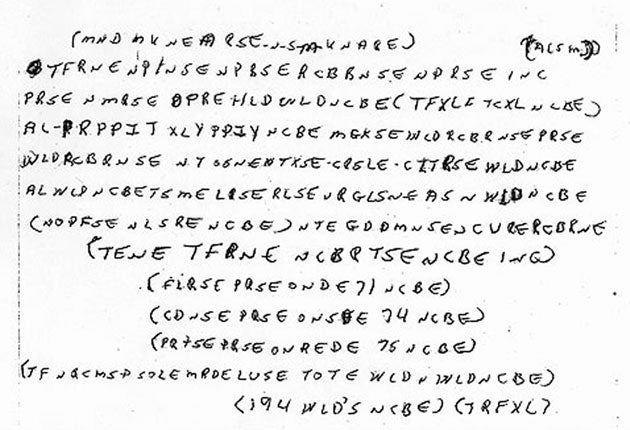
The partially decomposed body of 41-year-old Ricky McCormick was found in a Missouri cornfield in June 1999. He had been killed by a blow to the head, and FBI agents investigating the apparent murder soon happened upon an intriguing clue: two coded messages were scrawled on crumpled scraps of paper in his trouser pocket.
Twelve years later, and with little progress made in solving the case, the FBI is using the internet to invite amateur sleuths to have a go at cracking the code used to create the mysterious jumble of letters and numbers on the notes.
The exercise in what is in effect the "crowd-sourcing" of detective work comes after experts at the FBI's Cryptanalysis and Racketeering Unit and the American Cryptogram Association failed to work out the meaning of the messages, which are published on the FBI's website. All they know is that they were written by McCormick two or three days before his death.
"We are really good at what we do, but we could use some help with this one," admitted Dan Olson, the head of the Cryptanalysis Unit, in a statement. "Breaking the code could reveal the victim's whereabouts before his death and could lead to the solution of a homicide."
Officers who investigated the original death said that McCormick was an eccentric figure who for most of his adult life had experimented with
codes and ciphers. The messages he apparently scrawled are about the only remaining lines of inquiry in the case, since they found no murder weapons or forensic evidence.
The victim was a high-school dropout, who had no relationship with his four children, and was living on disability benefits. He had served a short amount of time in prison several years previously for statutory rape, although they do not believe that case had anything to do with his death.
McCormick's mother apparently told investigators that he had written coded messages since childhood, but that she had no idea why, or what they meant. He did not own a car, and lived 30 miles from the place where his body was discovered. The last confirmed sighting of him was five days earlier, when he received medication at a St Louis hospital for chronic heart and lung problems.
"The family said he [wrote coded messages] quite often," said Craig McGuire of the St Charles County Sheriff's Department, who investigated the original case. "We were always hopeful that these cryptic notes would give us information as to his associates, his business, where he might have been the last few hours of his life. It may just be a bunch of gibberish, but right now, we just don't know."
On the website where the FBI published details of the case and copies of the notes, the agency has attempted to position its plea for help within a grand tradition of crime-fighting. "The FBI has always relied on tips and other assistance from the public to solve crimes, and although breaking a code may represent a special circumstance, your help could aid the investigation... There is no reward... just a challenge and the satisfaction of knowing that your brainpower might help bring a killer to justice."
There are no obvious patterns or discernible systems at work in the way the messages were created, Mr Olson added, and solving them is made harder by the use of symbols and a lack of normal publication.
"Even if we found out that he was writing a grocery list or a love letter, we would still want to see how the code is solved," Mr Olson admitted. "This is a cipher system we know nothing about."
www.fbi.gov/news/stories/2011/march/cryptanalysis_032911/cryptanalysis_032911
How to decipher
Breaking any code involves four basic steps:
1) Determining the language used
2) Determining the system used
3) Reconstructing the key
4) Reconstructing the plaintext
Consider this cipher: Nffu nf bu uif qbsl bu oppo.
Now apply the four steps:
1) Determining the language allows you to compare the cipher text to the suspected language. Our cryptanalysts usually start with English.
2) Determining the system: is this cipher using rearranged words, replaced words, or perhaps letter substitution? In this case, it's letter substitution.
3) Reconstructing the key: this step answers the question of how the code-maker changed the letters. In our example, every character shifted one letter to the right in the alphabet.
4) Reconstructing the plaintext: by applying the key from the previous step, you now have a solution – Meet me at the park at noon.
Join our commenting forum
Join thought-provoking conversations, follow other Independent readers and see their replies
Comments
Bookmark popover
Removed from bookmarks