First test for Obama's more engaging foreign policy plan

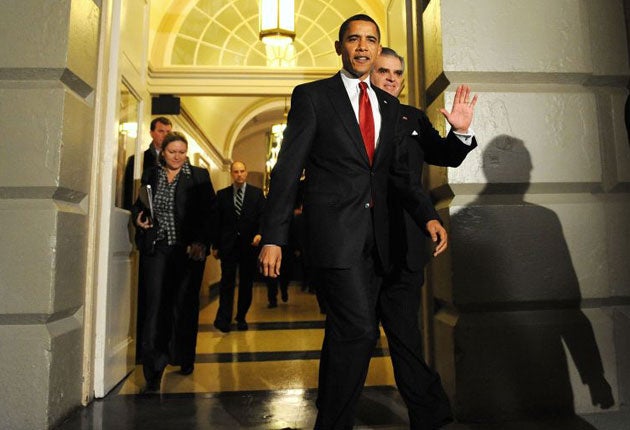
President Barack Obama's policy of open engagement with America's adversaries faces its first real test at the G20 summit in London this week during which he will hold private meetings with Russian and Chinese leaders.
Mr Obama wants to turn the page on George Bush's confrontational style which stirred so much anti-American sentiment, but he also needs to deliver on his objectives or face the risk being dismissed as a lightweight on the international stage.
In a hectic five-day schedule the President hopes to set a new course for US relations by agreeing negotiations with Russia that would lead to an eventual nuclear-free world; engaging China in a quest to share the load in fighting climate change; and taking steps to reverse the worst economic crisis since the Great Depression.
In his first face-to-face talks on Wednesday with Russia's President, Dmitry Medvedev, Mr Obama is expected to agree steps to restart arms control talks to remove the thousands of long-range nuclear weapons in US and Russian arsenals on hair-trigger alert. Mr Obama hopes the talks will send a signal to North Korea and Iran that the superpowers no longer intend to rely on nuclear missiles for protection. A new round of missile talks is expected to bring in Britain and France, and be expanded to include China – all to prevent a rapid proliferation of weapons among unstable states.
On the campaign trail, Mr Obama faced the constant jibe that the presidency is no place for "on-the-job training". Despite his enormous popularity around the world, competing national interests will prove a crucial test of his ability to project US influence.
Mr Obama has already won praise for his foreign policy, in particular holding out a sincere hand to Iran, ordering Guantanamo Bay closed within a year, and banning torture.
This week's meetings in London, Strasbourg, Baden-Baden, Prague and Ankara will test the new diplomatic style by revealing whether once-reluctant allies of the US are prepared to become cooperative global partners.
The Obama administration has made a point of keeping expectations low ahead of the five-day trip, declaring that the President will be confronting "inherited challenges" left by Mr Bush. The best they hope for is broad agreement on an approach to begin economic recovery; cornering al-Qai'da; and bringing peace to unstable regions of the world.
Referring yesterday to his new strategy for Afghanistan, he stressed: "Our plan does not change the recognition of Pakistan as a sovereign government," saying that Islamabad would be consulted before the US targeted "high-value" militants in Pakistan.
Apart from the formal G20 summit on Thursday, Mr Obama has a weighty schedule of one-on-one meetings.
On Wednesday he will hold his first bilateral talks with President Hu Jintao of China where discussions are expected to focus on the financial crisis and recent military tensions over North Korea's planned rocket launch. Mr Obama will also hold talks with South Korea's president, Lee Myung-bak.
At his meeting with Mr Medvedev, where the shadow of Vladimir Putin will loom large, aside from slashing nuclear arsenals, they are expected to discuss pressuring Iran to curb its nuclear ambitions, and US back-pedalling on plans to deploy a controversial missile shield opposed by Russia.
On Thursday, Mr Obama will meet India's Prime Minister, Manmohan Singh, whose country remains concerned by the volatile situation in Pakistan and Afghanistan. Mr Obama will also make his first stop in a Muslim nation when he travels to Turkey. In Prague, at the weekend, he will hold a round-table session with students. He will also deliver an address after speaking at the Nato summit in Strasbourg, where Afghanistan will again be on the agenda. He will also squeeze in an audience with the Queen.
All the President's men
Some 500 officials will accompany the President on his tour. Along with heavy weaponry, they are bringing several of the $300,000 presidential limousines, known as The Beast, to ferry the President and act as decoys. Mr Obama will be protected by more than 200 US Secret Service agents. Constantly at his side will be his trusted "bodyman" or personal aide, Reggie Love, a former pro basketball player who now attends to the President's every need.
Join our commenting forum
Join thought-provoking conversations, follow other Independent readers and see their replies
Comments