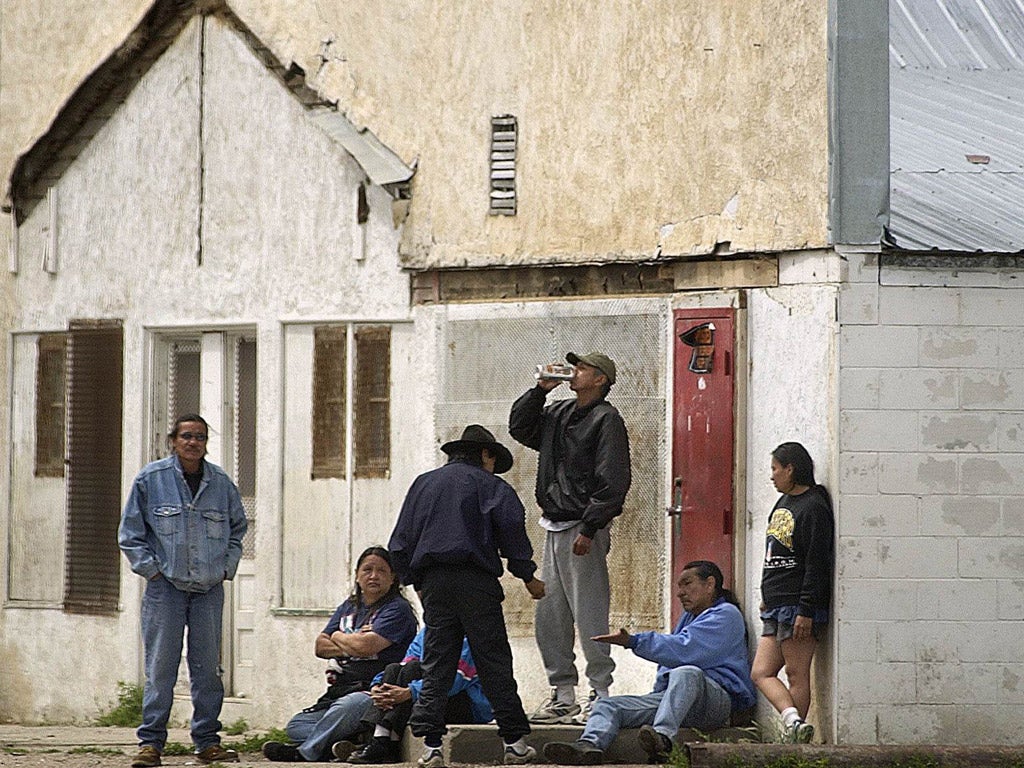
It doesn't take a genius to work out how the rural town of Whiteclay, Nebraska, which has a population of exactly 11, can support four off-licences selling around five million cans of beer each year. Roughly 20 minutes' drive north, across the South Dakota border, lies the Pine Ridge Indian Reservation, home to 20,000 Native Americans, which suffers one of the most severe alcohol problems found anywhere in the developed world.
No less than 85 per cent of local families contain at least one alcoholic, while one in four children born there suffer foetal disorders caused by alcohol abuse. Life expectancy is between 45 and 52, the shortest average lifespan of any community in the western hemisphere outside Haiti. With this in mind, elders of Pine Ridge's Oglala Sioux tribe have decided to pursue a very modern-day solution to their modern-day problem: they are taking their fight against the "great remover" to the country's compensation courts.
A lawsuit filed last week against America's biggest brewing companies, Anheuser-Busch, InBev, SABMiller, Molson Coors, MillerCoors and Pabst, along with the four off-licences in Whiteclay, seeks $500m (£310m) in damages for their alleged encouragement of the "illegal sale and trade in alcohol" to members of the tribe.
The Oglala Sioux tribe has outlawed drink on its property, in line with its legal rights, and therefore claims that both the brewers and local liquor stores are selling their products in the knowledge that they will be smuggled into the reservation for illicit consumption and resale. "The illegal sale and trade in alcohol in Whiteclay is open, notorious and well documented by news reports, legislative hearings, movies, public protests and law enforcement activities," the lawsuit reads.
Tom White, the lawyer representing the tribe, told Associated Press that he had no wish to outlaw legitimate beer sales in the town. But he wanted to prevent store owners selling it in vast quantities to people who are clearly intent on smuggling it over the border. "You cannot sell 4.9 million 12oz [356ml] cans of beer and wash your hands like Pontius Pilate, and say we've got nothing to do with it being smuggled," he said, noting that the quantity equates to 250 cans per year per resident of the reservation. Pine Ridge is the only major population centre within reach of Whiteclay's off-licences.
The tribe says the $500m compensation will reimburse it for the cost of providing healthcare, social services and child rehabilitation, and describes the lawsuit as its last resort in the battle to curb alcohol abuse. None of the store owners, or brewing firms, has yet responded to the claim.
Legal experts say that the Oglala Sioux may be on to something. Thomas Horton, a law professor at the University of South Dakota, said the claim could have implications across the country. Native Americans have a famously destructive relationship with alcohol, and the abuse at Pine Ridge is mirrored in communities across the US. If their claim succeeds, dozens more could follow.
The reason for the disproportionate levels of alcoholism among Native Americans divides experts. Some scientists suggest they have a genetic predisposition to alcoholism. Others blame cultural factors, including high unemployment and social disenchantment in their communities.
Join our commenting forum
Join thought-provoking conversations, follow other Independent readers and see their replies
Comments