Independent Appeal: Weaving their way out of deprivation
A hammock-making co-operative in El Salvador is giving disabled people the confidence and skills they need to become self-reliant. Guy Adams reports

The latest headlines from our reporters across the US sent straight to your inbox each weekday
Your briefing on the latest headlines from across the US
It is, perhaps, a sign of the times that Gustavo Larin's most treasured possession is a text message. Written in perfunctory Spanish and stored in his battered mobile phone, it contains the name of a woman, Leonora, and a brief sentence ending in muerte.
Leonora was Gustavo's mother. The text was sent to him the night she died, in June 2006, explaining how a gang had broken into her home in a shanty town on the outskirts of San Salvador, where she'd moved in search of a job, and fired two bullets into her head.
"My mother was killed by bandidos," he says. "Earlier that day, she had been on a bus they hijacked. One of the gang lived in the same barrio and she recognised him. So he later decided that she should be murdered, to stop her giving evidence to the police."
Stories like Gustavo's are common in El Salvador, a nation that recovered from its long and bloody civil war of the 1980s only to fall victim to a rising epidemic of gang-related violence.
Today, the Central American state is the most dangerous country in the western hemisphere, outside of a war zone. At least 5,000 people from a population of five million are gunned down each year. The capital, San Salvador, boasts, if that is the right word, the highest murder rate of any world city.
The orphans of this violence face an uncertain future. Gustavo was 17 when Leonora was killed. His father, who had emigrated to the United States years earlier, was in prison. So the teenager was left as the sole breadwinner for a his grandparents and sister.
If that wasn't bad enough, Gustavo is also severely disabled. A bus crash when he was a child left him with brain damage. He is almost totally deaf and cannot speak. He missed out on a formal education and can only communicate through sign language.
In normal circumstances, this would be a one-way ticket to extreme poverty; 10 per cent of Salvadoreans are disabled (a legacy of the country's troubled history) and most are denied access to mainstream employment and shunned by a society that traditionally keeps them hidden away.
But Gustavo got lucky. A couple of years ago, a local human rights organisation, Comus, came to San Francisco Javier, a small town in the foothills of a mountain range near his home in rural Usulutan province. They announced plans to open a day centre and workers' co-operative for the disabled.
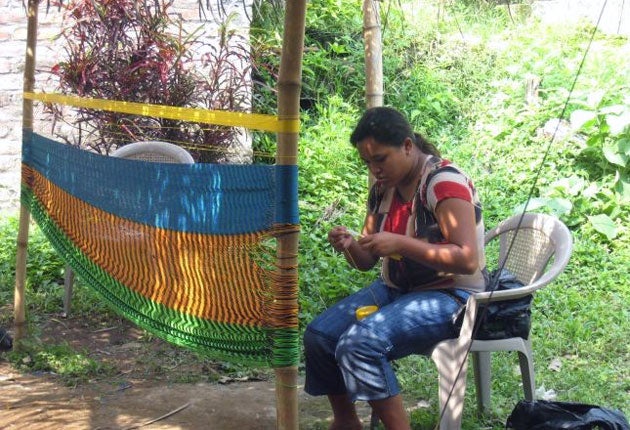
After recruiting a dozen locals, some blind, deaf, crippled or unable to speak, they decided to start a business making hammocks. The facility opened last year. Today, its brightly-woven hammocks sell in markets for $60 (£39), meaning that each worker earns about $10 a day. They learn to make hammocks but are also taught financial administration and marketing skills, which could one day allow them to start their own businesses.
The facility also doubles as a health centre, providing the community with its only doctor and dentist, and allows many co-operative members to receive their first ever proper therapy for their disabilities.
When Maria Beltran came to the centre a year ago, she had been crippled by childhood polio and had to walk with crutches. Today, thanks to massage, electrotherapy and fitted leg irons, she walks with relative ease.
The experience has revolutionised her personal life, giving the 31-year-old an opportunity to interact with other adults for the first time. Like many disabled people, she had been denied social opportunities and didn't attend school until she was 16.
"My father didn't like me leaving the house, because he was embarrassed by my disability and afraid other children might damage me, maybe through fighting or playing. I used to be too shy to talk to other adults. Thanks to my experiences here, I realise how to interact with others."
Indeed, she admits with a giggle that she recently acquired a steady boyfriend, a delivery boy called Marcos, who she hopes to marry.
Remarkably, considering the number of lives it has changed, the hammock factory project cost a relative pittance to set up. It was made possible with a grant of just £14,000 from One World Action, which is one of the three charities supported by The Independent's Christmas Appeal.
One World Action, which supports Comus and groups like it across the developing world, believes that with a helping hand in the right place, disenfranchised people can become self reliant and independent, and able to contribute fully to their communities. The charity doesn't just throw money at projects, it also makes sure they are sustainable. The hammock co-operative has the potential to one day support itself on its revenues, and can provide a blueprint for similar projects across the region.
Watching the workers painstakingly weave hammocks in their mud-brick workshop demonstrates how the organisation also gives them that most precious of commodities: hope.
Disabled people in El Salvador are normally denied the opportunity to start businesses, since banks refuse to lend to them. The support of One World Action has allowed them to demonstrate their ability to contribute to the economy.
"This has given me my first chance to make money, and to dream of a career" says Armando Gaitan, 42, who, despite being blind, has learned to create stunningly beautiful patterns with the soft coloured thread.
Gaitan bears a tattoo on his right shoulder which reveals that he fought in the army during the civil war. He says making hammocks has turned his life around: after the war ended in 1992, he fell into alcoholism (he owes his blindness to being hit with a bottle during a punch-up). Now he has a sense of purpose.
"Normal business owners do not believe in the disabled, or think we can do things as well as other people," he says. "But thanks to this project, I now have a trade and an ability to make capital so that one day I can set up a business on my own."
Its greatest legacy, though, may be political. In the community around San Francisco Javier, the project's existence is changing perceptions about the disabled, who are traditionally unable to assist with local industries, which tend to centre around physical labour or subsistence farming of coffee, sugar or maize.
"In the past, people like me would be a nuisance," says Gustavo. "We were an expense for our families. All we could do was to stay at home, helping with household tasks.
"The experience of working here has shown that I can contribute, and support my family by going to work like any other man. It has made me feel, for the first time, like I want to get up in the morning. I think my mother would be proud of what it has helped me achieve."
Subscribe to Independent Premium to bookmark this article
Want to bookmark your favourite articles and stories to read or reference later? Start your Independent Premium subscription today.
Join our commenting forum
Join thought-provoking conversations, follow other Independent readers and see their replies