Man of the people Chavez survives scare to extend rule
Venezuelans re-elect 'el Comandante' despite country's crippled economy and spiralling murder rate

The latest headlines from our reporters across the US sent straight to your inbox each weekday
Your briefing on the latest headlines from across the US
After narrowly winning a presidential election that has left Venezuela more polarised than ever, a chastened Hugo Chávez has acknowledged that many of his compatriots are deeply unhappy with his "Bolivarian" revolution.
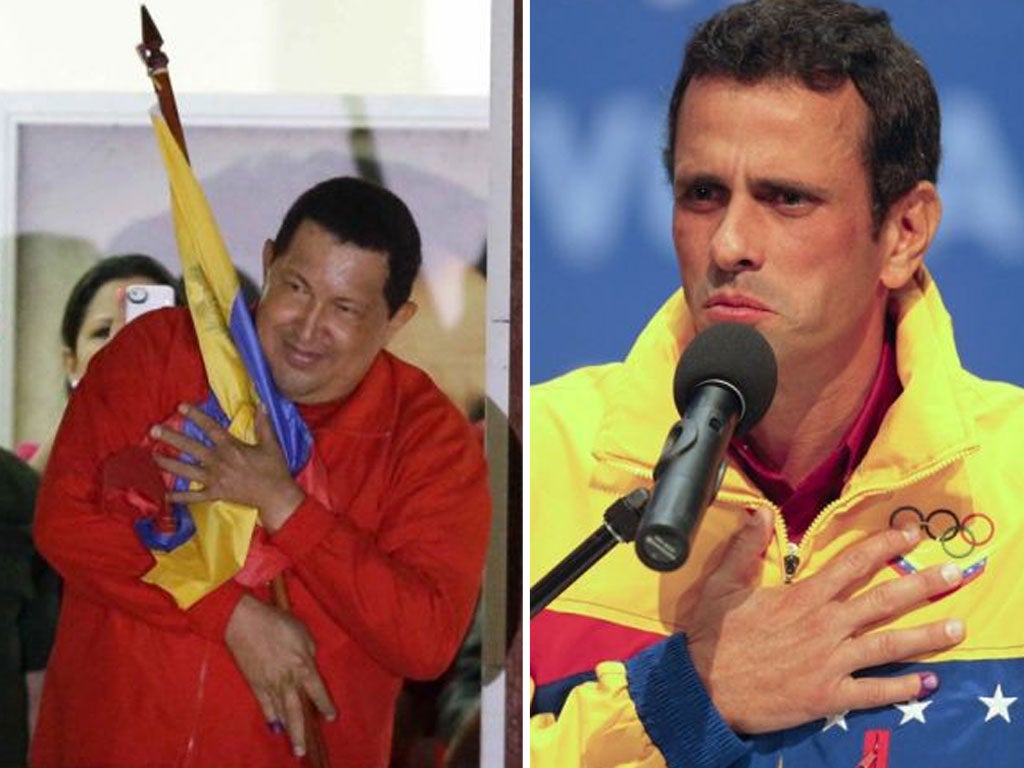
"El Comandante" won 54.4 per cent of the 13.6 million votes cast compared to 45 per cent for challenger Henrique Capriles, it was declared late on Sunday. Turnout was high at 81 per cent.
Speaking to crowds of cheering supporters from the balcony of Miraflores, the presidential palace, Mr Chávez thanked "everyone who voted against us for their democratic attitude, for their involvement, for the civic demonstration that they have given, despite not being in agreement with the Bolivarian project".
Meanwhile, Mr Capriles, who immediately telephoned Mr Chávez to congratulate him, told his supporters: "Hopefully he [the President] reads with magnanimity this expression of our people today. There is a country with two visions and being a good president is working for all Venezuelans."
After months of intense and often fractious campaigning, election day was peaceful and marked by a widespread atmosphere of rejoicing. Observers reported no major incidents or significant allegations of fraud. Yet even after winning another six year-term, which will extend his turbulent presidency of the oil-rich South American nation to 20 years, Chávez's tenure – and Venezuela's fate – remain clouded by uncertainty.
Despite apparently recovering strongly from the pelvic cancer which has seen him operated on three times in Cuba in the last 12 months, the long-term prognosis for Mr Chávez, who has refused to reveal the clinical details of his illness, is unknown. After his victory was confirmed, the President publicly prayed for "life and health" to allow him to stay in office. Under the Venezuelan constitution, there must be elections if the President dies in the first four years of his term. If he dies in the last two years, the vice-president – who Mr Chávez has yet to appoint – will see out the original term.
Meanwhile, many observers question how much further Venezuela's economy can limp without major reform. The country is thought to have the world's largest oil reserves and crude exports make up more than 90per cent of Venezuela's foreign currency income. Yet state spending, which has surged more than 30 per cent in the last 12 months, far exceeds revenue and some economists predict the government could go broke in the next two years.
Mr Chávez's policies of fixing both prices and the exchange rate have failed to stem surging inflation while a string of nationalisations have, in some cases, caused food shortages. The President blames "speculators".
Meanwhile, Mr Chávez has, until now, had very little to say about a violent crimewave that has made Venezuela the most murderous nation in South America, a fact which boosted Mr Capriles' candidacy.
But heavy backing from state media and lavishly funded anti-poverty programmes, including everything from subsidised housing to selling the poor imported microwave ovens and flat-screen TVs at cost, have cemented Mr Chávez's popularity among an underclass previously ignored.
"I am very happy. Mr Chávez is the joy of my heart," said Gladys Montijo, a 54-year-old teacher celebrating outside the Miraflores palace, illustrating the devotion that the President has inspired in many working-class Venezuelans. "He won and he will continue protecting the poor, the defenceless and the elderly."
Meanwhile, despite the bitter loss – Mr Capriles had triggered an unprecedented wave of optimism among Venezuelans critical of the President's "socialist" policies – the opposition appears to be at its strongest since Mr Chávez took office in 1999.
Mr Capriles, a former state governor and basketball-playing 40-year-old, provided an effective challenge based on old-fashioned grass roots campaigning that, initially at least, appeared to catch the President off guard.
Despite repeated attacks on him as "bourgeois", the candidate of the rich, and a stalking horse for US "imperialism", Mr Capriles succeeded in defining his own agenda , offering a centrist alternative to the President. Crucially, Mr Capriles also convinced many poor Venezuelans that rather than end the "missions", the President's vaunted anti-poverty programmes, he would actually extend them and make them more efficient.
If he can maintain the Democratic Unity alliance, whose members include all significant opposition parties both left and right, beyond the presidential campaign, Mr Capriles appears set to provide the leadership that the opposition has long been craving.
Chavez's inbox: President's priorities
Violent crime
Venezuela's annual rate of 49 murders per 100,000 residents is higher than in Mexico, South Africa, Iraq and Afghanistan, according to UN figures. Although most Venezuelans are terrified by violent crime, Mr Chávez has largely avoided discussing the issue that – more than any other – cost him votes on Sunday.
Inflation
Recorded at 18.6 per cent in August – a recent low – Venezuela's inflation rate is one of the highest in the world. Price controls and a fixed exchange rate have proved blunt tools to address the problem so far.
Oil
Production has been sinking at PDVSA, the bloated state oil company, while massive subsidies mean Venezuelans have the cheapest petrol in the world. Can the President bring efficiency and economic sustainability to oil production without relinquishing the country's greatest asset back to foreign oil companies?
Cancer
Possibly the biggest unknown of the President's new six-year term is his health. Oncologists interviewed by the media have been unable to say whether the President can expect decades of good health – or will be unable to see out his new term.
Subscribe to Independent Premium to bookmark this article
Want to bookmark your favourite articles and stories to read or reference later? Start your Independent Premium subscription today.
Join our commenting forum
Join thought-provoking conversations, follow other Independent readers and see their replies