Mississippi turning: A river with a life of its own
It is a river with a life of its own and attempts to domesticate it for the good of industry have so far failed. Now, says Daniel Howden, the stakes are higher than ever
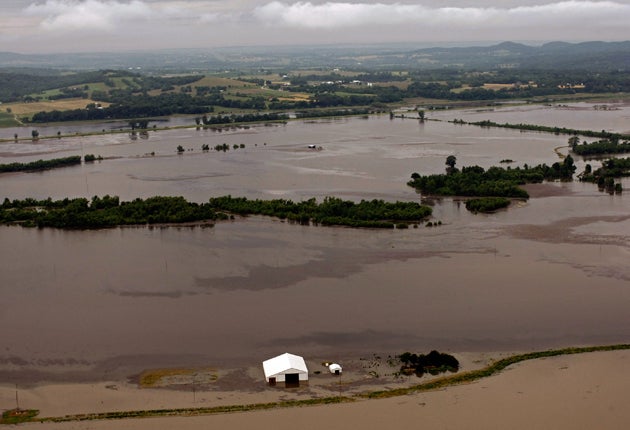
There's a great inadvertent truth hanging on the wall in the gloomy basement of the river museum in Memphis. A large panel welcomes the visitor to an exhibit titled: "War on the Mississippi".
In fact, it's a section devoted to the ironclad gunboats that helped to turn the tide of the civil war in favour of the Union. But it could just as well describe America's fraught relationship with the mighty river that drains half of the continental United States. Long before there was a "war on terror" or even a "war on drugs", America was at war with its largest river.
At times, it has been a desperate battle, waged with grim determination by the US army corps of engineers. Since 1879, military engineers, many of them trained at West Point academy, have been tasked with domesticating the third largest river in the world.
It's a mission that ignores the advice of Mark Twain, who famously wrote: "One cannot tame that lawless stream, cannot curb it or confine it, cannot say to it 'go there' and make it obey ... cannot bar its path with an obstruction which it will not tear down, dance over, and laugh at."
And yet that is precisely what the corps has been trying to do, at great expense, ever since. It has built levees and dams, sealed off distributaries, set up spillways and confined the river to an artificial course that shotguns "Old Muddy" out into the Gulf of Mexico.
On two occasions since then, in 1927 and 1973, the army has come close to losing the war as great floods have threatened to permanently breach the defences, drown the millions of acres of flood plains and change the course of the US's most important navigation channel. Now the Corps finds itself fighting a war on two fronts, as the restless Mississippi has been joined by rising sea levels in a process that is overwhelming the eco-system of coastal Louisiana – and, at the same time, presenting the richest country in the world with one of its toughest test cases on the consequences of climate change.
John M Barry, an award-winning environmental author and advisor to the White House on the Mississippi Delta, believes that what is happening there will be a model for the rest of the world. "It will either be a model to emulate or a model to avoid," he said. "People are watching very closely, internationally."
Speaking at a gathering of religious leaders and green experts in New Orleans this week, he added: "So far the United States has failed the test." The Religion, Science and the Environment symposium brings together some of the world's leading climate scientists, local and international leaders to try and push for a successful outcome from the UN climate summit in Copenhagen next month.
With Washington's position going into the summit still unclear, the New Orleans meeting has attempted to puncture the damaging misconception that the immediate effects of climate change will only be felt in the developing world. "New Orleans is the point of the spear," Mr Barry said. "What happens in New Orleans will, with sea-level rises and increased storm intensity, obviously threaten every coastal city in the world."
What has already happened to the Mississippi and the coastal wetlands of Louisiana is a mixture of poor decisions and unintended consequences. In their wake they have left what locals might call a toxic gumbo of chronic problems, or what one scientist referred to as "200 years of short-term thinking".
Old Muddy is a continental watershed whose tributaries drain the US's Corn Belt and industrial zone. Its brown waters carry millions of tons of sediment to the Delta. That rich mud and silt once built the Delta itself – as well as the wetlands, marshes, swamps and bayous that protect the same precious infrastructure, communities, cities and industries that the Corps has been trying to safeguard.
Left to its own devices, the Mississippi would have switched course already to the largest of its distributaries, the Atchafalaya. The 1973 flood was nature's attempt to do just that. However, that was deemed economically unacceptable as it would have left New Orleans on a slack backwater, cut off the petrochemical industry from the gulf and severed a navigational artery that carries 11 per cent of America's total commercial shipping.
The irony is that the straitjacket of levees and flood controls built by the army have been starving the marshes of the sediment and freshwater they need to survive, while these same wetlands are needed as a buffer zone from the fury of the Gulf Coast hurricanes. In the last 50 years, 2,300 square miles of Louisiana have been lost to the sea – an area equivalent to the state of Delaware. The consequences of this loss were brought home four years ago by Hurricane Katrina. The storm missed the Big Easy, but the seawater surges that it blew in from the Gulf of Mexico flooded the city, killing 1,800 people, and raising questions about the long-term viability of New Orleans.
Seen from the air there's another clear culprit in the destruction of the Louisiana's natural defences – the oil and gas industry. It is the oil and gas wells that make Louisiana the powerhouse of much of the US. They also bring with them a destructive flow of saltwater into a freshwater ecosystem. The effects are clear, with dead trees stretching endlessly in all directions. All that stand in their place are the so-called "Christmas trees", which are not trees, but small, metal drilling stations. Alternately starved of freshwater and sediment from the river and carved into pieces by canals, the wetlands are both choked and sinking.
"We have broken the eco-system," says Chris Macaluso, who is heading up the biggest effort at restoring the wetlands. "We have to get some of it back to get it to work again and to get the Mississippi to work."
Louisiana's economic importance to the US cannot be overstated. It is home to half of the country's oil-refining capacity, 25 per cent of its seafood and much of its natural gas. When Katrina struck, the cost of petrol at the pump nationally went up $1.50 (90p) a gallon overnight. "What happens in coastal Louisiana can switch off the lights in Chicago, Baltimore and New York," said Macaluso.
The answer, the head of the Coastal Protection and Restoration Authority believes, is to unshackle the river from the levee system and put it to work feeding the sediment-starved wetlands. Doing this on the land side of New Orleans is not an option, but doing so to the south and east of the city is – albeit an expensive one.
There is currently a total of less than $18bn (£11bn) earmarked in several different projects to repair coastal Louisiana. The real cost will be closer to $200bn (£122bn), according to Macaluso. He says at best there are seven years left to do this and the state's efforts are hampered by the Corps of Engineers who still see their mission as enabling navigation.
Their priorities are navigation, flood protection and maintaining the eco-system, he explains. The problem is that the split of emphasis is: "96 per cent, 3 per cent and 1 per cent". A massive federal bailout of the eco-system is needed urgently otherwise the Gulf of Mexico will be lapping at the city limits of New Orleans and the oil and gas industry will be at the perpetual mercy of Hurricane Alley. "While the sea out there continues to rise, the land continues to sink. If we don't give these wetlands a fighting chance, we'll lose them forever," says Macaluso.
In the last month a private memo was circulated by the White House suggesting that the Obama administration might consider making Louisiana a test case for mitigating climate change. The disconnect between science and policy that had become a hallmark of the Bush administration could be coming to an end, experts in the state are now daring to hope.
Louis Hatty has lived in the Bayous all his life. He used to be a shrimper, but has given that up to take tourists on swamp tours on his airboat or "buzz king", as it is called in Cajun style. He counts the lost land in football pitches: during hurricane season, an area of land equivalent to a grid-iron field disappears every six seconds. But he is not going anywhere, and says that the restoration is finally starting to happen: "It's a shame it has been so long in starting," he adds.
Standing on the dockside in the Lafitte Bayou, he points out across the swamp in the direction of the Gulf of Mexico. In the 1950s the sea was 40 miles from here, he explains; now it is 18 miles away. "If we don't do something in the next couple years," he says, "this is going to be the Gulf of Mexico."
Join our commenting forum
Join thought-provoking conversations, follow other Independent readers and see their replies
Comments