Nicaragua: Betrayal of the revolution
Sandinistas were idealists who ousted a corrupt dictatorship. Now they are stealing elections and crushing their opposition. John Carlin reports
In March 1983, a few days before the arrival of Pope John Paul II in Nicaragua, Father Bismarck Carvallo sinned. Never at peace with his vows of chastity, he succumbed to the allure of a comely Sandinista intelligence agent who invited him at night into her home. He did not know she was a plant of the revolutionary government, whose left-wing doctrine the Catholic Church denounced as heretical, often out of the mouth of Fr Carvallo himself, who was the Church's official spokesman. At a critical moment, a man posing as her husband burst into the house, dragged him naked out of bed and threw him out on to the street, where the unhappy prelate was blinded by a barrage of camera flashes. The intelligence people, naturally, had tipped off the press.
The story, complete with photographs, was duly splashed across the front page of the next morning's edition of the official Sandinista newspaper, Barricada. The Pope was not amused, but what happened next put him in a blind fury. An open-air mass he celebrated the following weekend in Managua was reduced to a farce by a Sandinista mob who disrupted the liturgy from beginning to end with jeers and revolutionary chants.
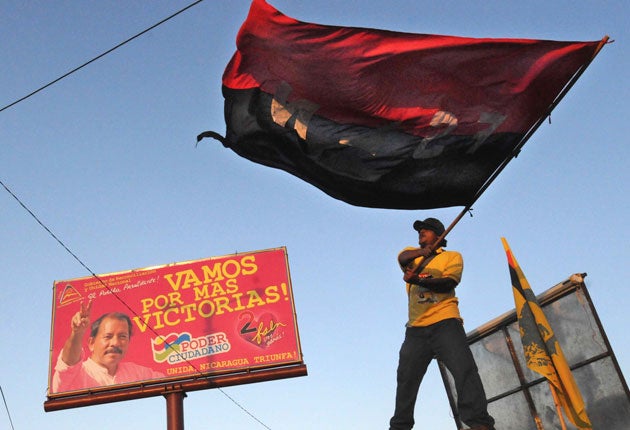
That was then. Travelling around Managua today, amid the reek of electoral fraud from last week's nationwide municipal polls, you could be forgiven for imagining the country was being run by a Catholic theocracy. Since the Sandinistas returned to power after a 16-year hiatus in 2006, under the presidency of the very same Daniel Ortega who was in office at the time of the Fr Carvallo incident, statues of the Virgin Mary have been planted at every significant city intersection. At strategic points around Managua, chosen in order to usurp the places where opposition groups stage their protests, huddles of old women are to be seen day and night kneeling in prayer under banners that proclaim, "Love is greater than Hate". You turn on the TV or radio and you hear, again and again, the government's favourite slogan: "The People's will is God's will".
What in Sandino's name has happened? Could it be that Daniel Ortega, a man with a worldwide reputation as a serial child-molester, has really sought solace in divine succour? You would think so judging from his behaviour during the election campaign two years ago when he would make a point every Sunday of being seen at Mass, sitting on a front row pew. Or from his decision – also during the campaign – to get married by the Church to his long-time companion, political soulmate and mother of their eight children, Rosario Murillo, whose daughter by a previous liaison, Zoilamerica Narvaez, President Ortega is accused of having sexually abused throughout her teens, starting at the age of 11.
But, in at least one important respect, Mr Ortega has followed through on the teachings of Mother Church. He promised during his campaign that, if elected, he would extend the country's ban on abortion to cases where giving birth poses a serious risk to the mother's life. On coming to power, he made the pledge into law.
It is hard to believe that there is an iota of sincerity in the President's seeming conversion. At least as plausible is the explanation of Sofia Montenegro, once a high-profile Sandinista militant who now heads a women's rights group that campaigns, among other things, on the abortion issue. "When I say that they are mad. I do not mean it in pejorative terms," she said in a recent newspaper interview. "I mean that they are clinically insane."
Their lust for power is such, she said, that in their pursuit of absolute rule they have become utterly unscrupulous. "They have become tropical banana monarchs," Ms Montenegro said. Maybe, but there is method in King Daniel's madness.
It turns out that patriotism is not, in Nicaragua at any rate, the last refuge of a scoundrel; God is. A Catholic God with whom Mr Ortega has made his own singular variation on the Faustian bargain: give me power and I'll sell You my soul. The point being, of course, that, in three unsuccessful presidential campaigns, Mr Ortega found that without the Catholic vote he could not win. Going to bed with the Catholic Church has been the President's banana-republic version of what John McCain did in appointing Sarah Palin, the darling of the Christian right, his vice-presidential running mate. Only that in this case it worked.
He has tried to make it work again in the muncipal elections this month, hence the huddling old ladies at prayer; and hence the crass vote-rigging, that has been denounced far and wide. First, two significant parties were arbitrarily denied the right to participate in the elections, one of them being the Movement for Sandinista Renewal to which Sofia Montenegro belongs, as well as Mr Ortega's vice-president in the revolutionay days, Sergio Ramirez, and Gioconda Belli and Dora Maria Tellez, guerrilla heroines of the insurrection that brought the Sandinistas to power in 1979, after overthrowing the caricature tin-pot dictator Anastasio Somoza. Another pre-emptive move was to wage war on the independent press. A particular target was Carlos Fernando Chamorro, a high-profile TV investigator who ran Barricada during the busting of Fr Carvallo and whose newspaper editor father, Pedro, was assassinated by Somoza in 1978.
Mr Ortega prevented international observers from overseeing the elections and ensured that the Supreme Electoral Council was entirely in Sandinista hands. It was hardly a surprise last week, amid protests and clamours for a recount, to learn that piles of ballots favouring the opposition Constitutionalist Party were found on a rubbish heap. Or that the official election figures, handing the Sandinistas a handsome victory, showed wild discrepancies between the versions in the newspapers and those found on the electoral council's website.
Ten days after the vote the dust has not settled and the opposition continues to demand a serious recount. Stone-throwing Ortega supporters clashed with demonstrators in Managua this week, and an attempt for Liberal Party supporters to host a demonstration in the city of Leon was blocked by Sandinista supporters bearing clubs and machetes who took possession of the road, intimidating all comers, with the police glaringly absent. "This was no spontaneous action; obviously it was co-ordinated from Sandinista headquarters," said Gioconda Belli, a celebrated poet and internationally acclaimed novelist who dedicated 30 years of her life to the Sandinista cause.
One thing that is clear to her, as it is to Sergio Ramirez, Sofia Montenegro, Carlos Fernando Chamorro and others who seek to preserve the conscience of the old Sandinista cause, is that everything that Ortega and his people do is aimed at one objective: the perpetuation of his hold on power. (Currying favour with the Russians is deemed useful in this regard, which was why Mr Ortega decided that Nicaragua should be the first country to recognise the "independence" of South Ossetia after the Russian invasion in August.) Mr Ramirez echoed Ms Belli's words when he said in an interview with El País on Sunday that the elections have been all about the attempt "to consolidate an authoritarian regime with the seeming legitimacy of popular support". Mr Ramirez said that the more practical objective, reminiscent of the attempt by Mr Ortega's best friend in Latin America, Hugo Chavez, to do similarly in Venezuela, is to acquire sufficient electoral numbers to allow Mr Ortega to push through a constitutional amendment that would allow him to remain President for as long as he wanted.
It is all a far cry from the bright-eyed revolutionary days after the fall of Somoza, when the Sandinistas were the poster-children of the international left. They were young, romantic, idealistic. Despite the counter-revolutionary war financed and directed by Ronald Reagan's "Yankee imperialism", Managua was a festive place where it was not unusual late at night to run across comandante de la revolucion poetically confessing, having drunk a few nica libres (rum and cokes), the Sandinista dream of making the spirit of Paris '68 come true, of perfecting the socialist model that Stalinism had betrayed.
Today in Nicaragua, two years after the Sandinistas' return to power, there is no idealism, no poetry, no romance. The regime over which President Ortega presides is an anthem to brute cynicism. Or a parable of human weakness, the old story of what happens with idealists, always and everywhere, once they have tasted power. It is Animal Farm all over again. The threats against Carlos Fernando Chamorro, whose offices were ransacked by Sandinista thugs and whose father was killed by Somoza, have closed the Orwellian circle. The slaves have become like the old masters; Sandinistas, like Somocistas. The discourse is different from Somoza's, but also more hypocritical, but the methods remain the same and the objective too.
The President and his acolytes live ever better as Nicaragua remains the poorest country on the Latin American mainland, and one of the most unequal. Mr Ortega, who pays lip-service to socialist rhetoric with barely more conviction than he does to the Catholic God, is converting Nicaragua into a banana caricature of that cruel place Orwell envisioned where "all animals are equal, but some animals are more equal than others".
Join our commenting forum
Join thought-provoking conversations, follow other Independent readers and see their replies
Comments