
The latest headlines from our reporters across the US sent straight to your inbox each weekday
Your briefing on the latest headlines from across the US
Pushed over the finish line by President Barack Obama, and marked by ferocious politicking that lasted late into the night, a bill to reform America's healthcare system is a step closer to reality after being narrowly endorsed in the House of Representatives.
The package, designed to extend medical coverage to 96 per cent of the country, squeaked through by a majority of 220 to 215, shortly after the President publicly implored supporters to "answer the call of history" and implement what has become his top domestic priority.
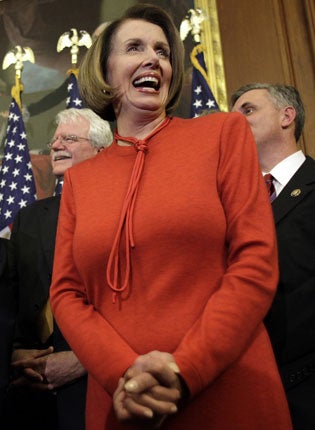
Noisy cheers and high-fives were exchanged on the floor of the chamber at about 11.15pm on Saturday, when hours of fractious debate ended with news that the 2,000-page bill had been passed. Democratic speaker Nancy Pelosi won praise from the bill's supporters for her relentless work in chivvying recalcitrant members into voting "Yes". As their victory became clear, some Democrats asked her to sign their copies of the bill.
"This is an historic moment for our nation and for American families," Ms Pelosi said, comparing the legislation to the passage of social security in 1935. Democratic whips had spent days securing commitments of support from party members and eventually gained the votes of 219 Democrats, together with a lone Republican, Joseph Cao.
The remaining 176 Republicans, with 39 Democrats from the party's conservative wing, opposed the legislation. Mr Cao, who represents a left-leaning district of New Orleans, said he cast his vote after an amendment was passed limiting government funding of abortions.
President Obama hailed the move as "historic", saying "opportunities like this come around maybe once in a generation". He said he was "absolutely confident" that the US Senate would now pass its own healthcare bill, allowing him to sign reforms into law in the new year. But Mr Obama's healthcare proposals face a rougher ride in the upper house of Congress, where some conservative Democrats retain reservations that could stymie the bill's passage.
Under the reform, every American citizen will be required to obtain health coverage, or face penalties. All but the smallest employers must cover their workers. A national marketplace will be created, giving people the chance to buy into a government-run "public option" insurance plan if they prefer.
It will become illegal for insurance firms to deny someone health insurance because of pre-existing medical conditions, or to drop coverage when a customer falls ill. They will no longer be exempt from "anti-trust" laws that are designed to stop cartels of companies colluding to fix prices at inflated rates.
The impact of the bill has been fiercely disputed. The non-partisan Congressional Budget Office said that over the reform's 10-year lifespan, it would reduce the number of uninsured Americans by 36 million, from 17 per cent of the population to roughly 4 per cent.
Democrats have been trying to rebuild healthcare for almost 40 years, and regard Saturday's vote as a signal victory. "[The bill] offers everyone, regardless of health or income, the peace of mind that comes from knowing they will have access to affordable healthcare when they need it," said their representative, John Dingell.
Republicans have been fiercely opposed to President Obama's mooted changes, regarding them as a government takeover of a vast sector of the economy. "We are going to have a complete government takeover of our healthcare system faster than you can say, 'This is making me sick'," said the party's representative, Candice Miller. The plan will cost $1.1trn over 10 years.
Since the Democrats hold a strong majority in the House of Representatives, the key to passing the bill lay with securing the support of so called "blue dog" members of the party, who represent traditionally Republican districts and now face mid-term elections in 2010 at which healthcare will be a key issue.
As part of the horse-trading to secure majority support, the House voted by 240-194 to support a Republican amendment that tightened restrictions on abortion. Publicly funded insurance policies will now cover the procedure only in highly limited circumstances, such as rape.
Despite that setback, the vote represents a key victory for Mr Obama, whose party's poor showing in last week's elections was partly due to growing public scepticism about his ability to deliver on the promise of "change".
What happens now? The route to reform
By Miranda Bryant
What's the next step?
Now that the House of Representatives has approved the Healthcare Reform Bill, the battle will move to the upper house, the Senate, which has to pass its own version of the bill. If a bill is passed, then the two versions will be merged by a team of senior Democrats before it finally goes for a vote by both chambers that could finally bring the bill to the President for his approval.
Is there anything that could hold up the bill's progress?
Yes. If the House and Senate bills are at odds with one another, the process could take a lot longer, and key senators have already expressed their opposition to the so-called "public option", a government-run scheme that would be offered as an alternative to private insurance. Senator Joseph Lieberman, an independent who caucuses with the Democrats, yesterday warned that he opposes the idea of the government getting involved in insurance provision, and would reject any bill containing a public option. Opposition from centrists such as Mr Lieberman could have a critical effect on the chances of such a bill succeeding. If the Senate passes a bill rejecting a key element such as the public option, a conference committee, comprised of members from both chambers, would be established to reconcile the two options and present a fresh version for a vote.
When is it likely to become law?
Having made the reform of the healthcare system one of his top campaign promises, it is crucial for Mr Obama's political gravitas to get the bill passed by the end of the year and he may be willing to make compromises to ensure that it does. But disagreements within Congress could yet push final agreement on a bill back until 2010.
What happens if the bill fails?
So much of Mr Obama's political capital is riding on the bill now that some version of healthcare reform is almost certain to eventually pass, if only to save face: the danger for the President is that he could still be forced to dilute his plan to gain the support of the Senate. That could weaken his authority and make his wider agenda significantly harder to push through, besides, of course, re-energising Republicans and pushing back Democratic hopes of reforming healthcare for another generation.
Subscribe to Independent Premium to bookmark this article
Want to bookmark your favourite articles and stories to read or reference later? Start your Independent Premium subscription today.
Join our commenting forum
Join thought-provoking conversations, follow other Independent readers and see their replies