Obama: No shortcut to peace in Middle East

The latest headlines from our reporters across the US sent straight to your inbox each weekday
Your briefing on the latest headlines from across the US
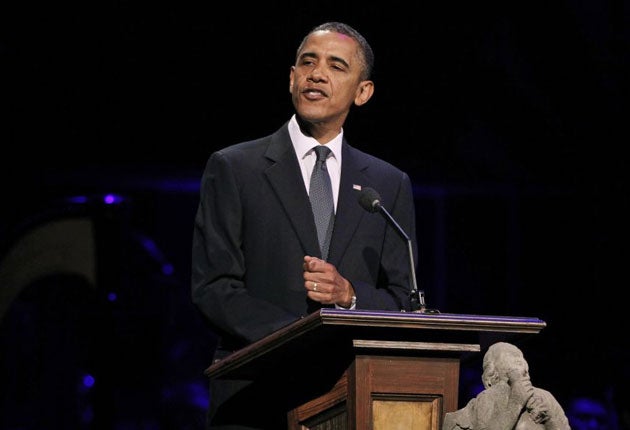
President Barack Obama declared today that there could be no shortcut to peace between Israel and the Palestinians, as he sought to head off a looming diplomatic crisis for the Middle East and US policy there.
"Peace will not come through statements and resolutions at the United Nations — if it were that easy, it would have been accomplished by now," the president told UN delegates. "Ultimately, it is the Israelis and the Palestinians who must live side by side. Ultimately, it is the Israelis and the Palestinians — not us — who must reach agreement on the issues that divide them."
But in the speech before the UN General Assembly, Obama stopped short of directly calling on the Palestinians to drop their plan to seek statehood recognition from the UN Security Council. US officials were working furiously behind the scenes to persuade the Palestinians. With the limits of US influence on the moribund peace process never more clear, Obama had no new demands for the Israelis, either, beyond saying that both sides deserved their own state and security.
"Peace depends upon compromise among peoples who must live together long after our speeches are over, and our votes have been counted," Obama said.
"That is the path to a Palestinian state."
The push by the Palestinians threatens to isolate Israel even further, and divide the US from allies in the Arab world who support the statehood resolution.
After the speech, which was friendly to Israel's position and did not criticise the Israelis, Obama went into a meeting with Israel's prime minister, Benjamin Netanyahu. There he affirmed the US commitment to Israel's security. Later in the day he was to meet with Palestinian President Mahmoud Abbas, still seeking to coax both parties back to direct peace talks.
At the same time, US officials are conceding that they probably cannot prevent Palestinian leader Mahmoud Abbas from moving forward with a request to the UN Security Council for full Palestinian membership. The Obama administration has pledged to veto any Palestinian statehood bid, arguing that only direct peace negotiations, not a UN vote, would allow the Palestinians to achieve the benefits of statehood.
It's a much different outcome than Obama hoped for a year ago, when he wanted to herald by now a negotiated agreement between the Israelis and the Palestinians. US persuasion and pressure failed to achieve that result and now peace again looks distant. Obama put the blame for that on Israel and the Palestinians.
"Despite extensive efforts by America and others, the parties have not bridged their differences," Obama said.
Obama's remarks on Israel and the Palestinians came in a speech that also swept up the convulsions of what Obama called "a remarkable year." He talked about the fall of Muammar Gaddafi's dictatorship in Libya, the killing of al-Qa'ida leader Osama bin Laden, the uprisings in Egypt, Tunisia and elsewhere, and the emergence of South Sudan as the world's newest nation.
"Something is happening in our world. The way things have been is not the way they will be," Obama said. "The humiliating grip of corruption and tyranny is being pried open. Dictators are on notice. Technology is putting power in the hands of the people."
The president talked of hope for the future, and a striving for freedom in "a time of transformation."
Yet the conflict between Israel and the Palestinians looked as intractable as ever.
Recognising that Palestinian leader Mahmoud Abbas seems intent to proceed, Obama was expected to privately ask him to essentially drop the move for statehood recognition after Abbas delivers a formal letter of intent to the UN on Friday.
A new approach being considered would see the "quartet" of Mideast peace mediators — the US, European Union, United Nations and Russia — issue a statement addressing both Palestinian and Israeli concerns and setting a timetable for a return to the long-stalled peace talks, officials close to the diplomatic talks said.
Israel would have to accept its pre-1967 borders with land exchanges as the basis for a two-state solution, and the Palestinians would have to recognize Israel's Jewish character if they were to reach a deal quickly, officials close to the talks said.
In an appearance with Netanyahu before their private meeting, Obama reiterated his call for direct peace talks as the only solution, saying "actions in the United Nations will mean neither statehood or self-determination for the Palestinians."
By Obama's side, Netanyahu condemned the Palestinian move.
"Their attempt to shortcut this process, not negotiate a peace, that attempt to get a membership, state membership from the United Nations, will not succeed," Netanyahu said.
"I think the Palestinians want to achieve a state in the international community," he said, "but they're not prepared yet to give peace to Israel in return."
Obama's speech mixed sympathy for the Palestinian desire for statehood with calls for supporters of the Palestinians to recognize Israel.
"Israel deserves recognition. It deserves normal relations with its neighbors," Obama said. "And friends of the Palestinians do them no favors by ignoring this truth, just as friends of Israel must recognise the need to pursue a two-state solution with a secure Israel next to an independent Palestine."
Obama was welcomed to the hall with polite applause from the delegations gathered for his address. There was little response from the audience throughout his speech, even on the hot-button issue of Middle East peace.
Facing a partisan struggle over deficits and jobs at home, Obama spoke to problems in the world economy, and made a brief plug for his new plans to create jobs, already running into Republican opposition in Congress.
"We must take urgent and coordinated action once more," he said. "In a global economy, nations will rise, or fall, together."
But Obama returned repeatedly to one theme: "Peace is hard," he said several times. "Peace is hard, but we know that it is possible."
AP
Subscribe to Independent Premium to bookmark this article
Want to bookmark your favourite articles and stories to read or reference later? Start your Independent Premium subscription today.
Join our commenting forum
Join thought-provoking conversations, follow other Independent readers and see their replies