Obama: the US can no longer fight the world's battles
President plans to cut half a million troops and says US can't afford to wage two wars at once

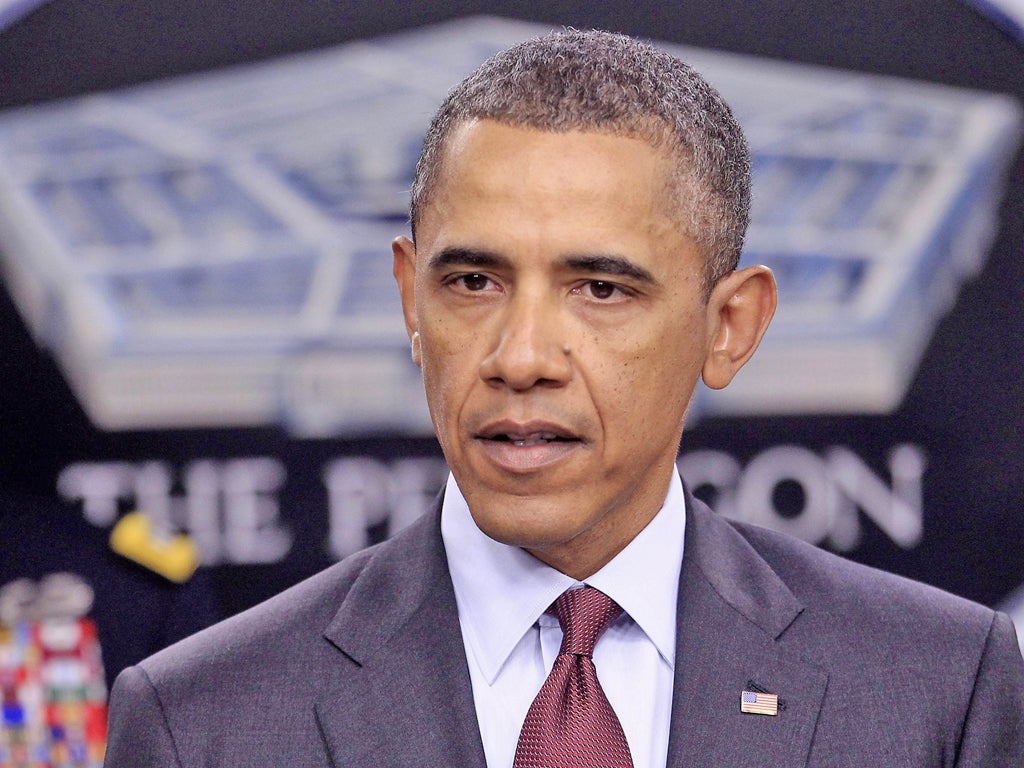
The mighty American military machine that has for so long secured the country's status as the world's only superpower will have to be drastically reduced, Barack Obama warned yesterday as he set out a radical but more modest new set of priorities for the Pentagon over the next decade.
Click HERE to view 'America's shrinking military' graphic
After the wars in Iraq and Afghanistan that defined the first decade of the 21st century, Mr Obama's blueprint for the military's future acknowledged that America will no longer have the resources to conduct two such major operations simultaneously.
Instead, the US military will lose up to half a million troops and will focus on countering terrorism and meeting the new challenges of an emergent Asia dominated by China. America, the President said, was "turning the page on a decade of war" and now faced "a moment of transition". The country's armed forces would in future be leaner but, Mr Obama pointedly warned both friends and foes, sufficient to preserve US military superiority over any rival – "agile, flexible and ready for the full range of contingencies and threats".
The wider significance of America's landmark strategic change was underlined by British Defence Secretary Philip Hammond, who used a visit to Washington to warn that America must not delay the production of US warplanes bound for British aircraft carriers. The US strategy is expected to make a drawdown of some of the 80,000 troops based in Europe.
"We have to look at the relationship with Americans in a slightly different light," Mr Hammond told Channel 4 News. "Europeans have to respond to this change in American focus, not with a fit of pique but by pragmatic engagement, recognising that we have to work with Americans to get better value for money."
But there is little doubt that Europe will be a much-reduced priority under the new scheme. The blueprint's status as the president's own property, after a first three years in office dominated by wars he had inherited from his predecessor, was underlined by his rare personal appearance at the Pentagon flanked by Defence Secretary Leon Panetta and other top uniformed officials.
Henceforth, Mr Obama underlined, the priorities would be maintaining a robust nuclear deterrent, confronting terrorism and protecting the US homeland, and deterring and defeating any potential adversary. To these ends, the US will also boost its cyberwarfare and missile defence capabilities.
At the same time, iIf all goes to plan, the centre of gravity of the US defence effort will shift eastwards, away from Europe and the Middle East. The focus will be on Asia and – both he and Mr Panetta made abundantly clear without specifically saying so – in particular on an increasingly assertive China, already an economic superpower and well on the way to becoming a military one as well.
The specifics of the new proposals, set out in a document entitled "Sustaining US Global Leadership: Priorities for 21st Century Defense", have yet to be fleshed out. But they are likely to entail a reduction of up to 490,000 in a total military personnel now standing at some 1.6 million worldwide, as well as cuts in costly procurement programmes – some originally designed for a Cold War environment.
The "Obama Doctrine" reflects three basic realities. First, the long post-9/11 wars are finally drawing to a close. The last US troops have already left Iraq, while American combat forces are due to be out of Afghanistan by the end of 2014 (though a limited number may stay on as trainers and advisers).
Second, and as the President stressed in a major speech during his recent visit to Australia, America's national interest is increasingly bound up with Asia, the world's economic powerhouse, and where many countries are keen for a greater US commitment as a counterweight to China.
Third, and most important, are the domestic financial facts of life, at a moment when government spending on every front is under pressure. For years the Pentagon has been exempt - but no longer, as efforts multiply to rein in soaring federal budget deficits.
At $662bn, Pentagon spending for fiscal 2013 will exceed the next 10 largest national defence budgets on the planet combined. Even so, that sum is $27bn less than what President Obama wanted, and $43bn less than the 2012 budget.
Join our commenting forum
Join thought-provoking conversations, follow other Independent readers and see their replies
Comments