Obama's Afghan strategy hit by deaths and dissent
October now bloodiest month in conflict while US diplomat resigns in protest at war

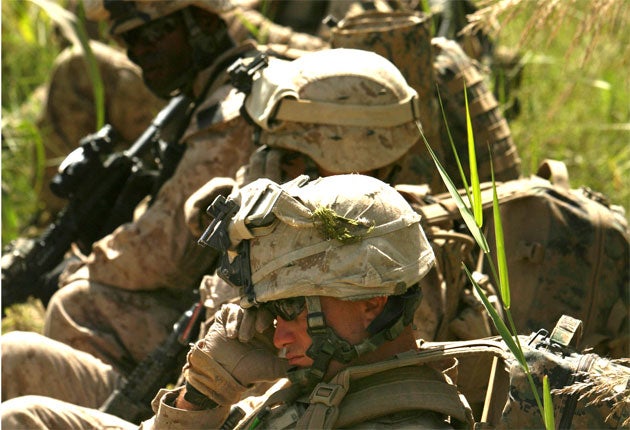
The loss of eight more American soldiers yesterday, the resignation of a highly regarded US Foreign Service officer, and new tensions over next week's Afghan election run-off have combined to intensify pressure on Barack Obama as he edges towards a crucial decision on a major increase in US troop strength in Afghanistan.
On Friday the President is to hold a further meeting with his military chiefs. He will be doing so at the end of the bloodiest single month in the conflict. The latest deaths bring to 55 the number of troops already killed in October, more than the previous high of 51 in August. They came the day after 14 US personnel died in separate helicopter accidents. In all more than 900 US soldiers have so far lost their lives in an eight-year war whose end is not in sight.
For Matthew Hoh, the sacrifice has simply become so pointless that he felt no alternative other than to become the first US diplomat known to have resigned over the war, citing reasons that reflect not just his own doubts over the conflict, but those of an increasingly disillusioned American public.
"I have lost understanding of, and confidence in, the strategic purposes of the United States presence in Afghanistan," says the resignation letter of the former Marine captain and Iraq veteran, who joined the State Department to work as the top American official in Zabul province in eastern Afghanistan, close to the border with Pakistan.
The US involvement was simply fuelling the insurgency, Mr Hoh wrote, and was causing American servicemen to die "in what is essentially a far-off civil war", or more accurately a number of small local wars in which the sides are united only in their resentment of a foreign intruder. His problem was not how Washington was pursuing the war – the issue Mr Obama is grappling with in round after round of consultations with his top national security and military advisers – "but why and to what end" his country was fighting it in the first place.
The resignation, revealed yesterday in The Washington Post, has sent shockwaves through the administration, which made repeated and strenuous efforts to change Mr Hoh's mind – including a one-on-one meeting with Richard Holbrooke, the special envoy for Afghanistan. "We took his letter very seriously," Mr Holbrooke told the newspaper. He described Mr Hoh as a good officer, and admitting that he shared much of the diplomat's analysis, although not his conclusion.
Tellingly, Mr Hoh emphasises he is no "peacenik or pot-smoking hippie who wants everyone to be in love". As he made clear to the Post, he is a tough former professional soldier, who believes the Taliban and al-Q'aida have "plenty of dudes who need to be killed", and the evidence of his personal courage makes him a difficult target for pro-war voices. Mr Hoh came home from Iraq with citations for "uncommon bravery".
Nor was he a mere grunt: in his time as a Defence Department civilian working on reconstruction in Tikrit, Iraq, he employed up to 5,000 people and handled millions of dollars in cash. Yet despite that experience, he said the weeks spent considering his decision and drafting the four-page resignation letter left him feeling "physically nauseous".
Later this week the now-resigned diplomat will meet with the chief foreign policy adviser of the Vice-President Joe Biden, the leading advocate in the administration of the approach favoured by Mr Hoh: a greater focus on Pakistan coupled with a scaled-down US combat presence in Afghanistan. "We have to draw the line somewhere, and say this is their problem to solve."
Complicating matters further is the new dispute over the election run-off, after Abdullah Abdullah, the challenger to the incumbent president Hamid Karzai, demanded the dismissal of the country's top election officer. Mr Abdullah, a former foreign minister, maintains that the supposedly neutral official could not guarantee a clean election, after the widespread fraud that marred the initial vote in August.
But yesterday Mr Karzai rejected that demand and others, with little sign of significant change in the practical organisation of the run-off, scheduled for 7 November. In retaliation, Mr Abdullah has threatened to boycott the vote – a move that would all but destroy the chances of Afghanistan gaining a leader with genuine national legitimacy, a declared pre-condition of a boost in US troop strength.
The request submitted by General Stanley McChrystal, the top allied commander in Afghanistan, reportedly seeks an increase of up to 40,000 men from the currently planned ceiling of 68,000. Failing that, the general argues, the war might to all intents be lost within a year.
Mr Obama has said he will not be rushed, and will make up his mind only when the election produces a clear-cut, accepted winner. In the meantime relations are by all accounts highly strained between the Obama team and Mr Karzai. The latter's agreement to accept a run-off was secured not by Mr Holbrooke, who reportedly has clashed with the Afghan President, but by the visiting John Kerry, chairman of the Senate Foreign Relations Committee.
Hoh's resignation letter: 'This reminds me horribly of Vietnam'
"In the course of my five months of service in Afghanistan... I have lost understanding of and confidence in the strategic purpose of the United States' presence in Afghanistan
"My resignation is based not upon how we are pursuing the war, but why and to what end... I fail to see the value or worth in continued US casualties... in support of the Afghan government in what is, truly, a 35-year-old civil war
"Like the Soviets we continue to bolster a failing state, while encouraging an ideology and system of government unknown and unwanted by its people
"If the history of Afghanistan is one great stage play, the United States is no more than a supporting actor, among several previously, in a tragedy that... has violently and savagely pitted the urban, secular, educated and modern of Afghanistan against the rural, religious, illiterate and traditional.
"The Pashtun insurgency... is fed by what is perceived by the Pashtun people as a continued and sustained assault, going back centuries, on Pashtun land, culture, traditions and religion by internal and external enemies. The US and Nato presence and operations... provide an occupation force against which the insurgency is justified
"The bulk of the insurgency fights not for the white banner of the Taliban, but... against the presence of foreign soldiers and taxes
"[This] reminds me horribly of our involvement with South Vietnam... against an insurgency we arrogantly and ignorantly mistook as a rival to our own Cold War ideology."
Bloodiest month: US losses in October
27 October 2009 Eight American troops die in two separate bomb attacks in southern Afghanistan, making October the deadliest month of the war for US forces since the 2001 invasion to oust the Taliban.
26 October 2009 Eleven American soldiers are killed in separate helicopter crashes. One helicopter goes down in western Afghanistan, killing seven soldiers and three civilians working for the US government. In a separate incident in the south, two other US choppers collide in flight, killing four American troops.
3 October 2009 Eight US soldiers are killed when their outpost in Kamdesh, Nuristan, is attacked by as many as 300 militants. Another soldier dies in Wardak province when a bomb detonates as he attempts to disarm it.
The US military has suffered 905 fatalities since the invasion of October 2001.
Source: AP
Join our commenting forum
Join thought-provoking conversations, follow other Independent readers and see their replies
Comments