Occupy activists fear that America's pro-Israeli lobbyists want a war
“Bomb, bomb, bomb, bomb, bomb Iran!” sings the AIPAC delegate, striding cheerfully through illegal Israeli settlements in his sharp tan suit.
Granted, the settlements are three feet high and made of cardboard, part of a pop-up anti-war occupation outside the conference of Israel's top lobbying group, where President Obama is due to speak. As another war in the Middle East begins to look feasible, Occupy has begun to focus its energies on foreign policy.
The American Israel Public Affairs Committee (AIPAC), a powerful tax exempt lobby that provides campaign finance in return for promotion of what it deems Israel's interests, pushed for a war in the Middle East in 2003. Activists with the Occupy movement, along with many others, are convinced that it now means to push for another. In the central Washington DC square leading to the conference, they have constructed mock- checkpoints and wear pink IDF uniforms with plastic guns, obliging the sharply-dressed AIPAC delegates to walk through.
“They’re disgusting,” whisper the delegates as they shuffle into line outside the conference centre. “They’re misinformed.” And what about war? “Well, we’ll just see what the president has to say,” says Talia, a student in the AIPAC line, smiling tactfully.
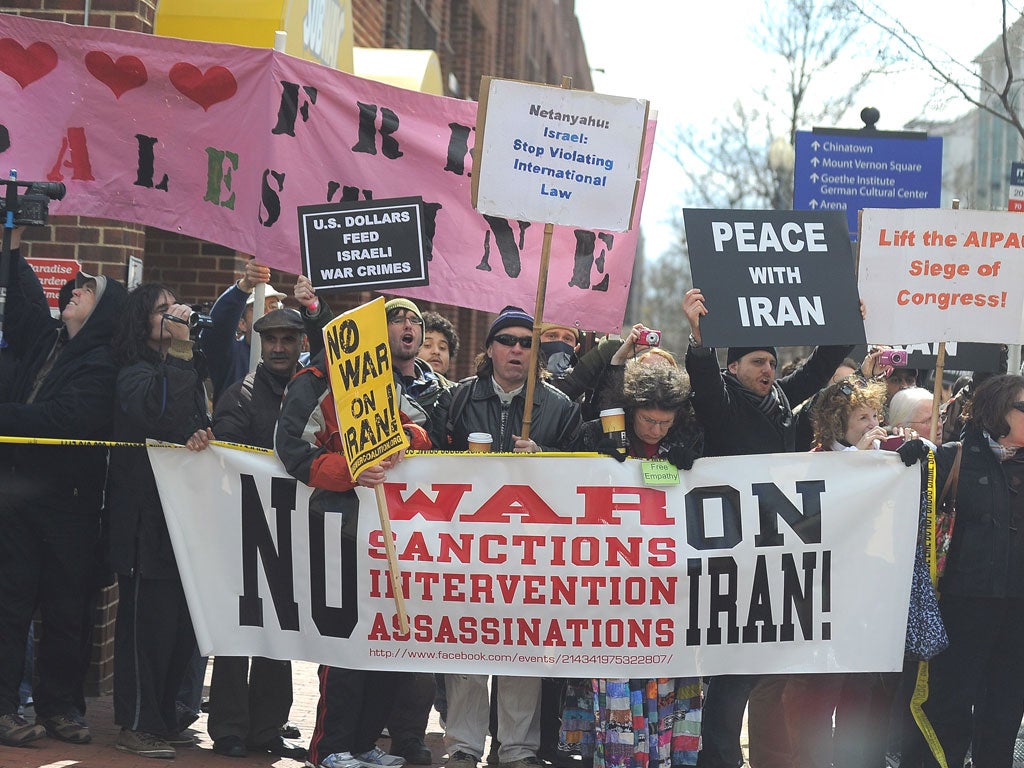
Many of the hundred peace protesters opposite have been campaigning for years before the Occupy movement sprang up last autumn to fight financial injustice. Now peace activists are using the “Occupy” brand to draw links between economic inequality in America and military spending abroad. “Money for jobs and education, not for war and occupation!” they chant, led by a girl in a headscarf whose voice cracks with emotion.
“Last year we galvanised the Palestine crowd but no one else seemed very interested,” says 24-year-old student Sasha Gelzin, one of the coordinators of Occupy AIPAC. “This year you've had the Arab uprisings and Occupy, you’ve had the thousands of activists making connections between domestic policy and foreign policy.”
The activists have called a parallel conference across the road from AIPAC. Ms Gelzin admits that the use of the “Occupy” name caused some problems: “In the beginning there was a lot of contention about using the Occupy name, given that this isn't a grassroots effort, it's a top-down effort.”
On Thursday, the Occupy Wall Street General Assembly in New York passed a motion of solidarity with Occupy AIPAC, although the issue of Israel had previously been avoided at central committee discussions because it was deemed too contentious. The issue, for many protesters, is as much about money as it ever was about race or religion - specifically, about stripping the lobbying money out of Washington politics and preventing another war of choice from draining more money from domestic spending.
“Follow the money, then you'll always find the answer,” says one occupier who declined to give her name - which sounds reasonable before she launches into a theory about Zionist property developers bankrolling the 2001 attacks on the World Trade centre. Discussions of Jews, money, secret deals and nuclear weapons have a tendency to sound conspiratorial, and there are certainly times when the rhetoric at events like these begins to twist the lid off the jar of nuts.
But the greatest conspiracies happen in plain sight. AIPAC has long been understood to have had a great deal of unelected influence over US foreign policy and “de facto immunity” from investigation, as author Grant F Smith put it in a speech to the conference. The shadow of past, present and future wars in the Middle East has hung over the Occupy movement from the start, and activists are quite clear what they are here for: to prevent another war.
What it will take to achieve that is unclear. The essential generational difference seems to be between those who believe that the outrage of right-thinking liberals in a room together is itself enough to effect change, and those who came to political awareness knowing different. For the handful of young representatives of Occupy skulking around the edges of the conference hall, including myself, the spectacle of peaceful marching and pamphleteering failing entirely to stop a war in the Middle East was our first real political memory. We remain sceptical about the possibility of things being different this time.
The conviction that the older generation of peace activists still nurses is, in effect, that American democracy does what it says on the tin: that if enough activists make their feelings about war with Iran clear, lawmakers half a mile away on Capitol Hill will simply take notice. The language of Occupy, however, is replete with the conviction that the “1%” - of which AIPAC are certainly members - could not care less about the democratic process. Amidst the litany of complaints, the call for direct action is becoming lost, and direct action is what Occupy has always been best at. As one speaker from Syria put it, those who will suffer at home and abroad in the event of war could do with “a little less kum-by-yah and a lot more kung-fu.”
At the end of the day, when veteran war reporter Chris Hedges gives a rousing speech denouncing AIPAC, the younger members of the audience are slow to join in the standing ovation. They know that Hedges recently denounced the tactics of some of the anarchist organisers who have driven the momentum of Occupy Wall Street as violent and dangerous. The tension between rhetoric and action, between passive protest and active resistance, may yet make a difference in whether or not America goes to war - and the generational choice is stark.
Join our commenting forum
Join thought-provoking conversations, follow other Independent readers and see their replies
Comments