Oil spill in Gulf of Mexico 'could be worse than Exxon Valdez disaster'
BP struggles to stop crude pouring from well a mile under the sea as growing slick menaces US coastline
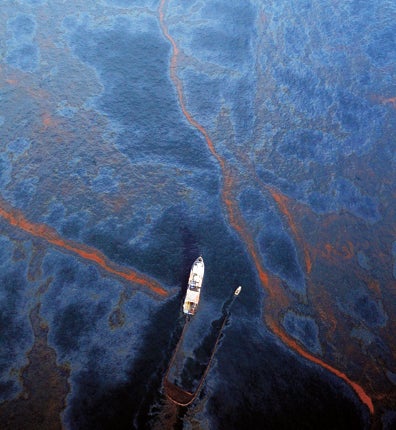
The first coating of oil from a growing spill in the Gulf of Mexico was expected to reach the US shoreline last night, despite frantic efforts by the United States and BP to halt its drift and avert the threat of an environmental calamity not seen since the Exxon Valdez disaster of 1989.
The US Coast Guard and the oil firm were leading the bid to limit the spread of slick, fed by oil leaking from broken well pipes one mile under the sea at an estimated rate of 5,000 barrels a day – five times greater than initial estimates. But the White House last night served notice that BP, whose rig exploded last week and then sank, must foot the bill for the entire clean-up.
With three leaks detected near the sea, the spill could eventually match the Exxon Valdez disaster in 1989, when 11 million gallons gushed from a crippled tanker into an Alaskan sound, devastating the local habitat. In fact, it could prove even more serious, the Secretary of Homeland Security, Janet Napolitano, told reporters. "The Valdez was a knowable quantity of oil because it was a ship. This is a well," she said.
As the slick bore down on the US coastline, the state of Louisiana, still recovering from the ravages of Hurricane Katrina, declared a state of emergency, and President Barack Obama promised to use "every single available resource at our disposal". The Pentagon was put on notice to ready military equipment, including ships and aircraft. "We are being very aggressive and we are prepared for the worst case," Coast Guard Rear Admiral Sally Brice O'Hare told reporters.
BP, Britain's largest corporation, which saw its share price tumble 6 per cent, was trying to accelerate efforts to seal the leaks and tackle the slick, including containing it with booms.
Last night the slick, covering an area a little larger than Jamaica, was within 12 miles of the mouth of the Mississippi in Louisiana, where fishing businesses contemplated the possible destruction of their shrimp and oyster crops. A class lawsuit against defendants that include BP has already been filed on behalf of two local fishing companies.
There may be no escaping the blame for the gathering disaster falling at BP's door, even though the rig itself was owned by Transocean, a Swiss company.
The chief operation officer of BP, Doug Suttles, said on US television that the firm was working with the experts across the industry. "We're applying absolutely the best science we know. We welcome the help of the government. We're not interested in where the idea comes from," he said "What we're interested is how do we stop this flow, and how do we stop it now?" A series of controlled sea-surface fires started by the US Coast Guard late on Wednesday appeared to have been successful. But only about 3 per cent of the errant oil can be burnt off, leaving the rest posing a threat not just to Louisiana but also to Alabama, Mississippi, Florida and Texas, and possibly over time even to the shores of Mexico.
A federal probe has already been launched into the circumstances of last week's explosion on the rig, the Deepwater Horizon, and BP executives and engineers could be called by subpoena to testify. Questions are already being asked about the reported absence from the rig of a sonar device that can be used as a last resort to close off the flow of oil from an underwater well. Such equipment is required by Norway and Brazil, but not the US. Bill Nelson, a Democratic Senator from Florida, announced he was filing legislation to temporarily prohibit the Obama administration from expanding US offshore drilling.
Once the oil begins to wash ashore, damage could be sudden and widespread. Aside from concern that tourist beaches as far away as Florida could become fouled, experts warned of the threat to species ranging from alligators to plovers and Louisiana brown pelicans. Also at risk are whales, dolphins and blue fin tuna, which are currently releasing billions of eggs that float close to the ocean surface.
There was little optimism last night that efforts by BP to use robotic equipment to seal the leaks will be successful. That leaves the company two options: constructing a large dome over the area of the leaks and drilling a relief well nearby to relieve the pressure at the sites of the leaks. Both could take many weeks – and probably months.
Industry veterans recalled a blow-out of the Ixot 1 rig off the coast of Mexico in 1979 when engineers struggled for nine months to cap a well leaking 30,000 barrels a day. That rig was operating in just 150ft of water. This rig was drilling at a depth of one mile.
How does this leak compare to those of the past?
Historic Spills
Santa Barbara (1969)
4m gallons
On 28 January 1969, one of Union Oil's offshore platforms experienced a blowout that caused around 4 million gallons of oil to contaminate more than 40 miles of the southern Californian coastline over the course of eight days. Dead seals and dolphins washed ashore in the aftermath and thousands of birds died after being soaked in the oil.
Exxon Valdez (1989)
11m gallons
On 24 March 1989, the Exxon Valdez oil tanker struck Bligh Reef in Prince William Sound, off Alaska, spilling about 11m gallons of oil into the sea. More than 1,200 miles of coastline was spoiled – immediately killing 2,000 sea otters, 300 harbour seals and 250,000 seabirds – in what is now considered one of the worst man-made environmental disasters in history. When the incident came to court Exxon, fearing a $5bn award for punitive damages, applied to investment bank JP Morgan & Co for the credit to cover it. The bank covered the potential exposure by inventing the "credit default swap", a financial instrument which would later lie at the heart of the global banking collapse in 2008.
Gulf War oil spill (1991)
520m gallons
The worst oil spill in history occurred in in the Persian Gulf after Iraqi forces deliberately opened valves of oil wells and pipelines to impede the US invasion in 1991. The oil slick reached a maximum size of 101 miles by 42 miles and was five inches thick.
Join our commenting forum
Join thought-provoking conversations, follow other Independent readers and see their replies
Comments