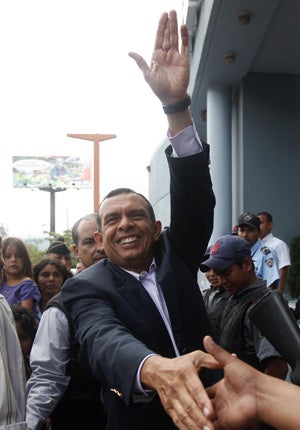
Declaring that "there's no more time for divisions", and hoping to draw a line under the political crisis that has paralysed Honduras for almost six months, conservative candidate Porfirio Lobo has claimed victory in the country's disputed presidential election.
The 61-year-old National Party candidate described the ballot as "the cleanest in the history of the country", and promised to restore diplomatic relations with the rest of Latin America as he addressed crowds chanting his nickname, "Pepe", in Tegucigalpa, the capital of Honduras, late on Sunday.
Initial results suggest that Mr Lobo gained 56 per cent of the votes, comfortably ahead of the 38 per cent achieved by his nearest rival, Elvin Santos of the Liberal Party, which was previously led by Manuel Zelaya, the president deposed at gunpoint in June's military coup.
Mr Santos quickly conceded defeat, saying it is time for "unity, the only path to confront the future and ensure the victory of all Hondurans". A turnout of 60 per cent, five points higher than the last presidential election, suggests a boycott called for by Mr Zelaya failed to gain widespread support.
"The people voted massively," the victorious Lobo said in an interview with the country's Channel 5 TV station yesterday. "The people elected me and threw a bucket of cold water on any attempt to hinder the election process."
Mr Lobo is a wealthy landowner who once flirted with communism, studying in Moscow in the 1980s, before swinging to the right after he was elected to the country's Congress in 1990. He was narrowly beaten by Mr Zelaya, by just 70,000 votes, in the country's previous presidential elections in 2005.
Known for his broad smile, Mr Lobo this time presented himself as a "unity" candidate, and promised to open Honduras to foreign investment, which has dried up in the upheaval of recent months, significantly hurting the economy. In a country rife with gang violence, he also made populist pledges to be tough on crime.
However, the legitimacy of Sunday's election is open to debate. Many left-leaning nations will refuse to accept its result until Mr Zelaya, who has been in exile at the Brazilian Embassy in Tegucigalpa for the past three months, is allowed to return to power and finish his elected term in office.
To do otherwise would set a dangerous precedent by effectively rubber-stamping the coup, argue countries including Venezuela, Brazil and Argentina. That puts them in direct conflict with the US, Peru, Costa Rica and Colombia, together with many European nations, who have said they will recognise Mr Lobo's election.
The Honduran Congress will vote on Wednesday on whether to allow Mr Zelaya to complete his term, which expires at the end of January. The country is currently ruled by Roberto Micheletti, a member of the Liberal Party, who was installed as interim leader following the coup.
Mr Zelaya, who started his political life on the right, drifted towards the left when in power, and was forcibly removed from office on June 28, amid allegations that he was attempting to alter the country's constitution to remain in power indefinitely, a charge he strongly denies.
He was frogmarched to the airport in his nightwear in what later became known as the "pyjama coup", and was sent into exile. Weeks later, he smuggled himself back into the country, in the boot of a car, and took up residence in the Brazilian Embassy.
Yesterday, Mr Zelaya criticised the decision by the US, Honduras's biggest trading partner, to recognise what he now describes as a corrupt election, saying: "If they are democrats in their country, they should be democrats in Latin America."
Join our commenting forum
Join thought-provoking conversations, follow other Independent readers and see their replies
Comments