Rio tries to contain slums with concrete
Mayor builds seven-mile network of 10ft walls 'to protect the rainforest'
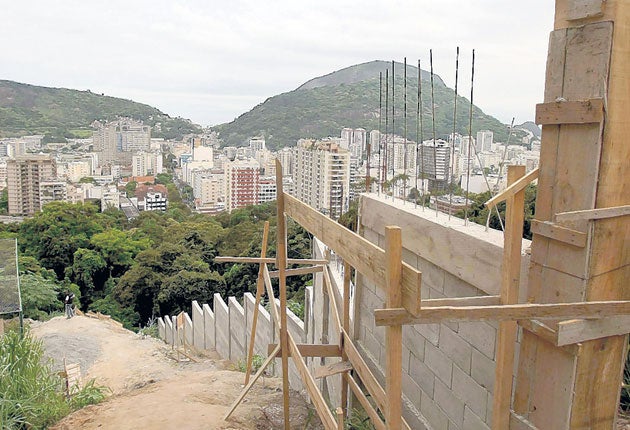
Rio de Janeiro might be the biggest party town in the world, but Brazil's second city has another side that the authorities would rather hide: a vast and lawless array of ramshackle slums that simply won't stop growing. Now, in an effort to stifle that growth, the local government has begun work on a seven-mile network of walls that has drawn stinging criticism from local residents and charities.
The 10-foot walls will surround 40 of the slums, or favelas, before the end of the year, at a cost of £12m. Some 550 houses have been earmarked for demolition to make way for the new barriers. Visiting a section under construction, city public works chief Icaro Moreno told reporters that the aim was "to show residents that they can only build up to a certain point".
According to Mr Moreno, the aim is to protect the rainforest that surrounds Rio from the ever-expanding slums. More than 500 acres of the Atlantic rainforest – the equivalent of 283 Wembley pitches – was hacked down between 2005 and 2008 – double the rate of the previous three years. However, critics say the motives are not so simple. Rio is one of the most socially-divided cities in the world, with rich areas that rival anything Europe has to offer sitting alongside slums where conditions are more comparable with sub-Saharan Africa. The contrast makes many who live in the richer areas uncomfortable, and the continued advance of the slums across the hillsides threatens Rio's reputation as an idyllic tourist destination.
Shortly after his inauguration in January, new mayor Eduardo Paes promised voters that he would bring a "shock of urban order" to the city. And on his first day in power, in a highly-charged move, he ordered the demolition of an illegal house. "They are strong and emblematic actions," he said. "They show we will not practice ostrich politics."
Such remarks have prompted some residents to worry that the mayor's appeal to the affluent would come at the expense of struggling slum dwellers. "The middle classes hate favelas," says Bob Nadkarni, a Briton who has lived in Rio for 30 years and runs a bed and breakfast in the Tavares Bastos slum. "They want to forget they exist. This is a popular move to appeal to them. But a quarter of the population live in the slums. They should be heard as well."
This is not the first time steps have been taken to limit the growth of the favelas. Until recently the "ecolimits" beyond which the slums were not supposed to spread were marked by metal cables running around the edge of the settlements. But newcomers desperate for a place to live continued to build homes beyond the boundary marker. They now live under threat of demolition.
Whereas in previous years Brazil's president Luiz Inacio Lula da Silva has condemned efforts to curb slum growth, this time he has said little. City authorities insist that those who are being forced to move to make way for the wall are not being badly treated. "There is no discrimination," said spokeswoman Tania Lazzoli. "On the contrary, we are building houses for them elsewhere and improving their lives."
Given the previous struggles to provide alternative housing, there is some scepticism about this pledge. Graca Martins da Silva's home is slated for demolition. "I think it is a good project," she told the Associated Press. "But only if they really build new homes for us."
Join our commenting forum
Join thought-provoking conversations, follow other Independent readers and see their replies
Comments