Senate scrabbles for a solution to US debt crisis as deadline looms
Time is running out for the warring factions to find a compromise that will avert a devastating default
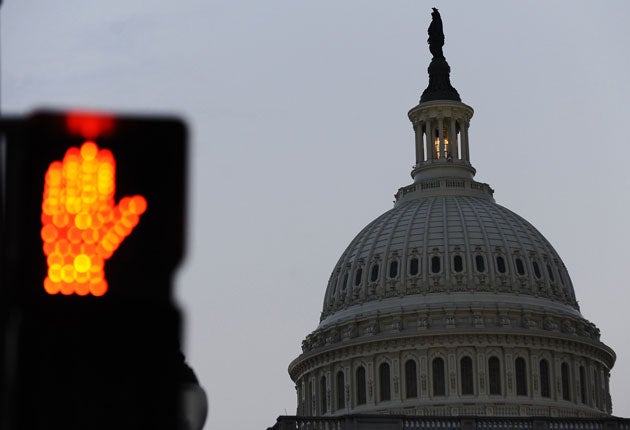
Both sides on Capitol Hill were grasping frantically last night for elements of a compromise to save America, the world's biggest economy, from a calamitous default on its debt this week, all the while aware that they face a towering task in bringing recalcitrant, right-leaning Tea Party members on board.
With less than 100 hours left before Tuesday's deadline, when the US Treasury would find itself unable to pay all its obligations, Congress was plunged into a marathon of debating, voting, and back-door negotiating in an effort to avert a default. The two sides must agree on ways to raise the $14.3 trillion (£8.7trn) debt ceiling and enact deep spending cuts. Failure to do so could sabotage the economic recovery and would shock world markets.
There were mixed messages about the chances of reaching a deal. Democrat Senate leader Harry Reid said Republicans "still refuse to negotiate in good faith," but Republican senator Mitch McConnell insisted: "I think we've got a chance of getting there."
Most of the attention has been on the Democrat-led US Senate, which on Friday received a bill passed that day by the Republican-controlled House of Representatives. It was killed, but only after several concessions had been stitched into it by the Speaker, John Boehner, to satisfy his Tea Party wing – one a demand that Congress begin work on a constitutional amendment to require balanced federal budgets.
That alone made the bill unacceptable to Democrats. "This is the most outrageous suggestion I have heard," said Senator Richard Durbin, the assistant Democratic leader in the Senate. A debate on a competing debt-ceiling plan, crafted by Senator Harry Reid, the majority leader, was set to begin yesterday evening and run into the early hours of today.
Political and financial observers strained to tell whether the exercise might yield a deal that President Barack Obama could sign by Tuesday morning. So high are the stakes, it seemed sane to assume that it could. Yet the political obstacles remained daunting. At the heart of the mess are the Tea Party members in the House of Representatives, many new to Congress and elected on pledges to force Washington to slash spending and chop away at the limbs of federal government. Many refused even to support the Boehner plan on Friday.
They know their voice counts because any plan that comes out of the Senate in the next 48 hours, even one with the blessing of the Republican leader in that chamber, Senator Mitch McConnell, has to win majority approval in the House of Representatives too. The "hobbits" of the Republican Party, as Senator John McCain, a Republican himself, labelled them, may yet be preparing to hold the whole country – and global economic health – hostage to its demands. Some may even prefer to see default over compromise, because what hurts the government may help shrink it.
Almost powerless in this tense endgame is President Obama, though he can use his bully pulpit to harangue Congress, as he has done almost daily. "There are multiple ways to resolve this problem," he said in a radio address yesterday.
The search for a compromise meant that Senator Reid was likely to drop his preference for a one-step process whereby cuts in spending of $2.2trn over 10 years would be accompanied by a big enough increase in the debt ceiling to see the US through to the end of next year, crucially after the presidential elections. Some kind of phasing of that process over the next 18 months, requiring more Congressional action, seemed likely last night, though Mr Obama would assuredly be disappointed.
Hampering progress was the extraordinary sourness of the mood in Washington. It was characteristic of the antagonistic atmosphere that the House was set to meet again last night purely to reject Senator Reid's plan even before it came to a vote in the Senate. The smoke signals continued to suggest war, not compromise.
For their part, Democrats remain livid that under Speaker Boehner, the Republicans took what in the past has been a routine procedure – the periodic raising of the debt ceiling – and politicised it so much that the country now faces global humiliation come Tuesday, barring a resolution. Even if a deal is done, which most market observers still think likely, the risk remains that ratings agencies could downgrade America's debt. The issue of the debt ceiling and of radical cuts in US spending, is certain now to dominate next year's presidential race.
The sheer fright that that prospect of default imparts may or may not be enough to jerk all sides out of their posturing. "The country's in crisis," declared Senator Charles Schumer, another member of the Democratic leadership in the upper house. "This is not a time for politics as usual."
Doomsday scenarios: What bad things could happen if Tuesday dawns without a deal?
* For the first time ever, the United States, with its huge debts, will not be able to borrow more money to bridge the gap between revenues from taxes and all its outgoings – which include the interest on those debts.
* The US Treasury reveals who it will – and will not – be paying: veterans and welfare recipients in the US may be the first to see the money dry up. And federal workers may be asked to work without getting their pay cheques.
* World markets go into a historic swoon as the reality of Uncle Sam defaulting sets in. Expect chaos on the bond markets too. The shock will threaten to push the US – and perhaps Europe – back into recession.
Join our commenting forum
Join thought-provoking conversations, follow other Independent readers and see their replies
Comments