
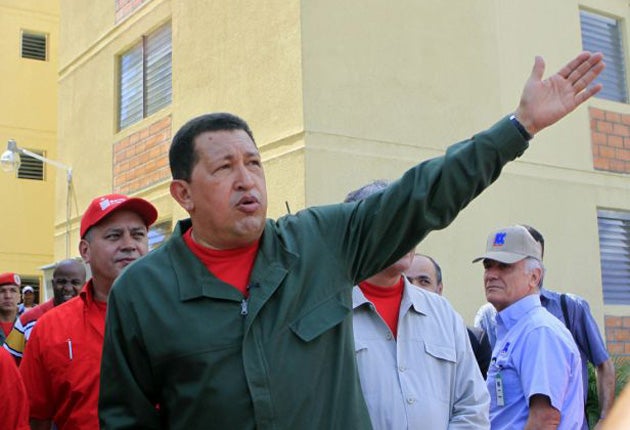
Telling his people, "If you want peace, prepare for war," and accusing the US of secretly plotting to invade and seize Venezuela's oil reserves, Hugo Chavez announced that he intends to send 15,000 troops to his country's border with Colombia.
The hostile move, which has inflamed diplomatic relations across the region, saw the left-wing president urge his soldiers to "defend this sacred nation called Venezuela" against what he called a creeping right-wing "empire". In response, Colombia said it would complain to the United Nations.
"Fellow military personnel, let's not waste a day on our main aim: to prepare for war, and to help the people prepare for war, because it is everyone's responsibility," he said in a televised speech. "We are going to train military groups, revolutionary students, employees, women... The best way to avoid war is preparing for it."
The comments come amid growing tension between Mr Chavez and his neighbour's right-wing president, Alvaro Uribe, who has close political ties to Washington and who last month signed a military co-operation pact with the US.
Under that deal, American forces will occupy seven military bases in Colombia for at least the next decade, ostensibly to fight drug traffickers who control much of the region's cocaine trade. However, Mr Chavez seems convinced that the move sets the stage for a sudden invasion of his homeland.
"The empire is settling right under our noses," he told viewers of his Sunday talk show, Alo, Presidente, claiming that one of the US bases would be "20 minutes" away from Caracas (which is possibly the case, but only via supersonic jet). "Don't make a mistake, Mr Obama," he warned the US president, "by ordering an attack against Venezuela by way of Colombia."
Posturing by Mr Chavez normally causes little alarm as it has become so common. In his televised Sunday speeches to the nation, which sometimes last several hours, he has recently railed against enemies as diverse as the Catholic church and the "bourgeois" sport of golf.
However, the recent speech is being taken more seriously, since tensions have been growing between the two nations for years and recently spilled over into violence. A fortnight ago, the bodies of 11 Colombian men were found dumped over the border. Aides to Mr Chavez claimed they were paramilitaries who had been killed while training to mount a coup against him.
In October, Venezuela announced that it had arrested several Colombian spies on its soil. Two months earlier, when Bogota signed its pact with Washington, Mr Chavez announced that the "winds of war" were blowing across the region, and unveiled a series of trade tariffs against the neighbouring country, which is, in normal circumstances, one of his leading trading partners.
Against this backdrop, regional analysts are concerned at the build-up of troops on the border, saying that the smallest spark could now lead to widespread bloodletting. Venezuela has in recent years spent more than $3bn (£1.8bn) on weapons, leading the US Secretary of State, Hillary Clinton, to warn against an "arms race" developing in the region.
Mr Chavez, who spent much of his early career in the armed forces , laid on the bellicosity in his latest speech, addressing it to "all commandants", and delivering it in front of rows of saluting army officers.
In response President Uribe issued a statement insisting that the US presence in Colombia, which has been criticised by many other regional governments, was purely aimed at helping it fight the battle against the drug trade. He insisted his country had no intention of attacking its neighbour.
"Colombia has not made nor will it make any bellicose move towards the international community, (and) even less so towards fellow Latin American nations," he said. "The only thing we are interested in is defeating terrorism related to drug trafficking, which has been so unfair to Colombians for so many years."
He called for "frank dialogue" with Mr Chavez, adding, "faced with these threats of war by the government of Venezuela, the government of Colombia is considering going to the Organisation of American States and UN Security Council."
The dispute leaves the US in a tricky position. Washington sees Mr Uribe's regime as a buffer against the growing number of socialist governments in the region, but there is little appetite for American troops getting caught up in a fresh foreign conflict.
Fighting talk: an escalation
TIMELINE
Nov 2007: Colombia withdraws support for President Chavez as mediator between Farc (Revolutionary Armed Forces of Colombia) guerrillas and Colombian government.
Jan 2008: Chavez calls Uribe 'liar', 'coward' and 'pawn of the US empire' .
March 2008: Venezuela expels Colombian diplomats and orders army to border after Colombia invades Ecuador in pursuit of Farc guerrillas. Colombia claims that Ecuador and Venezuela ignore the presence of the guerrillas on their territory. Chavez calls Uribe 'a mob boss'.
July 2009: Chavez withdraws ambassador from Bogota after US announces plan to expand military presence in Colombia. Chavez denies 'arming any guerrilla or armed group' and says US plans to turn Colombia into 'the Israel of Latin America.'
Oct 2009: Chavez threatens to reduce trade with Bogota, worth $7bn in 2008, 'to zero'. Colombia appeals to WTO.
Nov 2009: Chavez orders his army 'to prepare for war' with Colombia, 'in order to preserve peace.'
Join our commenting forum
Join thought-provoking conversations, follow other Independent readers and see their replies
Comments