The Big Question: How did the Rio Carnival become the biggest extravaganza in the world?
Why are we asking this now?
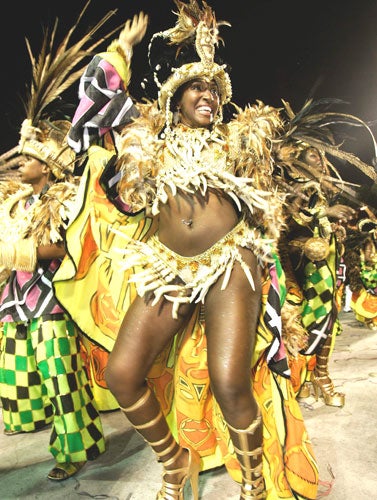
Because the annual Rio de Janeiro carnival – Carnaval, as it known locally – begins today, a dazzling, extravagantly over-the-top celebration of life that draws millions of people on to the streets of the Brazilian city. The benchmark against which all other carnivals are measured, this multi-million dollar affair – which always starts on the Friday before Shrove Tuesday and concludes on Ash Wednesday – is sponsored by the gaming industry and fronted by some of Brazil's biggest TV stars. The whole country stops to watch, if not in the stands, then on television. It's Brazil's equivalent of America's Super Bowl Sunday, only with significantly more "wardrobe malfunctions".
How and when did the Rio carnival begin?
Carnival is a European import beginning in the 1600s as a version of Europe's grand pre-Lent balls. It was practiced by the Portuguese elite behind closed mansion doors, with Brazil's black African population excluded. But the recipe for these masked celebrations, danced to the rhythm of the time, the polka, travelled out into the "favela" shanty towns and Carnival really began. By the 20th century these individual community parties developed into a humble cousin of the fully-blown carnival we see today complete with music of its very own: samba
How big is it?
Foreign visitors number some 700,000 each year. There are 30 samba schools with thousands of members. Each school is fronted by a queen and led by hundreds of drummers and a cavalcade of floats. And this is just the official parade. Bandstands for public parties and Carnival balls are found across the city, along with more off-beat parties in clubs and venues in Rio's centre and beyond.
What sort of impact does it have on Rio, and how does the city cope?
Massive ranks of seating and barriers are constructed along the route taken by competing samba schools. Planning to cope with this unwieldy-sounding beast goes like clockwork, if not quite Swiss, set up by samba groups, businesses and the municipality months in advance. Samba schools start major dress rehearsals (superb parties in themselves) after Christmas (having been practicing since last carnival's end). In Samba City, in the massive purpose-built buildings where the floats are prepared, preparations are underway months in advance and there are even international volunteering organisations taking people over to Brazil specifically to help set up infrastructure.
Does is it have a religious dimension or is it just an expression of hedonism?
Carnival has its roots in the devout as much as the decadent although today the show is one characterised by sequins rather images of saints. But it's not all about hedonism. Each year the schools choose a theme, often a major social or historical issue that is illustrated through costume and song. Last year a float which portrayed the bodies of naked victims of the Holocaust was banned after Jewish leaders in Rio sought an injunction.
Who are the creative forces behind it, and its biggest stars?
Alongside community costume creations major Brazilian fashion designers have made their name in these parades. The most famous being Clovis Bornay who, before he died in 2005, was single-handedly attributed with bringing over-the-top camp and colourful glamour to Rio's previously more formulaic carnival.
The Carnival Drum Queens are Carnival's biggest stars: traditionally the most beautiful women in each community. Today the queen has to have glamour model beauty coupled with an athlete's endurance to lead her battery of drummers through Rio's streets. These young women are chosen for maximum exposure in every sense, so are usually selected from a crop of actresses and models. The queens are followed round like reality TV stars in the run-up to the event with every gym outing and restaurant visit (not to eat of course) recorded for public consumption. This year, a former Miss Brazil has been selected by the Porto da Pedra school and two schools have broken with tradition by choosing women over 40 for Carnival drum queens.
How much of a role is there for ordinary Brazilians?
It's not just the stars of TV Globo (Brazil's equivalent of Bollywood) who get a leading role in Carnival. If you are part of a samba group – and this can simply be a follower rather than a musician or dancer – then you are centre stage for the big show. That said, certainly big-name sponsorship and international interest has driven ticket prices for the main event to well above that which the average Brazilian can afford but this is where the city's burgeoning unofficial street parties are born.
How important is it to Rio's global image and to its economy?
Rio's global image is so closely associated with Carnival that the two things are almost synonymous. Everything from the tourist industry to episodes of The Simpsons have found it hard to separate the two entities. Usually this is a huge boost for Rio's economy but this year the global credit crisis has even taken the shine off Carnival. Materials for the parades have shot up in price and costume suppliers have gone bust.
More important, the big-name sponsors and donating companies, such as Petrobras, the state-owned oil company, aren't able to contribute costing the parade millions of pounds. The Rio state government will donate several million, and tourist revenues, though likely to be down on previous years (hotels are expecting a 20 per cent drop in occupancy) will still be significant. Carnival goers are expected to inject $521 million into the city's economy, up from $510 million last year.
How do other carnivals such as New Orleans compare?
The northern Brazilian state of Salvador de Bahia hosts one of the world's largest celebrations, with 1.5 million people taking to the streets of the capital city of Bahia. Characterised largely by its distinctive musical styles this is the place to come to see vast 12 metre "trios electricos" trucks with ear-splitting sound systems. Further north still, in the adjoining cities of Olinda and Recife, you'll find a more home-grown carnival that jumps to the sound of the brass band led "frevo" music. Here home-made costumes are the norm and a tangible community feeling pervades. Worldwide, New Orleans has to be Rio's closest competitor in scale and reputation, a two-week festival that comprises some 50 giant parades and, even in the wake of Hurricane Katrina, draws hundreds of thousands from across the world.
Does Rio get bigger every year?
Yes. Even in a year of economic crisis numbers are expected to be up – largely boosted by domestic tourism. Some 719,000 international revellers are expected, a slight increase over last year's 705,000.
So is 'Carnaval' just a mask for Rio's social problems?
Yes...
* During Carnaval authorities give out millions of condoms but Aids rates in Brazil are among the world's highest
* There are samba schools that are allegedly linked to drug traffickers
* A stray bullet killed a 14-year-old girl at a recent practice session for Carnaval
No...
* Carnaval doesn't pretend to disguise Rio's social problems. And it provides locals with a creative outlet
* Samba schools are strong, inclusive community groups boosting troubled favelas
* Carnaval boosts morale in an often troubled city and is a huge source of pride for Brazilians worldwide
Join our commenting forum
Join thought-provoking conversations, follow other Independent readers and see their replies
Comments