The Big Question: Is Hugo Chavez guilty of wielding excessive power in Venezuela?
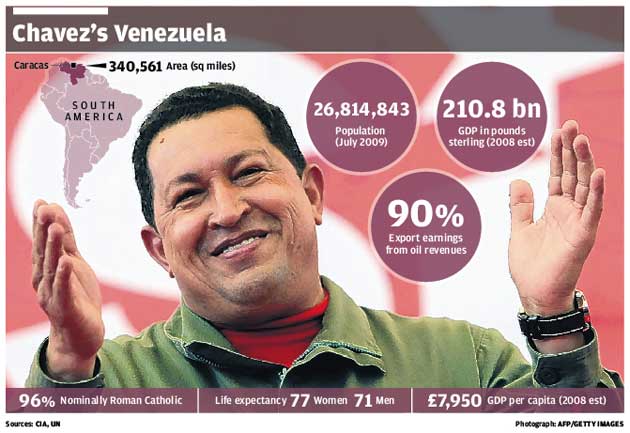
Why are we asking this now?
A group of radical supporters of the Venezuelan President Hugo Chávez have attacked an opposition TV channel, Globovision, including by firing tear gas. It comes just as the Chávez government has adopted a series of measures to control the media. Some 34 radio stations have been closed for "irregularities" and 200 more are "under investigation". Critics say it is an assault on free speech by the man who the leftist New Statesman once placed near the top of its list of "Heroes of Our Time". Yesterday the former Foreign Office minister Denis MacShane suggested that it was now time for the Hooray Hugos to give up their uncritical admiration for Chávez after the South American proletarian hero announced a law that could jail journalists for up to four years if they divulged information against "the stability of the institutions of the state".
How authoritarian is he?
In 2006 he withdrew the terrestrial licence for Venezuela's second largest TV channel and replaced it with a state network. But then the station had, along with all the other privately-owned channels, backed a United States-inspired coup against him. Then, earlier this year, he persuaded voters to lift the two-term limit on the presidency – enabling him to keep standing indefinitely for the job. Opponents criticised him for having a second referendum on the subject after the first one failed. (A trick he perhaps learned from the EU's second plebiscite in Ireland over the Lisbon treaty). But an impressive 70 per cent of voters turned out, and 54 per cent said "Yes". Chávez announced: "In 2012, there will be presidential elections, and unless God decides otherwise, unless the people decide otherwise, this soldier is already a candidate," he told his supporters. "I am ready!" Critics say Chávez is hollowing-out Venezuelan democracy, though his supporters point to Germany, which allows for re-election indefinitely (Chancellor Helmut Kohl was in power for 16 years before losing his fourth election) without any major threat to German democracy.
What about human rights?
The lobby group Human Rights Watch has been critical of Chávez's expansion and toughening of penalties for speech and broadcasting offences. It has accused him of a disregard for the separation of powers, with attacks on the independent judiciary and on workers' rights to associate freely. The Venezuelan police have never sunk to the levels of barbarity of places like Brazil and Argentina at their worst, but it is said that those who don't tow the chavista line can be excluded from state jobs or benefits.
So why do Venezuelans keep voting for him?
Because, for all his faults, Chávez is a lot straighter and more honourable than the corrupt and kleptocractic regimes that preceded him. They also like his flamboyant and ribald style, which is on show not just in big set speeches but in his own live TV talk show Aló Presidente. Over the last 10 years there have been 14 referenda and elections and he, or his party, have won 12 of them. Chávez is generally viewed as speaking and acting in the best interests of the poor. Though his opponents dub him a dictator, Chávez keeps getting re-elected – and with very high turnouts in elections praised as free and fair by international observers such as the EU.
Have the poor benefited?
Undoubtedly. Chávez has channelled billions of dollars into social programmes in the form of health and literacy programmes aimed at the poorest. There is free dental care, free health, access to education and vocational training, social housing and cheap food subsidised by the state. There are elected neighbourhood community councils, which decide how government money will be spent locally. There are 3,500 local communal banks for micro-financing. The incomes of the poorest have risen by 130 per cent. Social indicators, on child mortality, disease, illiteracy, malnutrition and poverty, show huge improvement.
Things are far from perfect – state control of food prices has led to sporadic shortages. But the net improvements are clear. Official UN figures show that poverty has dropped from 51 per cent to 25 per cent since 2003. Extreme poverty is down from 25 per cent to just 7 per cent. Venezuela is well on the way to reaching its first Millennium Development Goal years ahead of schedule – in stark contrast to those Third World countries relying on the affluent West for aid.
So who exactly is against him?
The vested interests who depended on the old corrupt economic model for handling the country's oil economy, which is the fifth largest in the world. Also the professional and middle classes who relied on the working of the old elitist model. Prominent among these are the owners, managers, and commentators workings on the five major private television networks and largest newspapers who have opposed Chávez for a decade. Their airwaves and pages are full of day-to-day issues like muggings (crime is high in Venezuela) and the price of milk. But their real concern is the shift from alignment with the US-dominated globalised economy to the bilateral trade and reciprocal aid agreements which Chávez has called his "oil diplomacy" – bartering oil for arms with Brazil, for doctors and other expertise with Cuba, and for strapped meat and dairy products from Argentina.
They were also alarmed by Chávez's wider proposals as part of a constitutional reform including limiting central bank autonomy, strengthening state expropriation powers and providing for public control over Venezuela's international reserves. It is measures like that which have caused Washington to massively subsidise Venezuela's opposition parties.
How has the arrival of Obama changed things?
The United States has long seen Chávez as a threat. In the Bush era it backed a botched military coup against him and, at the same time, criticised him for "undermining democracy". Chávez was applauded in 2006 when he referred to President George W Bush in the UN General Assembly as "the devil". But the arrival of Barack Obama has robbed Chávez of his anti-American card. He is now talking of re-establishing diplomatic ties with the US.
What impact is the recession likely to have?
Chávez's critics say he is buying his popularity by squandering the nation's oil wealth on social programmes which are transitory and will bring no lasting change to underlying structural problems. With the fall in oil prices they predicted doom would follow.
But that was when oil was $40 a barrel, and they knew that Chávez's budgeting was predicated on a world oil price of $60 a barrel. Yesterday the price was $71 and even the cheaper Venezuelan crude oil was $63. There may also be something of a longer-term structural problem. The private sector is shrinking relative to the overall economy. Millions more Venezuelans depend on the state for jobs and handouts than a decade ago. But the oil will not run out before Chávez's time in power is well over, however long he might extend it.
Is it time to give up faith in the President of Venezuela?
Yes...
* His violations of human rights are becoming more authoritarian as the years pass.
* He is squandering vast amounts of oil wealth on social security programmes that are only a sticking plaster on deep structural woes.
* Constitutional changes allowing him to rule indefinitely are dangerous.
No...
* He has massively improved the lives of his country's poorest people.
* His foreign policy remains an important challenge to the power of the US in the region.
* Venezuelans still support him far more than voters in democracies like the UK or US support their leaders.
View all comments that have been posted about this article.
Offensive or abusive comments will be removed and your IP logged and may be used to prevent further submission. In submitting a comment to the site, you agree to be bound by the Independent Minds Terms of Service.
- Print Article
- Email Article
-
Click here for copyright permissions
Copyright 2009 Independent News and Media Limited


Comments
Chavez is salami slicing his way to a fascist dictatorship. The pillars of a free and democratic society are being made Chavista-compliant: police, army, judiciary, press, public sector & unions.
If, as in Iran, people are denied the opportunity to democratically challenge a fascist state, they -or some of them - will seek alternative solutions...
The presently elected president of Venezuela spent 2 years in jail because of that partial army Coup you mentioned. If you knew me just a little ,you would understand,I despise Coups and believe in free press and democratic values as much as you do.
We agree on that one. Now , is it important to go backwards and forwards in order to understand an issue?
Important world democratic leaders and actions practiced by their Administrations did drive countless of Latin American Countries into the arms of far right dictatorships and in some cases, mass murder.
Could you name one such world democratic leader who ended up
spending 2 year in jail? 1 year? 1 month? 1 day? 1 hour? 1 minute? You see, Justice and Time not always walk hand in hand. Time on its own is such a vacuous and misleading word when linked to just 1 fraction of it. So is Justice and so is Judgment.
I met street people in Caracas who proudly showed me their thumbs coloured blue with the ink showing that they had voted in the municipal elections that occurred while I was there. When the lowest of the low in a society start to find their voice you know that a genuine revolution is occurring.
To say that Chavez has squandered money on social security when the governments that criticise him squander money on “social security’ for corrupt bankers surely gives new meaning to the word ‘hypocrisy’.
The coup in Honduras shows the future for Venezuela if the United States gets its way. That’s not a ‘coup’ say the Americans, merely an interruption of democracy, like a break in transmission of a television program.
The people of Latin America know what is in store for them now that the US is encouraging coups again. Chavez isn’t being dictatorial, he is battening down the hatches for a struggle of wills with the USA.
http://www.presstv.ir/detail.aspx?id=10
Democratically elected and fantastically popular with the poor MAJORITY of his country
He has helped the poor people of Venezuela rather than ignore them
He is trying to change the corrupt elitist social and economic structure of Venezuela which meant that over 100 yrs after oil production started the vast majority of Venezuela were poor and had few options to advance themselves or their children
On the other hand:
The massively escalating crime rate (murder rate has tripled since Chavez came to power)
The social programmes look more like a tool to bribe and control the masses rather than fix the underlying problems (i.e. give a man a fish so he becomes dependent rather than teach him to fish so he has choice and freedom)
The need to change the constitution to keep power
The nationalisation of everything, increasing the dependency of everyone on the government which he controls
The nepotism with many of his family members having senior state or national positions in government
The destruction of the "free" press (understanding that much of the press might be biased against him) with wholesale movement of media into the control of the government
Persecution of those who oppose him e.g. everyone who signed the petition to get Chavez removed is on a database that allows government agencies to refuse them services e.g. renewal of passports or driver licenses
As I said, I am conflicted. It was good to see some social justice when he 1st came to power but now he is looking more like a Mugabe in the making. The only direction Venezuela is going is down.
I am Trinidadian. Which means I live on a small island very close to Venezuela (7 miles) watching the flood of refugees from Venezuela overwhelm my country and looking nervously at the arms that Chavez is buying. The most frustrating point being Trinidad's only guarantee of security comes from everyone's favourite villian (at least in the UK) the USA.
The vested interests who depended on the old corrupt economic model"
So far away, yet so near to home.
The US is planning to take over South America? I doubt it!! The more I read the Independent and the comments therein, the more convinced I am that England is more and more like their French sisters across the channel. I have said before and I will say it again, withdraw US military bases from ALL foreign soil. Withdraw all of the jobs they create, all military support, all financial support and concentrate on the United States. Militarize the borders. Columbian drug smugglers, execute at the time of capture. Immigration, closed. Middle East goes up in smoke? Too bad. As long as the rest of you stay out, we need not be involved. Korea dumps an ICBM on Hong Kong, Japan or Shanghai, tough. They are not their brothers keeper, and further more, since they are the source of the world's ills in your estimation, they are not your brothers any more. Randy Newman had it right in the sixties. (see Political Science 101 on You Tube)
Where would most US corporations go if they could only sell to the US market? How far down the toilet? It is the world's biggest market, but it is nowhere near enough to keep the US economy going.
You might want to bear in mind that countries' national foreign policies tend to work on the basis of what is in the economic interest of the countries in question.
But then, that might spoil some of the hero fantasy nonsense about the US being something other than a country just like any other, only in a more powerful position.
What do you think?
The USA would crumble like a mountain of ash without the rest of world.
Capitalism has brought with it the most vicious people and ideology, to every capitol of the western world. It affects national leadership and governments with corruption, through handouts to political corporate facilitators.
The same for Islamic solidarity--a tough nut to crack--but the murky purveyors of this elitists' capitalist system, knows the power of money--and will always find useful dissenters to undermine an alternative system for them.
Chavez will make mistakes--and they will facilitated by his opponents--but he will have a seriously long way to go to create the crimes and inequalities of capitalism over the centuries, to arrive at the current situation, where all, but the rich, world elites, have suffered severely with their savings and investments.
You can talk about human rights violations when Chavez refuses to prosecute torturers or to publish torture pictures.
You can talk about human rights violations when Chavez starts sending killer drones into Colombia and bombing weddings there.
If there were no demand for cocaine, there wouldn't be many export sales.
Also, the US is not as detached from planet earth as you appear to believe.
Getting back to my beliefs, having grown up on a farm, I feel more than adequately able to grow enough food for my family. I can build a home if need be. I can hunt and gather whatever else I need and barter for what I want with surpluses I have. America is not perfect but then, contrary to some opinions, neither is England, France or anyone else. Many would not cope. I know of farmers who have been amazed that city kids weren't aware that milk, cheese, cream and beef came from cows or that bread came from a plant seed. They would be totally dependent and probably could not function without Xboxes, Flat screen tv and such. But, I am not their keeper either.
As for coke being in the US because there is a demand, from much of what I have read, some at least being anti-drug propoganda aimed to scare recreational users, the stuff is highly addictive and turns casual use to an addiction quickly. Might be wrong there because I never felt the need to try it. Never bothered with the crap from the Golden Triangle either.
Therein lies the problem - we should not love our political leaders, we should judge them objectively and critically.
Chavez does not stand up to objective and critical analysis. He'll continue to be voted in as long as the majority of Venezuelans are uneducated, uncultured and dependent on state handouts. Of course, El Jefe will ensure they remain thus enslaved. Sigh...
It is true RCTV were punishable in 2002, but so were all other TV stations. The only difference is that RCTV remained critical of Chavez and the others not. The referendum of 2007 was rejected with all its amendments and yet he not only managed to get the possibility for reelection
approved this year, but he also pushed through full powers every single of those amendments, even if they were not supported.
I am surprised a journalist can compare indefinite re-election in a parliamentary system where the chancellor must answer on real time to precise questioning of the opposition, where on top the Bundesländer are very independent with a strongly presidential system as is the case in Venezuela.
Chavez has taken away powers and money from the regions since the opposition won a few highly populated states making up 45% of the population: he took away hospitals, schools, harbors, airports and motorways from the governors and much more.
Chavista mayors have in the middle of the day painted Swastikas on opposition governor houses, attacked newspapers.
"So why do Venezuelans keep voting for him?"
Mainly the petro-state. The popularity of every president of Venezuela has always depended on oil prices. When Chavez came to power, the oil barrel cost $12.
It started to climb and it was at $160 last year. That means that the state got over 1000% more dollars as 90% of Venezuelan exports are oil. Even now it is over 500% higher than in 1998.
The last oil boom Venezuela had was in the early 70s, when Carlos Andres Perez, a very corrupt man, was president for the first time. In 1988 he ran again for president and the gullible, thinking he was going to give them another golden time, elected him, but then oil prices were much lower.
"Chávez is a lot straighter and more honourable than the corrupt and kleptocractic regimes that preceded him."
Proof? Chavez gives the crumbles from a hugely higher oil income. His family owns a lot of haciendas in Barinas. Arne Chacon, the brother of one of his key ministers, Jesse Chacon, was a penniless in 2001 according to social tax declarations and yet he has bought several banks since in value of several hundred million dollars.
"Chávez is generally viewed as speaking and acting in the best interests of the poor. "
And yet Barlovento revolted last month and the military had to come and Petare, the largest slum, voted against him. As far as the observers of the EU, please look at the article "The truth about EU observers in Venezuela", written not by a CIA agent, but by an EU observer.
"Have the poor benefited?
Undoubtedly. "
Indeed. They always benefited from petrodollars, even if less than the richest, even now. There is more theft by the rich, just higher oil prices and industrial production is even lower now.
Social programmes collapsed in the eighties and nineties with oil prices.
Were the previous governments corrupt? Very much and I protested against them as far as I could, democratically. Were the rich profiting back then? Yes. They are still now. The Ancien Regime is fine and prospering as long as it remains quite and there is the new Boliburguesia.
"literacy programmes":
In 1998 literacy was at 93% and 50% of the illiterate were over 65 years old.
The last time Venezuela took part in open international evaluation tests of education was in 1998, just before Chavez came to power. The government stopped that because it hates real transparency.
We, normal people, have asked the government to join the PISA programme on open evaluation as we know public schools have an abysmal level.
"The incomes of the poorest have risen by 130 per cent": do you have an idea about inflation in Venezuela? Please, check the latest post of Oil Wars Blog, a former Chavez fan.
The murder rate in Venezuela was high in 1998: 19 murdered per 100000 per year. Now, the number is close to 70. Most of those are poor.
Please, read my blog Venezuela Europe for further information.
You can ask concrete questions there.
It takes a great deal of bravery to protect your vulnerable citizens from the USA and the Oil giants.
His DEMOCRATIC hold on power gives hope to people who have been excluded from the most basic rights.
However, if he were a right-wing despot Im sure we'd all turn a blind eye.
Realpolitik only seems to apply Shell when need some more Oil.
Friends and locals I know there all say crime has increased 'n' fold since Chavez came to power.
From that, there is only one conclusion ...
BB
It's great everything you said but how about what you didn't say, the country is totally divided between pro chavez and its opponents, crime is worse than ever, there is nothing in regular supermarkets a huge lack in milk oil beans the basic food for venezuelan because yes there are many government supermarkets called Mercal but they sell imported products which some of them are even past their use by date like milk. with such a wonderful country full of everything to feed venezuelan do you think that's great?! and how about hours people spent on line four one bag of sugar in mercal?! do you really think that's help?!! help would be if the country will be united the whole economy would be doing well, less crime more peace. when they supposedly take lands from "rich owners" that have worked there whole life for what they have or simply takes someone garden to live in! do you really think that's the way things should be? believe me you don't know what is going on in Venezuela if you don't live there! we are in great danger if mister chavez stays in venezuela the country will not improve, specially do you think someone that can be reelected for is entire life is good?! do you really think elections are clean?! do you really think when the opposition won the election about something it is normal to revote it?! NO NO NO! so really come and live in Vzla which is one of the most beautiful country of the world with wonderful people but it would be much better if democracy was maintained because do you think it is normal that radios are shut down just like that???!! we are in great danger please help us! and should are remaind this simple thing, a president in any country is president for everyone in that country not just for the people who vote for him. Thank you.
"We could do with Chavez here in the U.K."
But we've already got them havent we? Oh sorry , I thought you said Chavs.
Great, feed the ambition, feed the poor. Most will not have a problem with that.
The worst is always assumed.
Extending the amount of times someone can stand for president is nothing, british prime ministers dont even go through a popular vote except in their constituency and can stand indefinitly its hardly undemocratic to have unlimited terms of office.
and when state tv stations are set up people all seem to think goebbels when the truth could be much closer to the BBC. Im not saying it is just like the BBC just that no evidence of foul play in state media is offered. and that plenty of foul play in the privately owned companies has been.
the man has had 14 referendums, under electoral systems which are seen as free and fair, thats more than blair, or brown or probably any british prime minister ever.
so what if he wears military fatigues? - that just means he's a prat but doesnt necessarily make him a dictator
harassing political opponents is not on though - thats a load of bullshit that cant be defended,
but he's hardly pinochet, or saddam, or a somoza or any american funded puppet.
and as for social programmes merely sticking a plaster over structural problems, since when has fighting illiteracy and providing good healthcare been white wash policies??