The devious world of Clark Rockefeller
The man who disappeared with his daughter left behind a tissue of lies to confuse his pursuers

The latest headlines from our reporters across the US sent straight to your inbox each weekday
Your briefing on the latest headlines from across the US
Clark Rockefeller used at least four aliases, claimed he bought a yacht using $300,000 (£150,000) worth of gold bullion and let his ex-wife think he was a part of the famous oil family who share his name. Yesterday, it emerged that the man dubbed "Mr Crockefeller" may not even have had a valid social security number.
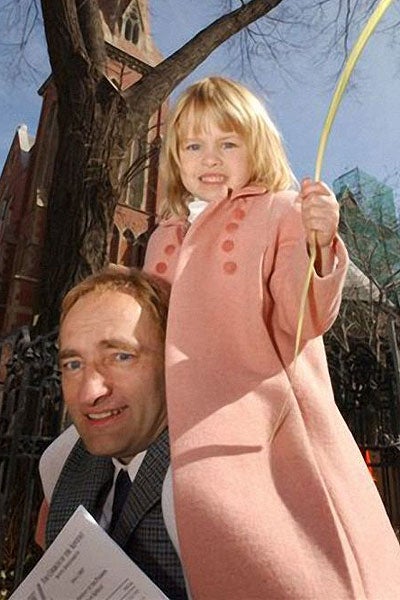
As the search continued for the millionaire divorcee and his seven-year-old daughter Reigh, who he kidnapped in Boston on Sunday in broad daylight, police have become increasingly baffled by the complex web of lies that he left behind to confuse his pursuers.
Initial reports that Rockefeller intended to sail his daughter to the Bahamas or South America on board his 72ft yacht Serenity were being treated with increasing scepticism by police yesterday, after the pair were reportedly spotted outside a car dealership in Delaware after boarding a train at New York's Grand Central Station. Some have even started to doubt that the vessel, which the millionaire boasted to friends that he paid for using bars of gold, exists at all.
It is now thought that Rockefeller, who kidnapped his daughter after she flew from her home in London to visit him, fabricated the story about the yacht to distract authorities while they escaped to another part of the US. Police also discovered that his social security number was not valid and that he went under a number of aliases including Clark Mill Rockefeller, James Frederick and Michael Brown.
At least two vehicles were used in the kidnapping. Boston police have recovered the first and are questioning the driver. The second car, which was spotted dropping the pair outside Grand Central Station, was driven by 30-year-old Aileen Ang, who said that Rockefeller had given her $500 to take him there from Boston. She did not know the millionaire and had no idea he had just kidnapped the girl who was playing in the back seat.
"I actually thought it was just going to be him," she said. "And when I got where I was going to pick them up ... his daughter was there."
Once she realised she had just played a part in a kidnapping, Ms Ang went to the nearest police station to tell them what had happened, before telephoning her mother, who said: "She called me and said, 'Mom, I am in a police station. The man I brought to New York City is kidnapping his daughter and wants to get out of the country.'"
Ms Ang told police that Rockefeller had jokingly asked her if she wanted to join them on a cruise to Bermuda, prompting the US Coast Guard to conduct an intensive search of the waters around Long Island using a spotter plane.
But friends of the kidnapper came out with very different stories when questioned by authorities. Rockefeller told one of them his destination was Alaska, and another that he was going to Peru. Another acquaintance said that he had asked her if she knew of a garage where he could store his car for a year while he went travelling.
The perfectly orchestrated kidnapping may be just the latest ploy from a man who appears to have been a dab hand at deception. Even the people of Cornish, the small town in New Hampshire where Rockefeller used to live with his ex-wife Sandra Boss and Reigh, cannot agree about the kind of a man he was.
"I think everybody was suspicious [of him]," said Judith Kaufman, who lives in Cornish. "I was suspicious from the first time I heard that he was supposed to be related to the Rockefeller family. Although there are a lot of Rockefeller relatives who live in New England, they don't operate in the way that he did. The way he wore the name on his sleeve, in a gloating kind of way, seemed unusual to me."
Ms Boss is now a senior partner at the global management consulting firm McKinsey & Company in London. She was convinced that her husband was a genuine Rockefeller – a claim that the famous family's archive centre strenuously denies.
While in Cornish, where he lived with his family in a sprawling 19th-century "cottage" with 15 rooms, Rockefeller became heavily involved in the community, writing articles for the local newsletter Consider This and donating money to neighbourhood causes. He even tried his hand at acting – something which he later proved to be very good at indeed – appearing in a local production with his wife and daughter.
"He was a very visible person in the community," said Ms Kaufman. "Even after he lived here, he attempted to get involved with community activities. He certainly wasn't a discreet, underground person or a recluse."
At one town meeting, Rockefeller offered to donate a vast sum of money to improve the local police and fire stations – but only on the condition that he was able to take over the running of a nearby church.
He also launched a campaign to purchase and privatise a local heritage site, the house and gardens of famous sculptor Augustus Saint-Gaudens, because he was worried that the US National Park Service was planning to expand the site and swallow up the nearby countryside.
"He might have had a Napoleon complex, wanting to become the new lord of the land," said Ms Kaufman. "It might have had nothing to do with liking Cornish, or the people, or the community. He might just have been interested in himself. I didn't know him well enough to tell what his motivations were."
But another resident of the town, a farmer who attended the meeting at which Rockefeller offered to make a "donation" to local causes, described Rockefeller as "a really good guy" who was merely interested in what was going on around him. "There wasn't really anything for him to gain by taking over the church, it was just a building that they used for community events," said the man, who did not want to be named. "I don't know whether he followed through with all the money but I think he did.
"I only met Clark once, at a town meeting. He just seemed like an okay guy who had a lot of money and wanted to be the town's benefactor. He didn't strike me as odd."
Another Cornish resident, 19-year-old Emily Miller, used to be the Rockefellers' babysitter. "I don't think he would try to harm her in any way," said Miller, who babysat Reigh for about two years. "I think this is him being upset about the divorce... and potentially losing his daughter, especially if she was in London."
Most people who knew Rockefeller, who is said to have an impressive collection of paintings by artists such as Mondrian and Rothko, are convinced he was a millionaire merely by the way he acted. In the past, he told friends he worked for an aeronautics company as a physicist, but police have still been unable to pinpoint exactly how he earned his millions and what he did for a living.
Subscribe to Independent Premium to bookmark this article
Want to bookmark your favourite articles and stories to read or reference later? Start your Independent Premium subscription today.
Join our commenting forum
Join thought-provoking conversations, follow other Independent readers and see their replies