The jungle massacre: Peru's tribal chief flees country
Amazon leader seeks refuge at Nicaraguan embassy after followers killed in clashes over oil and logging laws
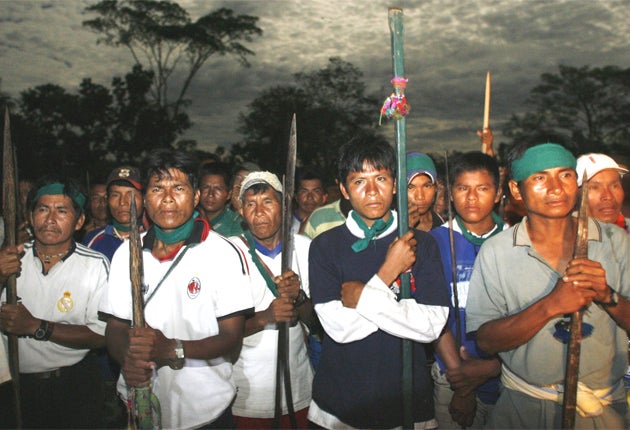
The leader of Peru's Amazon Indians will be flown to exile in Nicaragua after seeking asylum following violent demonstrations that killed scores of police and protesters.
Alberto Pizango, the head of Aidesep, which represents 56 tribes, spent yesterday at the Nicaraguan embassy in Lima. Dozens of his followers died during protests against new laws that will leave swathes of their ancestral homelands open to oil and gas exploration. He has been charged by his own government with "sedition, conspiracy and rebellion".
The London-based pressure group, Survival International, called on oil firms to withdraw from Peru, describing the incident as "The Amazon's Tiananmen" and accusing security forces, who have since imposed a curfew over the region, of burying and burning corpses to hide the scale of the killing.
"Peruvian Indians are being driven to desperate measures to try to save their lands which have been stolen from them for five centuries," said Survival's director, Stephen Corry. "This is the Amazon's Tiananmen. If it finishes the same way, it will also end Peru's international reputation."
Violence broke out on Friday when 2,000 Aguaruna and Wampi Indians, many carrying spears and machetes, clashed with heavily armed police officers following a highway stand-off near the rural town of Bagua Grande, roughly 870 miles north of the capital.
Human rights lawyers have since accused the President Alan Garcia's regime of an orchestrated cover-up. Official figures put the death toll at just 32, including 23 policemen. News reports say the number of deaths is closer to 60, and vast numbers of missing people have yet to be accounted for.
Trade unions are organising a strike across the country today, hoping to fan public outrage over the incident, which began when police fired tear gas and automatic weapons into noisy crowds of protesters. A delegation of human rights lawyers, who visited the scene yesterday, told the BBC hundreds of demonstrators were still missing. "I say to the authorities they should take care because sooner or later the facts of what happened will come to light," said one of the lawyers, Ernesto de la Jara, from the Institute for Legal Defence. "Dead bodies may be covered up for now but, little by little, the truth will come out and they will have to respond."
The crisis follows months of escalating controversy over Mr Garcia's attempts to implement a free trade agreement with the US. New laws, brought in to increase the number of oil and logging concessions in the country's 67 million hectares of rainforest, appear to allow for the sale of tribespeople's ancestral territories.
In April, Aidesep supporters began blocking roads and rivers in rural areas of the country. A crucial oil pipeline across northern Peru has been shut down since the end of the month, costing the state oil company an estimated US $ 120,000 (£75,000) a day.
Mr Garcia has long talked of turning Peru into an oil superpower by opening its forests to exploration from firms like France's Perenco, Spain's Repsol and the US company, ConocoPhillips. However his plans are being tested by protesters blocking remote parts of the country's road network. "We don't get anything from this huge exploitation, which also poisons us," Mateo Inti, a leader of a group of Aguaruna Indians , told the Associated Press. "We've never seen any development and my community lives in poverty."
Indigenous people, who account for almost half of Peru's 28 million inhabitants, have for years had a tense relationship with the ruling class, who are largely descended from Europeans. Mr Garcia's has attempted to dismiss his Amazonian opponents as brutal savages, accusing them of "elemental ignorance".
The crisis is eating into the presidential power-base. Last night, Peru's parliament voted to suspend the controversial land laws for 90 days, until public order is restored. On Monday, Carmen Vildoso, a populist minister often described as Peru's Margaret Thatcher, had quit the cabinet in protest at Mr Garcia's handling of recent events.
Join our commenting forum
Join thought-provoking conversations, follow other Independent readers and see their replies
Comments