The upstart with a dream
One year ago, he was behind in the polls and his campaign was being written off. Leonard Doyle reports on how Obama upset the odds
Two large military gunships swooped across the inky blackness of a Virginia sky as Barack Obama's motorcade drove into view, flanked by 12 motorcycle outriders. He would not become president-elect for a further 21 hours or so, but it already felt like the torch had been handed over.
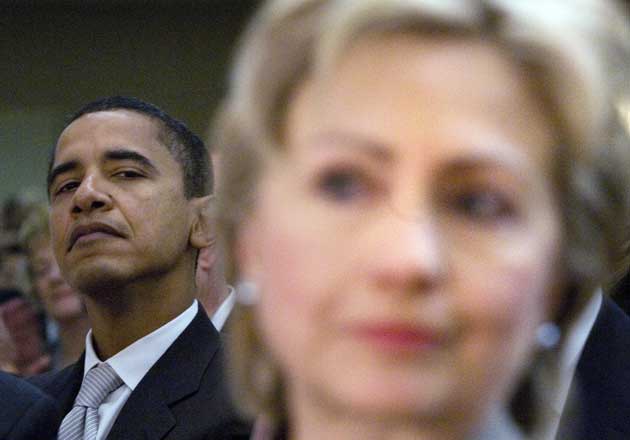
Knowing victory was within his grasp, Mr Obama dispensed with much of his stock speech on Monday night, to reflect on the vicissitudes of the campaign. A little more than a year ago, he recalled, he was far behind in the polls, unable even to secure the endorsement of many black politicians who figured he could never beat Hillary Clinton. Many in the US political and media establishment had also concluded that his campaign was a flash in the pan. He was all but written off as a talented but fundamentally inexperienced upstart.
But the story of Barack Obama is one of being constantly underestimated by his opponents. From his earliest days as a community organiser on the south side of Chicago he revealed a talent for motivating people who thought they were powerless. As a young politician, hungry with thwarted ambition, his intellect, self-confidence, astonishing networking skills and a capacity to charm people into supporting him, turned him from a lowly Illinois state senator into a political superstar.
His election remains nevertheless a story of extraordinary talent and self-discipline, along with some fortunate timing. With a first name that rhymes with Iraq, a middle name of the former dictator of that country and a surname that even American television anchors confuse with Osama Bin Laden, the 47-year-old Chicago politician was always going to be a hard sell with America's so-called "low information" voters.
But if one theme has emerged from his meteoric rise from community organiser in the Chicago ghetto to the mansion on 1600 Pennsylvania Avenue, Washington, it is his capacity to turn apparently fatal weaknesses into powerful political weapons.
Exactly a year ago this week, Mr Obama was lagging 33 points behind Mrs Clinton in the opinion polls, and his supporters were in despair. Two gut-wrenching presidential election losses to George Bush in a row had taught Democrats that a winning candidate needed to retaliate against attacks quickly if he was to avoid the fate of John Kerry and Al Gore. The pundits concluded that the Democratic race was all but over, and national magazines had already put Mrs Clinton's face on their covers as the presumptive Democratic nominee. The polls, and the money pouring into her war chest, told them she had to win, but they did not count on the tsunami of enthusiasm that the Obama campaign would unleash.
Yet, as he headed into the crowded contest for the Democratic nomination, the Illinois Senator had several advantages over his opponents. He was the ultimate outsider at a time when voters were desperate for change in the way Washington is run. And as a politician who had never benefited from the patronage of a political machine, he knew how to operate on a shoestring. It was also Senator Obama's good fortune that Mr Bush's eight-year term proved such a disaster.
By opposing the Iraq war, well before the 2003 invasion, Mr Obama got on the right side of history and sowed the seeds for a robust but thoughtful foreign policy. "I am not opposed to all wars. I am opposed to dumb wars," he said in autumn 2002, a position which enabled him to outflank even Republicans by calling for stepped-up military action in Afghanistan and even against al-Qa'ida inside Pakistan.
None of this seemed decisive, however, when all six Democratic candidates rolled into Des Moines, Iowa, on a bitterly cold night early last November to attend the Jefferson Jackson Dinner, as tedious an event as can be found in an election-year calendar. The national media was mostly absent as 9,000 raucous supporters – most wearing Obama's "Change" T-shirts, packed a boxing arena to watch Democratic big shots arrayed around a centre stage tuck into dinnerThe Clinton campaign dismissed the enthusiasm of the youthful Obama fans, saying they had all been bussed in from Chicago for the night. It was a fateful error of judgement, by a campaign that already reeked of a sense of entitlement. Because the "JJ dinner" as Democratic insiders call it, would turn out to be a game-changer.
The first five would-be candidates rattled through their stump speeches. Mr Obama was last to speak. Deadlines had already passed for television news and most newspapers. People were already leaving the hall. But the first-term Senator from Illinois sprinted on to the stage and gave a barnstorming speech. His supporters were delighted, but crucially, so were potential big-money backers, who saw for the first time that he could throw a punch.
The Iraq war, "should have never been authorised and should have never been waged," Senator Obama said. "We have a chance to bring the country together to tackle problems that George Bush made far worse, and that festered long before George Bush took office." That was an implied criticism of Bill Clinton, then still revered by most of the party, but his next words dealt a stinging blow to Mrs Clinton's candidacy.
"When I am the nominee of this party," said Mr Obama, "the Republican nominee will not be able to say I voted for the war in Iraq, or that I gave George Bush the benefit of the doubt on Iran, or that I support Bush-Cheney policies of not talking to leaders that we don't like." The only headline that mattered next day was in the Des Moines Register. David Yepsen, the paper's influential political editor, lavished praise on his speech and predicted an instant buzz across Iowa, where the first contest of the 2008 election would be held in eight weeks. "Should he come from behind to win the Iowa caucuses," he wrote, "Saturday's dinner will be remembered as one of the turning-points in his campaign here."
A month later, 18,000 people gave up their Saturday afternoon to drive through the snow and ice to Des Moines to watch Oprah Winfrey endorse the Obama bid and listen to hours of political rhetoric.
As David Broder, the veteran political writer of The Washington Post wrote this week, "In the eight Iowa caucus campaigns I'd covered over four decades, I'd never seen anything like this. In fact I'd not seen voters so turned on since my first campaign as a political reporter, the classic Kennedy-Nixon race of 1960."
Barack Obama has never been short of ambition, but as recently as 2004 he was unknown outside Illinois. Although by then he had spent eight years in the state senate, a brash attempt to win a safe Democratic seat in Congress ended in humiliation when he was badly beaten by a former Black Panther named Bobby Rush. He was still teaching at the University of Chicago Law School, and was up to his neck in student loans which he only managed to pay off in 2006.
But John Kerry had spotted the urbane young politician during his doomed presidential campaign against George Bush, and asked Mr Obama to give the keynote address at the 2004 Democratic Convention. His oratory not only helped revive a party which at the time was directionless and adrift, it swept him into the US Senate the same year, where he soon began positioning himself for a run for the presidency.
To Mrs Clinton's backers – and not only to them – it seemed ludicrously presumptuous. But in Iowa they discovered their mistake. While she was flying an expensive "Hillacopter" around the state, Senator Obama and his team logged tens of thousands of miles persuading rural white Iowans to back him. Through word of mouth and the efforts of his devoted followers, he won a state that is 95 per cent white.
And while Mrs Clinton depended on friends in the establishment to help her through the election, Mr Obama was busy building a grass-roots movement. He turned to the internet to raise money and used the explosion of online social networking tools to sign up and motivate an army of volunteers.
Time and again during the primaries, and the election campaign, that followed, Mr Obama showed his coolness under fire. When Mrs Clinton snatched victory in New Hampshire, setting the scene for a long and bruising campaign that went on for almost six months, he was not fazed. When his controversial pastor, the Reverend Jeremiah Wright, was exposed as a virulent anti-white demagogue, he delivered what many said was the most historically sophisticated speech on race relations since the death of Martin Luther King.
Some of the mishaps were of his own making. Condescending remarks he made about working class white voters "clinging to guns and religion" were a gift to his opponents, and even though he secured the Democratic nomination, he was polling 20 and 30 percentage points behind John McCain in must-win states like Ohio. Senator McCain's campaign was not slow to sow doubt about the first black major-party candidate for president, with millions of so-called robocalls telling targeted voters that like Osama Bin Laden, he had plotted with a domestic terrorist, Bill Ayers, who tried to bomb the Pentagon. In fact he had served on the board of an education charity with Mr Ayers, who later became a Chicago University education professor, but the smears had some impact.
Mr Obama's most grievous error followed Russia's invasion of Georgia in August, which Senator McCain exploited ruthlessly. Senator Obama's failure to condemn Russia's action – he blamed both sides for the invasion – reminded voters of Hillary Clinton's famous "3am phone call" advertisement in which she warned that Mr Obama was not ready for leadership. The polls turned in Mr McCain's favour for the first time in the race.
Mr McCain's decision to play the wildest card of the campaign, naming Alaska's governor Sarah Palin as his running-mate, stole all the thunder. As the presidential debates loomed, one poll gave Mr McCain a five-point lead. It was a margin he was not to enjoy again. The sudden crisis that engulfed the financial markets dealt a fatal one-two to the Republican campaign. It reinforced the point Mr Obama had been making all year: that the decisions of the Bush and Clinton administrations to remove regulatory oversight from Wall Street had led directly to the sub-prime mortgage crisis.
The second blow was self-inflicted. Mr McCain's claim that the US economy was "fundamentally sound" made him a laughing-stock; worse, with the economy going through convulsions, working class white voters, some 45 per cent of the electorate, began to reappraise their rejection of Mr Obama and look past their prejudices.
At his final Virginia rally, grieving for the grandmother who raised him, and who had died that morning, Mr Obama reflected on the harsh attacks he had endured on the campaign trail. He described a grim journey he made to South Carolina, looking for an endorsement at a time when his campaign was floundering. While he was introducing himself, a small woman began interrupting with the chant, "Fired Up!" followed a moment later with "Ready To Go!" It lifted his mood that day and became the catch cry of the campaign.
"That's how this thing started," he said, "It shows you what one voice can do. One voice can change a room, and if a voice can change a room it can change a city, and if it can change a city, it can change a state, and if it can change a state it can change a nation, and if it can change a nation, it can change the world."
Join our commenting forum
Join thought-provoking conversations, follow other Independent readers and see their replies
Comments
Bookmark popover
Removed from bookmarks