They wait for oil. But the sea brings death instead
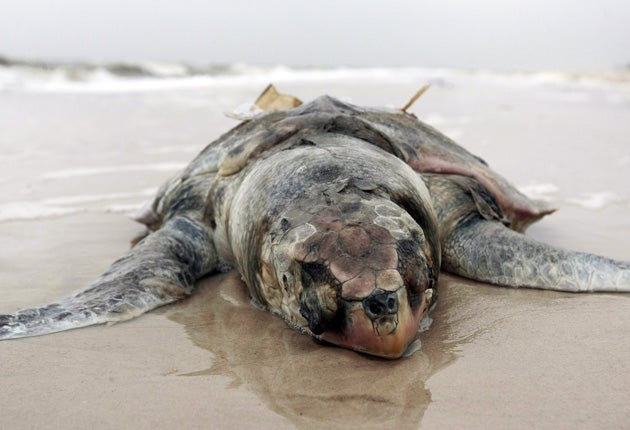
Kitchen sink gloves at the ready, Jackye Carroll, 62, patrolled the white-sand beach of Pass Christian yesterday looking for any sign of animal distress from the oil slick lurking over the horizon. Her vigilance soon paid off, though she was hardly pleased: a dead loggerhead turtle by the edge of the surf.
"I have been living here for 20 years," says Ms Carroll. "And I have never seen a single dead turtle on the beach." Pulling on the gloves as she had been instructed after volunteering for turtle-watch duty the day before, she dragged the turtle, about two feet in length, up the sand to where it would be collected.
Like everyone else, animal rescue teams and ecologists are watching and waiting, almost teased by an oil spill that promises to be catastrophic in scale but which so far has barely shown on the coastline itself.
A first indicator of the damage it will cause may be the surge in numbers of dead turtles found in just two days, not just here in Pass Christian – the town collected eight dead turtles yesterday and nine on Sunday – but all along the Mississippi shore. The first necropsies on the animals were started yesterday at the Institute for Marine and Mammal Studies in Gulfport, Mississippi.
"It is much higher than normal," admits Moby Solangi, the researcher who leads the facility, which is tucked next to a canal a few miles from the beach. He warns a reporter to cover his nose as he opens a deep freezer where 22 turtles, including several endangered Kemp's Ridley turtles, are individually wrapped in plastic bin-liners awaiting the arrival of the vets who will examine them.
Mr Solangi resists speculating as to the cause of the spike in turtle deaths. "There are just too many unknowns to say yea or nay now, but all I can tell you is it is higher than usual," he says. He added that it is "part of nature" for them to wash up from time to time. But as each necropsy is conducted, he and his colleagues will be looking for signs of oil ingestion or of suffocation from oil.
The institute, meanwhile, has prepared its series of holding pools to receive other sea fish and mammals that may be harmed as the oil slick continues to grow. He is particularly worried about the 5,000 or so dolphins that live in the area as well as numerous species of whale and gulf sturgeon. While the Exxon Valdez spill was grave, he pointed out that the amount of oil in the tanker had been finite in quantity. The same cannot be said of the oil now leaking from where the BP rig once stood before it blew up.
"Unless it is capped very quickly we will see some very serous consequences to all the wildlife and the ecosystem," Mr Solangi warned.
Preparations in Mississippi have continued unabated, just as they have in neighbouring Louisiana and Alabama. In Pass Christian yesterday, the head of the beaches department, Chuck Loftis, oversaw teams cleaning the beach of all debris to which oil might stick and then building a berm – raised barrier – to protect most of the sand should the oil eventually arrive. "We plan to build it all along for 26 miles," he said.
Elsewhere in Pass Christian, booms have been thrown across bays and inlets, areas crucial for the hatching of crab, shrimp and other marine species. At its main harbour, anxiety is running high for the fate of the town's 10-mile long man-made oyster reef, the second largest in the US. Renee Brooks, a councillor who is coordinating the response effort from the Harbour Master's Office, recalled with a wry smile that the annual blessing of the fleet was just two weeks ago. "We should have blessed it twice," she said.
"They are going to have to figure out how to cap that thing," says Dwight Gordon, the town's emergency management director, pointing to the latest slick-movement estimates from the US Coast Guard on a photocopied map indicating that it had reached the Chandeleur Islands, a small archipelago famous for its beauty and richness of fish stocks.
At least the wind had died, ending a three-day spell of stormy weather that had threatened to drive the slick ashore more quickly. But no one was relaxing. "We can't sit back and say this is not going to happen," says Mr Gordon.
Back on the beach Ms Carroll pulls off her gloves and decides to head home. "We are just crossing our fingers and hoping," she says with a sigh. But her discovery of one more dead turtle seems like an ominous sign.
*BP said yesterday that chemical dispersants seem to be having a significant impact in keeping oil from flowing to the surface. The update on the dispersants came as BP was preparing a system never tried nearly a mile (1.6 kilometers) under water to siphon away the geyser of crude from a blown-out well. However, the plan to lower 74-ton, concrete-and-metal boxes being built to capture the oil and siphon it to a barge waiting at the surface will need at least another six to eight days to get it in place. That could spill at least another million gallons (3.8 million liters) into the Gulf, on top of the roughly 2.6 million gallons (9.8 million liters) already estimated to have spilled since the April 20 blast. Those numbers are based on the Coast Guard's estimates that 200,000 gallons (757,060 liters) a day are spilling out, though officials have cautioned it's impossible to know exactly how much is leaking.
Join our commenting forum
Join thought-provoking conversations, follow other Independent readers and see their replies
Comments