US expands its drone war in push for victory over al-Qa’ida
The strikes bring to six the number of countries where the drones have been used. US officials increasingly identify the East African country as a major terrorist base

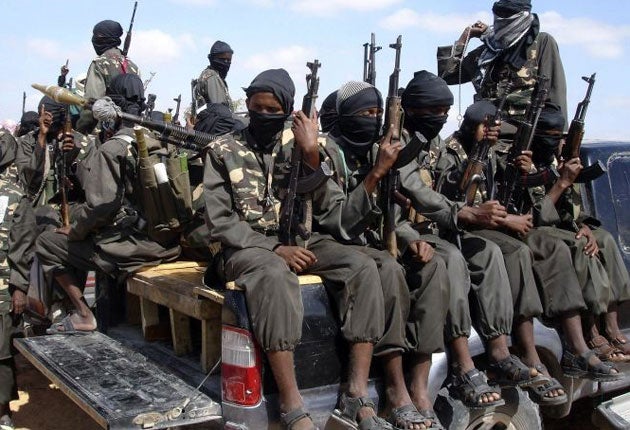
The CIA is reported to have used unmanned drones to target leaders of al-Q'aida's affiliate in Somalia for the first time, attacks coinciding with the unveiling of a new US counterterrorism strategy shifting the war on terror away from costly battlefields and toward expanded covert operations.
The strikes in Somalia, which last week apparently wounded two leaders of the al-Shabab militant group, bring to six the number of countries where the missile-armed drones have been deployed: Afghanistan, Pakistan, Yemen, Libya and Iraq, and now the lawless country in East Africa which officials here increasingly identify as a major terrorist base after the killing of Osama bin Laden in Pakistan.
US officials quoted by The Washington Post yesterday claimed the two individuals targeted had "direct ties" to Anwar al-Awlaki, the US-born cleric now based in Yemen who is believed to be a senior planner in al-Q'aida's operations. In May, al-Alwaki himself was targeted by a drone attack, but managed to escape.
There were also indications that al-Shabab intended to widen its operations outside Somalia. The group had become "somewhat emboldened of late" and as a result, the officials declared, "we have become more focused on inhibiting their activities". If confirmed, the strikes in Somalia would fit the new approach set out in the 19-page "National Strategy for Counterterrorism" released this week by the White House, and presented by John Brennan, President Barack Obama's top anti-terrorism adviser.
In some respects, this Administration is following the path trodden by the Bush Administration before it, placing the highest priority on protecting the US homeland from attack. In others though, it differs notably.
There is no mention of the Bush era "global war on terror". As Mr Brennan emphasised, the strategy is "not designed to combat directly every single terrorist organisation in every corner of the world". Instead, America has in its sights those groups who could pose a threat to the US mainland, and that still means al-Q'aida, despite the killing in May of Bin Laden, and the elimination of other senior commanders in the group.
In his address to a Washington think-tank, Mr Brennan was careful to insist that al-Q'aida still remained a threat. But rarely has a senior US official been as boastful about the inroads made into the organisation that in September 2011 carried out the deadliest-ever attacks on the American mainland.
Since Mr Obama had taken office, al-Q'aida's leadership had been "decimated," and "virtually every affiliate" had lost one or more of its top operatives, he proclaimed. Evidence recovered by Navy Seals from Bin Laden's hideaway in Abbottabad, Pakistan, had only confirmed that impression, he said.
For the first time, Mr Brennan explicitly raised the prospect of final victory over America's arch-enemy in the foreseeable future. "If we hit al-Q'aida hard enough and often enough, there will come a time when they can no longer replenish their ranks with the skilled leaders they need to sustain their operations."
In this campaign, America's main tools would be intelligence and Special Operations forces, backed up by the rapid deployment of what he called "unique assets", a reference to the drones that are becoming smaller and deadlier. But the deployment of drones is controversial, with frequent strikes in Pakistan's lawless tribal areas inflaming anti-American sentiment and creating tensions with Islamabad, already strained after the border-busting raid to kill Bin Laden. Human rights activists also say the civilian toll of the strikes is hard to calculate, given that the areas targeted by the drones are hostile and inaccessible, the very reason they are attractive to the militants.
Washington's new approach also reflects America's general weariness with large-scale foreign conflict at a moment when the economy is struggling, and the country is burdened by unprecedented debt. Only this week, an independent study reckoned the overall cost of the post 9/11 wars in Iraq, Afghanistan and Pakistan might top $4trn, equal to a quarter of the entire US annual economic output.
The mood was caught exactly by the outgoing Secretary of Defence, Robert Gates, in a February speech at West Point, when he declared that any successor of his who advised the President to send an American land army into Asia, the Middle East or Africa "should have his head examined".
Mr Gates took his formal leave yesterday at a Pentagon ceremony, attended by Mr Obama, at which the latter, unannounced, awarded him the Presidential Medal of Freedom, the country's highest civilian honour. A surprised Mr Gates noted in his reply that, as recent events have shown, "Mr President, you're getting pretty good at this covert ops stuff".
Join our commenting forum
Join thought-provoking conversations, follow other Independent readers and see their replies
Comments