US to launch covert strikes on terror targets
White House gives green light to clandestine Special Forces missions across Middle East
The US has authorised a sweeping expansion of covert military operations in the Middle East and Africa, aimed at destroying terrorist networks in the region, and preparing the ground ahead of any presidential decision to attack Iran.
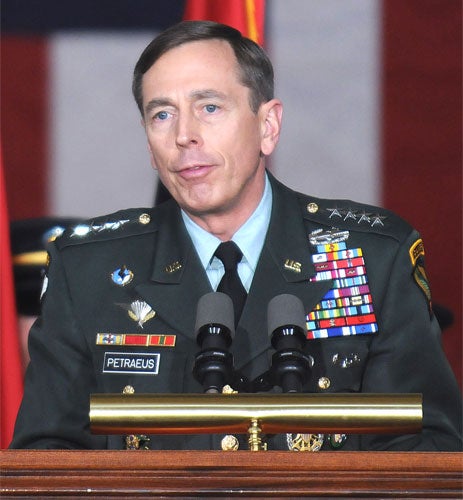
According yesterday's The New York Times, a directive, called the Joint Unconventional Warfare Task Force Execute Order, was signed on 30 September by General David Petraeus, head of Central Command and in charge of US military operations in the Middle East, Afghanistan and the Horn of Africa. Under its provisions, units of the Navy Seals, the Army's Delta Force and other Special Forces will be able to operate both in friendly countries, and in hostile countries with which the US is not technically at war.
The main job of these clandestine operations, says the order, will be to "build networks" to "penetrate, disrupt, defeat or destroy" terrorist organisations, and to "prepare the environment" for future offensives by the US or local forces – a plain reference to Iran.
In some respects, the strategy does no more than institutionalise policies initiated under George W Bush. The former defence secretary Donald Rumsfeld was a particular fan of secret operations, arguing that the Pentagon's Special Forces were just as effective as the CIA. But his approach has now been embraced by the Obama administration. In the wake of 9/11, the Bush White House moved to beef up the Joint Special Operations Command, in charge of such operations, and headed between 2003 and 2008 by General Stanley McChrystal. In mid-2009 Gen McChrystal was named by Barack Obama as top American commander in Afghanistan.
However there are major differences. Both Pentagon and CIA officials indicated that the directive gives the Pentagon a bigger foothold in operations that were once largely the preserve of the CIA. This means they will not automatically need approval by either the President or Congress.
In the eight months since the directive took force, some operations have become public, including the killing in Somalia last autumn of the al-Qa'ida operative Saleh Ali Saleh Nabhan, linked to the 1998 bombings at the US embassies in Nairobi and Dar-es-Salaam.
Special Operations Forces have also stepped up co-operation with the military in Yemen, where the Pentagon is doubling annual assistance to $155m (£108m), to equip Yemeni troops with helicopters, armoured vehicles and small arms. The main target there is al-Qa'ida's local affiliate, which claimed to have plotted the failed attempt to blow up a US commercial jet as it was about to land in Detroit last Christmas.
The other country in the directive's sights is Iran, where Mr Obama has specifically refused to rule out military strikes to halt Tehran's suspected nuclear weapons programme.
But as long ago as 2005, The New Yorker magazine reported that US Special Forces were making reconnaissance forays into Iran from across the border with Iraq. Now, however, US combat forces are scheduled to be out of Iraq by 2011. Had the abrasive Mr Rumsfeld still been in charge at the Pentagon, the new order might have created a furore. But, in the calmer climate prevailing under his successor Bob Gates, the change seems to have gone through smoothly. "There's more than enough work to go round," a CIA spokesman said yesterday. "The real key is co-ordination."
Join our commenting forum
Join thought-provoking conversations, follow other Independent readers and see their replies
Comments
Bookmark popover
Removed from bookmarks