Ahmed Wali Karzai: 'The stories are very hurtful. The only thing I haven't been accused of is prostitution'
If you believe his critics, Ahmed Wali Karzai is a corrupt gangster who has allowed the Taliban to flourish but remains untouchable because he is the President's brother. But, in a rare interview, he tells Kim Sengupta that his hands are clean
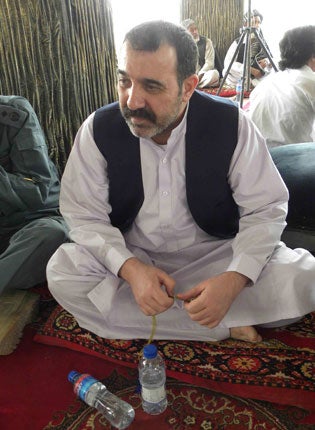
Ahmed Wali Karzai has a letter to prove that he is not a drug trafficker with a private army who runs Kandahar in the manner of a Mafia don. "It has taken years to get this, but here it is, and it shows that these accusations against me are false, baseless," he declared.
The letter from the US Drugs Enforcement Agency gives an assurance, Mr Karzai told The Independent, that he is not the subject of narcotics investigations. It will be made public in Kabul at a press conference in the near future by his half-brother, the Afghan President. "Then, perhaps, all these stories, which are very hurtful, will stop. I have been accused of so many things that I have begun to forget them. The only thing I have not been accused of so far is prostitution."
Much of the vilification , maintains Mr Karzai, came from his political enemies in Afghanistan. He is bemused by what he considers to be hypocrisy by some Western officials. American and British intelligence, he points out, have had no compunction about seeking his help when acting against narcotics barons and the Taliban.
There are few people in Afghanistan more controversial that Ahmed Wali Karzai. His detractors claim that he is in the centre of a fiefdom of corruption, grabbing international contracts, wielding menacing power which frightens senior officials, while, at the same time, remaining untouchable because of his blood ties with the country's ruler and commercial ties with the CIA.
In a report last April, Carl Forsberg, of the Institute for the Study of War, stated that "Ahmed Wali Karzai's influence over Kandahar is the central obstacle to any of [Nato's] governance objectives. Mr Karzai is described as the leader of "a small, exclusive oligarchy devoted to its own enrichment... Wali Karzai's behaviour and waning popularity among local populations promote instability and provide space for the Taliban to exist."
Mr Karzai and his supporters reply that, despite a sustained barrage of allegations, he has never been charged, let alone convicted, of anything. The reports of his supposed crimes, they say, help to hide the good he is doing for the community and his steadfast struggle against the Taliban which has resulted in nine attempts on his life.
The actions of Mr Karzai, or AWK, as he is named in diplomatic and military documents, are of particular importance with the war entering a critical phase and Kandahar, his power base, the centre of international attention.
A major Nato offensive is under way to clear the birthplace of the Taliban and what happens here will have direct bearing on a key Nato summit on the Afghan mission in November. A month later General David Petraeus, the US commander of coalition forces, will present his assessment of the campaign and possible timeline for withdrawal of forces to Barack Obama.
Ahmed Wali Karzai is by far the most powerful member of the Kandahar provincial council, which he chairs. His influence is expected to grow even further after the results of last week's parliamentary elections come in with a slate of 12 men and three women, backed by him, all getting seats. The Karzais' tribe, the Popalzai, is one of the largest in the south and he has played a leading role in keeping its young men from joining the Taliban. In a sign of the extent of his influence, he was recently invited to the headquarters of Nato's Regional Command South. "It was the first time I have been there. Some of the officers said they were surprised it had taken so long," he said.
But the President's 48-year-old younger brother remains a conundrum. "My sense is that he is either a candidate for an Oscar or that he is the most maligned man in Afghanistan," says Major-General Nick Carter, the British commander of Nato forces in southern Afghanistan. "He tells me he would far rather be watching Chelsea win the double [the Premier League and the FA Cup] than wasting his time trying to settle disputes at his house in south-western Kandahar. I believe that in many ways he is actually a positive influence."
Brigadier General Frederick "Ben" Hodges of the US Army agrees. "He is a controversial character," he says. "But, and I don't want to sound like an apologist, he has done some good things as well. The thing to do is to keep the spotlight on him and see what happens. At the same time, we should be spreading around contracts to make sure that the same group of individuals do not keep getting them."
Others in the military have taken a different view. Mr Karzai's name, according to Western sources, was put on Nato's "kill or capture list" by a senior US officer, leading to outrage from Hamid Karzai when he found out. The President demanded from the Western powers what proof they had of his brother's wrongdoings and why they were trying to undermine him.
President Karzai has himself had his troubles with his international sponsors over claims that he won his last election fraudulently, and acquiesced to systemic corruption among his political allies and members of his family. In Obama's Wars, Bob Woodward of The Washington Post says US officials believe that the Afghan leader is getting medication because of depression.
"I speak to the President three or four times a week mainly to discuss the situation in Kandahar," said Ahmed Wali. "Of course what is being written about in the book is not nice. If they think he is suffering from mental problems then they should say this to his face, but they never have said this. We think it is a matter of different cultures. In American and Britain you have people [in public life] leaking things, sometimes false things, about each other. This is not the culture here, and, of course, the President feels let down."
Diplomats wonder why President Karzai sticks by his prodigal brother with all the baggage that entails. One simple answer is that AWK delivered the vote in the south to him in last year's presidential elections – polls which were tainted in the region, as elsewhere in the country, by widespread fraud. But the two men are also said to be emotionally close.
"Just think, a father assassinated, becoming a target of the Taliban, al-Qa'ida, the ISI (Pakistani secret police) – it is a very uncertain existence," said Jawad Nasruddin, a political analyst." The more Western leaders attack President Karzai, the more he will turn to his brother and others he feels he can trust. They have had a hard and painful common experience."
Ahmed Wali Karzai is adamant. "The attacks against me are a way of attacking the President. I have always said 'Come and investigate me.' I am not stopping them. Did you see any tanks, artillery outside?"
In fact there is little overt security apart from a couple of checkpoints outside Mr Karzai's large but un-ostentatious house, 15 minutes' drive from one of the main Nato bases in Kandahar city. A hallway downstairs is filled with around 50 men from his Popolzai tribe, who have come, individually or in delegations, to petition him to settle disputes, secure jobs and, in a few cases, get members of the family out of prison. A portrait of Abdul Ahad Karzai, the father of Ahmed Wali and Hamid, hangs from the wall. A respected tribal elder, he was gunned down in Pakistan for speaking out against the Taliban.
Upstairs, wearing a plain blue salwar kamiz and black waistcoat, Mr Karzai, who spent years in America running an Afghan restaurant, speaks in fluent English, and gives his rebuttal to the charges against him. "My lawyer in the States have been asking for a long time for the DEA to reveal what exactly they have got on me [on narcotics dealing]. They have now said there is nothing and I am not part of an inquiry," he said.
"Sure I have been involved with drugs. In 2002 I was working here with American and British special forces giving them information which allowed them to carry out busts. The British used to organise flights so that I could go up to Kabul. There must be records of that somewhere.
"As far as the CIA are concerned, I have never signed anything. But of course I have given them information just as I have given the British intelligence information. Don't forget my family have been fighting the Taliban for a long time before Nato got involved. It was my duty as an Afghan to share information with the CIA and others." As he speaks, he jabs his finger in the air. "The only people who would have benefited if I had not done so would have been the Taliban and those in our neighbouring country who support them. That is why they have tried to kill me nine times – more than anyone else. But that is not going to stop me."
Mr Karzai does wish, however, that he and his family could have a break from Afghanistan. For him, the opportunity to watch Chelsea play in the English Premier League would be a welcome distraction. "I have been supporting them for almost 18 years. I do not know why people choose certain football teams, but I chose Chelsea. I particularly like Frank Lampard and John Terry: they are among the best in the world in their positions. It was fantastic when they won the double, we had a big feast."
Even his love of the beautiful game, though, is overshadowed by the position he finds himself in. "I wish it would be properly established in Afghanistan one day and that I could help," he explains. "But in the meantime I have to deal with other things."
The other things include the continuing corruption claims. An MP in Kabul said: "He is making millions from the international contracts and providing security for Isaf [the International Security Assistance Force] convoys. These are just the so-called legitimate earnings. It is not healthy to ask about his other activities but nothing goes on in Kandahar without his knowledge."
And yet you would not know it from a tour of the city. In the cafés of Kandahar, bringing up his name makes people uneasy. Some simply refuse to discuss him. There is consensus that he has made a fortune and much of that has been through illegal means. Even the few brave souls willing to talk, however, cannot provide verifiable details of the graft.
Yet at a classified meeting six months ago at the Isaf headquarters, General Stanley McChrystal, the then Nato commander, was given a dossier on Ahmed Wali Karzai's malpractice by officers who wanted him removed. In the event the evidence was so poor, according to those present, that the General said that Nato needs to co-operate with AWK rather than undermine him.
So what does the future hold? "I will continue to do my duty whatever people say about me," said Mr Karzai. "Afghanistan is winning this war against the Taliban and the insurgency will be defeated. We want politicians in the West to show just a little patience. The campaigns are now being led by Afghan security forces; we just need some support."
He has his eye on the Premier League, as well – which may even provide lessons for his own position near the top of Afghan life. "Chelsea shall win the championship, maybe they will also win the European Cup at last," he insists. "But they must not get complacent; they must watch out for Manchester United and Arsenal. One must keep an eye on rivals and deal with them."
Join our commenting forum
Join thought-provoking conversations, follow other Independent readers and see their replies
Comments