An artist's struggle for justice in China
Beaten to within an inch of his life, Ai Weiwei is still defiant.
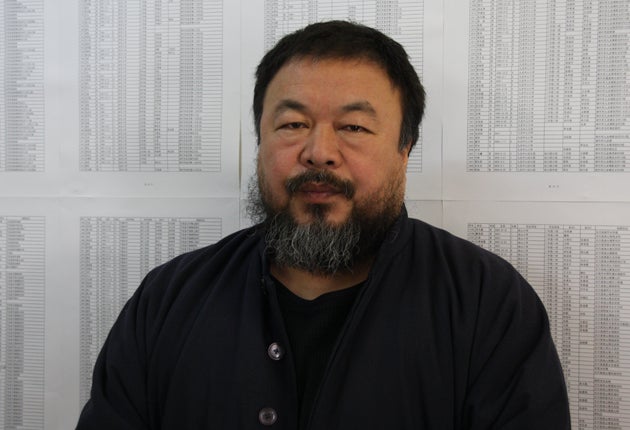
When you walk in to Ai Weiwei's studio in Beijing's Chuangyi art district, your eye is immediately drawn to the rows of A4 paper that make up a large rectangle on one wall. Each of these sheets of paper bears a set of names. There are 5,250 in total. They are the children who perished in the Sichuan earthquake two years ago.
It is a typically uncompromising statement from an artist and activist as well known for his criticism of the Communist Party as he is for his design work on the famous Bird's Nest Olympic stadium. And if Ai Weiwei does not take care, his political outspokenness may well land him in hot water – a prospect he views with equanimity.
But for today at least, Mr Ai's thoughts are not on Sichuan, or his own fate. Today he is worried about his neighbours. Artists themselves, they have just been attacked by thugs trying to force them out of their studios to make way for real-estate developments.
"Several were hit and injured, it was very bloody. They came to me to ask advice," said Mr Ai.
The artists decided to march on Tiananmen Square, site of the massacre of pro-democracy demonstrators in June 1989. They didn't get very far, but a point was made. "The decision was made to demolish this art base to obtain more land for the local government to sell – the government grabbed the land," said Mr Ai.
He attracts so much attention from people with grievances and complaints that you wonder how long his constant barrage of criticism will be tolerated. Other outspoken critics such as Hu Jia and Liu Xiaobo are already in jail.
"I've been doing too much, I realise this. It's a pity I've become this figure. Every time I say I shouldn't do so much because I'm putting myself in an awkward position but life's not like that. I'm not scared to be in jail, I'd just have to deal with it," he said.
His credentials are impeccable, a true cultural blue-blood. He is the son of the poet Ai Qing, who was denounced during the Cultural Revolution and packed off to a labour camp in Xinjiang with his wife, Gao Ying. Ai Weiwei himself spent five years there. His wife, Lu Qing, is also an important artist, and he attended the Beijing Film Academy with top film-makers Chen Kaige and Zhang Yimou.
But like his parents, his cultural standing has not kept him out of trouble. He has repeatedly placed himself into opposition with the government, a dangerous position in a single-party state. And his disdain for the powers-that-be shows no sign of abating. "The character of the Chinese government has changed to non-lawful, not using legal process, just for profit," he said. "It's a government with no ideology or vision. It's just about how to survive."
The paper on his wall is perhaps a symbol of that anger. In December 2008, Mr Ai started an investigation into the children who died in the Sichuan earthquake. The project was supported initially, but after researchers started asking why there were so many dead in some schools and not in others, things began to get awkward.
Police burst in to his hotel room in Chengdu at 3am on 12 August and beat him up so badly that surgeons in Munich later had to drill two holes in his head to remove 30ml of fluid from his skull.
"I almost got killed," he says now. "If it had been any more serious, I wouldn't be here. The point is if you want to make a point you are in danger. Whoever comes to this point will be crushed."
His colleague Tan Zuoren was jailed for five years for his work in helping compile data about earthquake victims.
"Tan was willing to take jail – someone has to do it. The real loser is the government. I feel sorrow to say it. China has no independent judicial system – everything is under Party control. It's all wrong because of the Party," he said.
Asked if he thinks Western governments do enough to confront China on rights issues, he said the situation was a bit like living next door to someone who is beating up their children.
"It's not your problem," he said. But ultimately the conscience will prevail. He hopes the same thing will happen to foreign countries that put business first.
"I think they will feel sorry, they will think about the people who work here, and what kind of society they are building up. Google did a good thing," he said, referring to the web giant's threat to quit China over cyber-assaults on dissidents' email and censorship.
"They made a statement. Making a statement is important to show you are not just an animal of profit making."
And Mr Ai, whatever else he is, is certainly a maker of bold statements. Asked about who inspires him, he says: "Me! Myself. I try to communicate with others and inspire people. The Dalai Lama is inspiring," he said.
Is Ai Weiwei an artist or an activist?
"Everything is art. Everything is politics. You can call it art or non-art, I don't give a damn," he said.
Join our commenting forum
Join thought-provoking conversations, follow other Independent readers and see their replies
Comments
Bookmark popover
Removed from bookmarks