Army launches investigation: Corrupt Afghans stealing millions from aid funds
Money that is supposed to help impoverished civilians and farmers is ending up in the hands of the Taliban, drug lords and profiteers
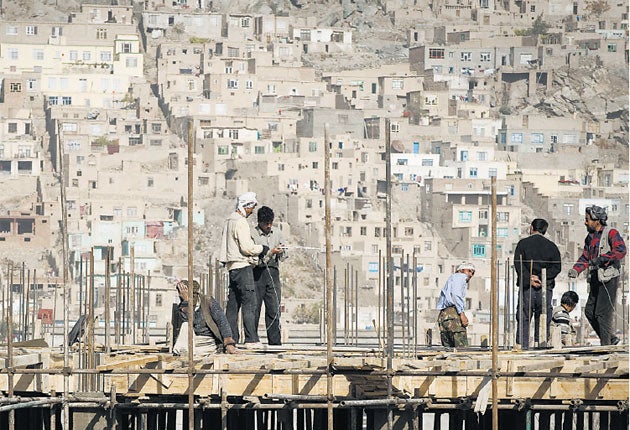
A major investigation has been launched into contracts awarded by coalition forces in Afghanistan that are worth hundreds of millions of pounds. The probe into construction and logistics contracts of the International Security Assistance Force (Isaf) has been ordered by Major General Nick Carter, commander of Isaf forces in the south of the country.
It is prompted by mounting concerns that the very money supposed to win over the hearts and minds of Afghans is ending up in the hands of the Taliban, drug lords or profiteers.
The British commander's concern is part of a wider crackdown on corruption, with General Stanley McChrystal having declared war on those making millions out of what has become a billion-dollar black hole for aid funds, in an anti-corruption directive issued last month.
A third of the costs of supplying the armed forces in Afghanistan is spent on paying protection, bribery and safe passage fees, and everybody is complicit, claim Afghan experts, who spoke under condition of anonymity.
Trucks pay a "Taliban tax" of up to $1,500 each time they venture out from Karachi to Camp Bastion. And millions are being made by a clique around Afghanistan's President, Hamid Karzai, many of whom have interests in transportation and private security.
Members of prominent Afghan families, including Hashmat and Ahmed Wali Karzai, brothers of President Karzai, and Hamed Wardak, the son of the Defence Minister, Rahim Wardak, are among those accused of controlling private security firms benefiting from lucrative security contracts by paying off the Taliban.
Up to $600m of aid for reconstruction projects goes on security each year, according to Afghan government sources. The US Congress is investigating allegations of a massive protection racket in which private security companies paid to protect routes for coalition forces are involved in paying off local warlords and the Taliban.
It is not just Afghan firms that are causing concern. The US Defence Secretary, Robert Gates, is to review allegations of misconduct in Afghanistan by the private security firm formerly known as Blackwater. The company is mired in allegations that it has previously misappropriated government weapons and hired people with violent backgrounds.
As little as a quarter of the aid money pumped into the country actually stays in Afghanistan, according to aid organisations in Afghanistan. Of the money that is spent on aid, about a third goes on bribes and protection money, claims Sayed Javed, president of the NGO Kabul Group Consulting.
Mohammad Hashim, from Integrity Watch Afghanistan, a Kabul-based NGO, claimed: "There is a huge corruption within Helmand province where the Afghan and international forces are fighting against Taliban. The reconstruction and most of the aid project has been conducted by the governor's own companies which are ultimately involved in corruption and futility. This governor is supported by central government."
Isaf would not comment on details of the investigation but a spokesman said: "Isaf is aware of allegations that procurement funds may find their way into the hands of insurgent groups, but we do not directly support or condone this activity." He added that relationships between contractors and subcontractors "are not entirely transparent".
But it is not just military contracts that are affected. One of Britain's flagship projects to encourage Afghan farmers to switch from growing opium to wheat is in crisis. The £13m Helmand Alternative Livelihoods Programme, run by the British-led Provincial Reconstruction Team, was supposed to get better quality seed to farmers in time for the growing season. But there have been at 12 arrested in Afghanistan amid accusations of widespread corruption in recent months, including allegations of people pocketing cash by giving farmers cheap seeds. Some seed came in sacks containing rocks to falsify the weight.
It is just one example of the corruption that has dogged Afghanistan's repeated attempts to drag itself out war. A wave of aid into Afghanistan has fuelled corruption, according to Dr Stuart Gordon, senior research fellow at the Royal Military Academy Sandhurst. "There has been this tsunami wave of money flushing around the system without it being adequately targeted," he said. "The result has been that the opportunities for corruption have been significantly higher than they needed to have been and it has fuelled militia groups and individuals who are in government positions who are widely seen as corrupt."
Widespread corruption is undermining the confidence of the Afghan people in their government and boosting the insurgency, according to a recent report by the UN Office on Drugs and Crime. It states that some £2.5bn was paid in bribes last year alone and, in a damning indictment of the corruption within the Afghan government, states: "As the de facto government in some areas, the Taliban's system of taxation and 'shadow' tribunals also provides the only form of criminal justice and security."
Despite billions spent on aid since 2001, Afghanistan remains one of the most corrupt and poorest countries in the world, with an economy underpinned by the illegal drugs trade.
It is suspected that much of the country's drug money is being sent to Dubai, a base for many wealthy Afghans. Last week it emerged that more than $1bn a year in cash is being flown out to the Gulf state. Earlier this year, US officials witnessed an Afghan man en route to Dubai with three briefcases stuffed with $5m. Days later, the same man made a repeat trip with a similar amount of cash.
The size of the problem first became apparent when the British company Global Strategies Group, which has an airport security contract, started filing reports on the money transfers at the request of Afghanistan's National Directorate of Security in 2009. But it is understood that complaints from the country's notoriously corrupt police force saw an end to this reporting last September.
The issue of corruption goes to the heart of the conflict, claims Matt Waldman of Harvard University's Center for Human Rights. He accused the Afghan government of playing a part in "perpetuating and exacerbating the conflict through exclusionary polices... through conduct which is actually predatory rather than serving the people".
Join our commenting forum
Join thought-provoking conversations, follow other Independent readers and see their replies
Comments