Army saves Afghan boy stricken with tetanus
Father praises 'fantastic' efforts of military doctors and nurses at Camp Bastion

For free real time breaking news alerts sent straight to your inbox sign up to our breaking news emails
Sign up to our free breaking news emails
The six-year-old boy was in severe pain, his body wracked with muscular spasms and running a "burning high" temperature. The medics at the remote American patrol base in the wilds of southern Afghanistan were not sure what he was suffering from, and his chances of survival were rated at no more than 10 per cent.
Rahmadullah was airlifted to the British-run hospital at Camp Bastion in Helmand with his condition deteriorating rapidly. He had contracted pneumonia and was lapsing in and out of consciousness. After extensive tests, doctors diagnosed that he had been infected with tetanus, a disease very rare in the West but still lethal in poorer countries.
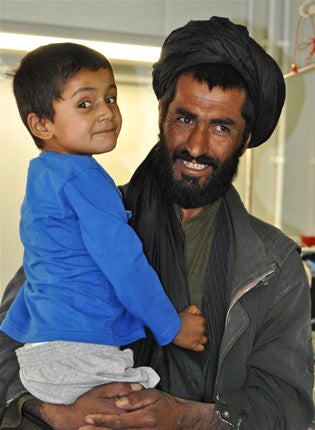
The treatment Rahmadullah received saved his life and he is now back at his home, south of Garmsir in Helmand near the Pakistani border. His father Neknazar, a farmer, who had carried his son in the desperate journey to the patrol base and then on to Bastion, said: "I saw my son getting weaker and coughing. I took him to local Afghan doctors and they could not do anything, and anyway I had no more money to spend on them. Then we went to the base where they told me just how ill he was.
"My son is happy now. The doctors and nurses have been fantastic. My son would have died if I had not brought him here, so, of course, I am very pleased."
The tetanus had developed from a small cut in Rahmadullah's foot which had became infected. There is no vaccination programme currently operating in Afghanistan.
Rahmadullah needed prolonged medical care, and his father had to return to gather the harvest at his farm. The boy was lonely, he said, but slowly began to build up a rapport with the staff and soon developed a great liking for bourbon biscuits and watching cartoons on the television. Coming from a landlocked country, he found the film Finding Nemo particularly fascinating, but was frightened by the sharks.
Major Sue Snaith, a reservist who is a specialist paediatric oncology nurse at London's Great Ormond Street Hospital, said: "Rahmadullah has been one of our miracles. At first we were unsure what we were treating, because none of us had ever come across tetanus before in our clinical careers. For a while he would get better then regress – it was a real rollercoaster. He eventually woke up and made a good recovery.
"Considering Rahmadullah was in a totally alien environment surrounded by people who do not speak his language, and being away from home, he coped very well. I can imagine the children I normally work with at Great Ormond Street would have been terrified if they were in his situation.
"His father had to return to his farm after a few days. When Rahmadullah began to get better, he would call for his dad all the time. To keep him occupied I would push him around outside the hospital in a wheelchair. It has been really rewarding for the staff to see him get better, knowing he would not have survived in his own healthcare system."
Lieutenant Colonel Andy Johnston, a physician with the Royal Army Medical Corps, said: "Rahmadullah had to be put on a ventilator for two weeks, he was extremely unwell. If it had not been for the medical staff and the intensive care unit at Bastion, he would have died."
Although there are no immunisation programmes against tetanus in Afghanistan at the moment, they have been carried out in the past. There was, however, opposition to vaccination from some Muslim clerics, and the Taliban attacked health facilities and abducted medical staff. Mohammed Aziz, an official with the Afghan health ministry, said: "We had a tetanus and measles campaign in southern Afghanistan [where the Taliban are particularly active] but less than 50 per cent of eligible mothers came forward.
"Women in traditional areas do not want to appear in front of male doctors, and we simply do not have enough female vaccinators. It is often not safe to take part in these schemes – the insurgents have kidnapped doctors and nurses. We had some ill-informed religious leaders who have said such vaccinations are against Islam, which is plainly the wrong interpretation of our religion."
Subscribe to Independent Premium to bookmark this article
Want to bookmark your favourite articles and stories to read or reference later? Start your Independent Premium subscription today.
Join our commenting forum
Join thought-provoking conversations, follow other Independent readers and see their replies