Army to be sued for war crimes over its role in Fallujah attacks
Parents of children with birth defects say Britain knew of US chemical weapons use
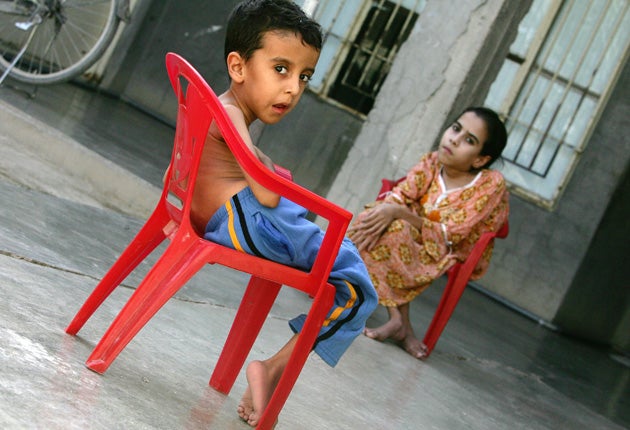
Allegations that Britain was complicit in the use of chemical weapons linked to an upsurge in child deformity cases in Iraq, are being investigated by the Ministry of Defence.
The case raises serious questions about the UK's role in the American-led offensive against the city of Fallujah in the autumn of 2004 where hundreds of Iraqis died. After the battle, in which it is alleged that a range of illegal weaponry was used, evidence has emerged of large numbers of children being born with severe birth defects.
Iraqi families who believe their children's deformities are caused by the deployment of the weapons have now begun legal proceedings against the UK Government. They accuse the UK Government of breaching international law, war crimes and failing to intervene to prevent a war crime.
Lawyers for the Iraqis have sent a letter before action to the MoD asking the Government to disclose what it knows about the Army's role in the offensive, the presence of prohibited weapons and the legal advice given to Tony Blair, Prime Minister at the time.
Legal actions against America are blocked by US federal immunity laws and the US government's boycott of the International Criminal Court.
The offensive against Fallujah, codenamed Phantom Fury, in 2004 was described as the most bitter fighting experienced by American soldiers since the war in Vietnam. But US forces were assisted by British units.
On 21 October, British soldiers were ordered by the Cabinet to help US forces throw a "ring of steel" around Fallujah. Six days later, a British battle group of 850 troops made up of the armoured infantry from the 1st Battalion, The Black Watch, an armoured reconnaissance squadron from the Queen's Dragoon Guards, elements of 40 Commando Royal Marines and supporting specialists including Royal Engineers and Royal Military Police were redeployed from Basra.
The battle group established a base at Camp Dogwood on the eastern approach to Fallujah where they provided essential aid and assistance to the subsequent attacks on the city.
Before the attack the former Attorney General, Lord Goldsmith is alleged to have warned Mr Blair about the legal dangers of committing British forces to the attack.
Public Interest Lawyers, the law firm representing the Iraqi families, wants the Government to release this advice in full and say whether any British soldiers were involved in the fighting or supplied or helped fire prohibited weapons. During the attack coalition forces are alleged to have used weapons including white phosphorus, a modern form of napalm, and depleted uranium.
The World Health Organisation, after reports first broadcast by Sky News two years ago, has begun investigating evidence of a worrying rise in the incidence of birth defects in the city, which Iraqi doctors attribute to the use of chemical weapons during the battle.
Malak Hamdan, a British Iraqi researcher working with doctors in Fallujah, told The Independent: "Doctors in Fallujah are witnessing unprecedented numbers of birth defects, miscarriages and cancer cases. Now, according to gynaecologists, paediatricians and neurologists in Fallujah, the numbers of these cases have been increasing rapidly since 2005."
She explained that the most common birth defects involve the heart and the nervous system but there have also been reported cases of babies being born with two heads, upper and lower limb defects and eye abnormalities.
"What is more disturbing is that pregnant women are completely unaware that they are carrying an abnormal child until the day they give birth – traumatising the mother and the rest of the family," said Ms Malak.
Mazin Younis, a UK-based Iraqi human rights activist who visited the city before the attack, said: "When I visited Fallujah a few weeks before the attack, I was shocked to see the majority of people had not left the city. Many of them had no one to go to.... We attacked this city ruthlessly without any concern for the fate of tens of thousands of civilians who were still living there. The unlawful use of white phosphorus in built-up areas was... never objected to by the British Government who assisted in the attack on Fallujah."
Phil Shiner, the UK lawyer leading the legal challenge, said: "The rate and severity of both foetal abnormalities and inexplicable illnesses such as leukaemia or those suffered by our clients in infants born to mothers in Fallujah has been the subject of numerous reports and letters to governments.... The full extent of the emerging public health crisis is unknown.... Doctors report a "massive, unprecedented number" of congenital health problems. The media investigation found that the incidence of birth defects in Fallujah has reached a rate 13 times higher than in Europe."
An MoD spokeswoman said: "We can confirm that we are in receipt of this letter from Public Interest Lawyers and will respond in due course. The MoD treats issues such as this very seriously but allegations must not be taken as fact."
Join our commenting forum
Join thought-provoking conversations, follow other Independent readers and see their replies
Comments