Battle begins to win over Taliban to Karzai's court
Cautious interest as Afghan government seeks to draw all parties to the table
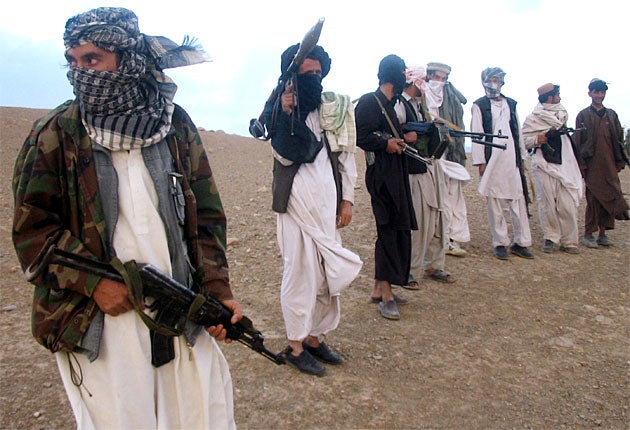
The Taliban fighter sitting in the front of the car was expressive, engaging, and dismissive of Afghan President Hamid Karzai's pleas for men like him to lay down their guns. Omar Khel, a tribal militant from Wardak province outside Kabul, is exactly the kind of reluctant rebel the Afghan government and the international community want to bring in from the cold.
"I am not in favour of fighting," Mr Khel, a chubby man with strong features and grey-flecked hair, said. "I don't have enmity with the Americans. I have enmity with Fahim, with Khalili, with Dostum. We are fighting them." He had named the three most notorious warlords in the new Afghan government.
Mr Khel's views are not representative of all insurgents, but they do illustrate one of the problems Mr Karzai's "big tent" style of government creates: the inclusion of some individuals inevitably alienates others. And unfortunately for the architects of the reintegration and reconciliation programme outlined in London last week, other insurgents may be harder to woo.
Abdul Rahmad, a Taliban commander from the volatile southern province of Kandahar, told The Independent that he was ready to enter peace talks with Mr Karzai, but only if the existing Taliban demands are met. These include the withdrawal of the foreign troops supporting the fragile Afghan government, and changes to the constitution implementing sharia law as interpreted by the Islamists. Although he admitted that the insurgents included "bad and corrupt people", he said he would fight on because "We have no sharia law, no sharia justice."
It is possible he was being disingenuous: the insurgents have little to gain by publicly agreeing to talks and would actually weaken their position by appearing ready to consider peace. Their strongest hand is running down the clock on the international community.
Acknowledging as much in an interview with The New York Times, the Afghan official in charge of reconciliation said the government had been discussing ways of ending the war with the Taliban for some time. Mohammad Massoum Stanikzai said Taliban denials of talks were a PR strategy. "They are continuing to say this, it's something they say in the media, but this is not a fact," he said.
And although past efforts at reintegrating rebel fighters have lacked the political will, resources or organisation to succeed there is a sense of optimism among Western diplomats in Kabul that last week's conference in London has changed this. One said: "What's different is that for the first time you have the infrastructure to not only make promises and agreements but to follow through and make sure they're enforced."
Against this are a series of challenges that Afghan and international officials are just beginning to address with specific proposals. One difficulty is ensuring incentives offered to genuine fighters are not seen by others as reason to become temporary insurgents. Sorting bona fide insurgents from opportunists will be hard for an intelligence community recently lambasted by Major-General Michael Flynn, US and Nato deputy chief of staff for intelligence in Afghanistan, as ignorant of the Afghan people.
Another concern is that reconciliation with the senior Taliban leadership can proceed only after offensives, beginning with the imminent assault on the insurgent stronghold of Marja in Helmand, start rolling the enemy back.
And women's rights groups and non-Pashtun ethnic groups opposed to the predominantly Pashtun Taliban have to be persuaded they are safe working with their traditional foes. A Western diplomat said these "different groups are looking at reconciliation-reintegration policy with great concern".
Yesterday Mr Karzai arrived in Saudi Arabia to seek help in drawing Taliban representatives to a loya jirga peace council. Saudi was among three countries to recognise the Taliban when it was in power.
The names of Taliban interviewees have been changed to protect their identities
Join our commenting forum
Join thought-provoking conversations, follow other Independent readers and see their replies
Comments