Botched attack by Nato kills 27 civilians
Karzai calls deaths 'unjustifiable' as airstrike heaps new pressure on alliance after Dutch exit
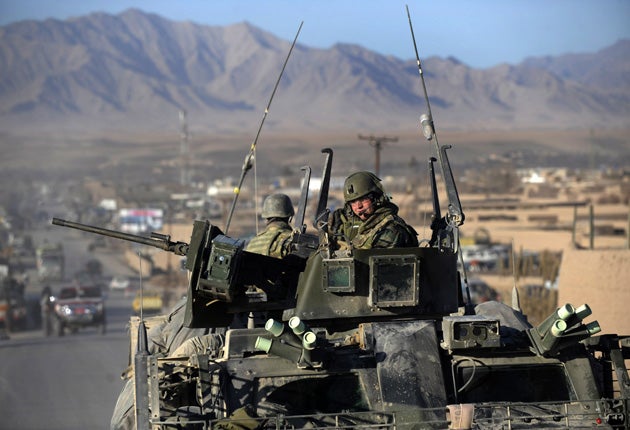
A bungled airstrike in Afghanistan has dealt Nato's effort to woo hearts and minds the third such blow in a week, with Kabul claiming the bombing killed 27 civilians, including women and children. Officials in the Afghan government said Nato planes attacked a convoy of three minibuses carrying 42 people, all civilians, in the mountainous province of Uruzgan on Sunday night, after mistaking them for Taliban insurgents preparing to attack Nato troops.
President Hamid Karzai's cabinet condemned "the repeated killing of civilians by Nato forces" as "unjustifiable" and urged the coalition to "closely co-ordinate and exercise maximum care before conducting any military operation" to avoid further civilian casualties.
The mistake, the deadliest attack on civilians by Nato forces in six months, is an embarrassment for the alliance's commander General Stanley McChrystal, whose revamped counter-insurgency campaign is built on protecting civilians rather than killing fighters.
Uruzgan is also the Afghan province where Dutch forces in the Nato mission are operating. The carnage came just a day after the fall of the Dutch government over a military mission which is deeply unpopular in the Netherlands. The Dutch political crisis and the fracturing of Nato unity threatens the transatlantic alliance with the loss of 1,600 troops by the end of the year and opens the prospect of other nervous US allies such as Canada, Australia and Germany also pulling out.
With three botched airstrikes in seven days, the emotive issue of civilian casualties is also threatening to overshadow Operation Moshtarak, the Nato offensive underway in Helmand and the highest profile example of the new strategy to date.
Sixteen civilians have been killed in central Helmand since the offensive started and the Uruzgan airstrikes, even though they are unrelated to the offensive, are undermining Nato's claim that it is taking extreme care to protect civilians.
At the same time they are exacerbating tensions between the Afghan government and its foreign backers.
General McChrystal apologised to Mr Karzai at the presidential palace and pledged that Nato would take part in a joint investigation of what had happened. He issued a public apology as well, saying: "We are extremely saddened by the tragic loss of innocent lives. I have made it clear to our forces that we are here to protect the Afghan people, and inadvertently killing or injuring civilians undermines their trust and confidence in our mission. We will re-double our efforts to regain that trust."
Since assuming control of Nato's Afghanistan mission last year, General McChrystal has introduced stricter rules limiting the use of airstrikes and slashing the number of Afghans killed by foreign forces.
The latest incident followed one last Thursday when, according to Nato, a patrol in the northern province of Kunduz came under fire. "The unit requested close air support, which dropped ordnance in support of the troops in contact," Nato reported. Later, it said, it discovered "that several Afghan police were killed and wounded in this operation".
Three days before that, an airstrike killed five civilians in Kandahar province after a "patrol observed the individuals digging along a path, and believed that the individuals were emplacing an IED [improvised explosive device]".
Addressing parliament, Mr Karzai warned that "we need to reach the point where there are no civilian casualties. Our effort and our criticism will continue until we reach that goal."
Yet at the same time as admonishing his allies, Mr Karzai has horrified them by unilaterally removing the statutory three foreign members from an anti-fraud watchdog that stripped him of almost a million votes during last year's election fiasco.
As The Independent reported last week, Mr Karzai also wants to limit the number of women parliamentarians and raise the barriers to running for office. None of this will please his Western backers, whose counter-insurgency campaign is based on the idea of alienating Taliban militants from the population by ushering in accountable, competent government.
Join our commenting forum
Join thought-provoking conversations, follow other Independent readers and see their replies
Comments
Bookmark popover
Removed from bookmarks