Burma's generals allow envoys to meet Suu Kyi
Jailed opposition leader discusses sanctions imposed by Western nations
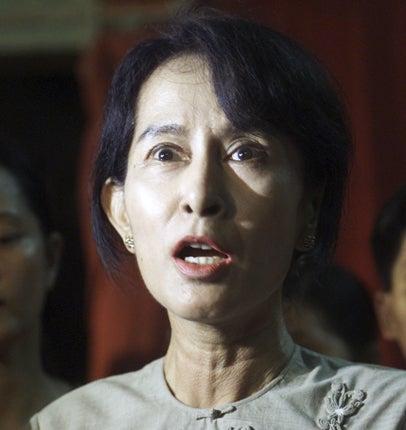
The imprisoned Burmese opposition leader Aung San Suu Kyi met foreign diplomats yesterday after the military junta gave her permission to discuss sanctions against her country.
Ms Suu Kyi, who has spent 14 of the past 20 years under some form of detention, was driven to a government guest house near her home where she spent an hour with diplomats from Britain, Australia and the US.
Speaking last night from Rangoon, the British ambassador Andrew Heyn, said he believed the leader of the National League for Democracy had treated the meeting as a "fact-finding mission". He added that Ms Suu Kyi said she had not yet formulated a policy either in support or against sanctions as she had not had the opportunity to gather all the relevant information.
"We met for an hour and it was very tightly focused on the issue of sanctions. It was very clear that this was a fact-finding mission. She wanted to know the details of the sanctions and how they had evolved," said Mr Heyn, who represented EU ambassadors at the meeting that was attended by the deputy heads of mission from the US and Australia. "She had not yet fixed a position."
Such a view appeared to contradict a letter that Ms Suu Kyi sent to the country's senior general, Than Shwe, two weeks ago in which she asked for permission to meet diplomats in order to discuss the issue of sanctions. In that letter, she wrote: "In order to work effectively for having the sanctions on Myanmar lifted, I need to understand the sanctions imposed on Myanmar, how much the country has suffered ... and the attitudes of the countries that imposed these sanctions."
The United States imposed sanctions in 1988 when the army that has ruled Burma since a coup in 1962 crushed pro-democracy demonstrations, killing up to 6,000. Sanctions were imposed by the European Union in 1996, and were tightened after the regime's brutal crackdown on demonstrations in September 2007, when around 100,000 Buddhist monks and ordinary people marched through the country's biggest cities.
Australia has visa restrictions on the regime and a ban on defence exports.
The military junta, known as the State Peace and Development Council, would like sanctions lifted and would particularly like to have closer relations with the US. Obtaining the backing of the imprisoned democracy leader in calling for the lifting of sanctions would represent a massive coup for the generals. As such, they probably believe they have everything to gain by allowing her to talk with the diplomats – the first such meeting with a British ambassador since 2003. It is unclear whether there will be further meetings with the diplomats.
After she wrote her letter to Than Shwe, the regime dispatched a minister, Aung Kyi, to meet the opposition leader. The pair have had two meetings, the most recent on Wednesday, which was also held at a government guest house.
In a statement, Australia's chargé d'affaires in Rangoon, Simon Starr, conveyed a message of support for Ms Suu Kyi's "struggle for democracy". "The message expressed the hope that her sacrifice would in time lead to a better Burma," it added.
Earlier this year the 64-year-old Nobel laureate was sentenced to a further 18 months' imprisonment after an uninvited American visitor swam to her lakeside home, allegedly breaching the conditions of her house arrest.
Most observers believe the charges brought against her were part of a policy to keep her detained until after an election planned for next year.
Join our commenting forum
Join thought-provoking conversations, follow other Independent readers and see their replies
Comments