Burmese music: Sound of the underground
When the junta banned traditional protest songs, its leading exponents chose a life of exile rather than fall silent. Andrew Buncombe meets them in Delhi
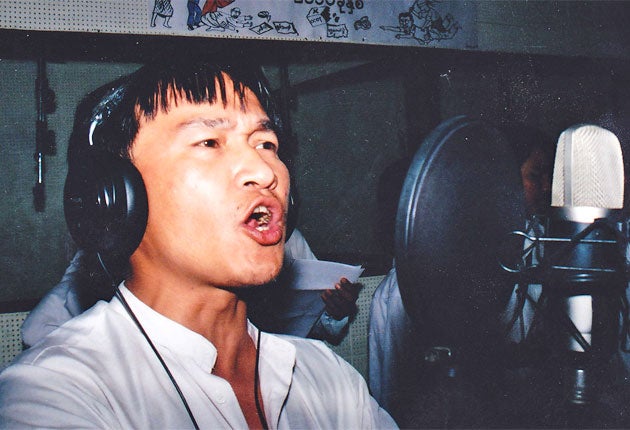
First comes the sound of hand drums, followed by a voice that is steady and persistent. As Ngwe Toe leans back and angles his words towards the microphone, his lines are met by a chanting group which takes up his theme and sings back at him, as a call and response.
"The religion in our country," sings Toe, as the group answers for him, "is Theravada Buddhism". The activist continues: "The colour saffron is growing everywhere."
The group responds: "The monks are very graceful, but now their power has been drained. They are hiding in the remote areas."
As the drums continue in a dreamy loop, Toe implores: "Tell me why." The chanters tell him: "The military devil is rising up."
This is a traditional Burmese protest song with a modern twist. For generations, the people of Burma marked their new year by performing Thangyat – songs and skits that gave voice to local grievances.
In 1988, the year in which the military authorities violently crushed a series of democracy demonstrations with the death of at least 3,000 people, the junta decided it had endured enough protest and banned the tradition, threatening jail for anyone who dared to disobey.
But the generals could not stop Thangyat, merely drive it overseas. Now, communities of exiled Burmese around the world put together their own collections of protest songs, which are sold on CDs and even broadcast back into Burma where residents listen secretly on their radios.
One of the most famous and popular groups, of which Ngwe Toe is a member, is based in the west of Delhi. Ahead of the traditional four-day new year celebrations, or water festival, which begins today, the activists recorded and released a new collection of songs, music and poetry entitled Gaining Victory for Us and Defeat for Them.
"During the festival, it is a tradition that if there is something the people do not like, it will be criticised – be it politics, social affairs or food," said Zin Naing, who escaped to India from Burma after the 1988 uprising and who helped produce the recording.
"Now, inside Burma, Thangyat is not allowed, so ours has become one of the only ones that people can get. We produce it on CD as well as cassettes, which are smuggled into Burma."
There are an estimated 6,000 Burmese exiles in Delhi, most of them from Chin state, on India's north-eastern border. Many of them took part in the 1988 uprisings and came to India, which at the time was critical of the military authorities and welcomed the refugees. Most have never dared to even visit their home country since.
Ngwe Toe, the 40-year-old lead singer, fled when he was just 19, leaving behind all his relatives. His father died in 2003, but he dreams of returning to the country with his wife and young son, and of being able to show his child to his mother.
In the meantime, he takes some measure of comfort from imagining his family furtively listening to the songs of protest that he and his friends have recorded. "It's like a rap," he said. "I say the first line and then the others respond with the second. It's a call and response, and when I am singing, I am shouting these slogans with emotion. I am very focused on the song. I would be happy if my mother hears it, and would then be able to give the message that her son is involved in the politics."
The lyrics for the song performed by Ngwe Toe were written by a Buddhist monk, forced to escape to India after taking part in the so-called Saffron Revolution of September 2007, when tens of thousands of monks and citizens took to the streets of Rangoon and other major cities, demanding democratic reforms.
The monk, U Dhamma, a smiling, round-faced 23-year-old, fled after he and several other monks from his monastery joined the demonstrations in the northern city of Mandalay. "I took part in the marches. I thought there would be a revolution. I believed in democratic rule for Burma," said the monk, who crossed into north-eastern India in January 2008 and now lives in the same dusty Delhi neighbourhood as many other exiles. "After the marches, I stayed at the monastery for some months, but then a minister came to give food. We were very angry and refused to accept this. The minister put pressure on the abbot to expel us, and the next day our names were put in the newspaper, saying that we were to be expelled. We had no chance to stay in Burma."
Those who wrote the collection of protest songs have had no shortage of material to inspire them over the past 12 months. Last year, the junta extended the house arrest of opposition leader Aung San Suu Kyi for 18 months, after she was convicted of breaching the terms of her detention when an uninvited US tourist swam to her lakeside home.
Then, last month, the regime announced new rules governing the controversial election due to be held later this year. The rules effectively bar Ms Suu Kyi from standing and say that her party, the National League for Democracy, (NLD), would have to oust her if it wished to field candidates. The NLD has announced it is boycotting the election.
It is not just the junta that comes in for criticism in the Thangyat. While the songs indeed condemn the regime's alleged nuclear ambitions, the election and the country's poverty, the NLD and even politicians in exile are also subjects of satire.
Such humour has long been a tradition of subtle dissent in Burma. One of the country's best-known comics, Zarganar, spent many years making barbed puns about the regime. Eventually, in 2008, the junta ran out of patience with him and seized on an interview he had given to the BBC criticising the authorities' response of the aftermath of Cyclone Nargis. He was jailed for 59 years, a sentence reduced to 35 on appeal.
Likewise, in Mandalay, members of a famous comic troupe known as the Moustache Brothers have been in and out of jail as a result of their performances making fun of the junta.
The Burmese exiles who put together the protest album remain confident that change can come. The song performed by Ngwe Toe says the monks will lead the transformation.
Its last lines, sung as call-and-response, conclude: "If the monks unite – the military becomes afraid. If the monks unite – the religion will be glowing. If the monks take to the front lines – we will escape from poverty. If the monks speak the truth – they will speak to the whole world."
Join our commenting forum
Join thought-provoking conversations, follow other Independent readers and see their replies
Comments