Can you really live on 42p a day? India needs to know the answer
Activists say poverty line is set low to save funds. Andrew Buncombe reports from Delhi
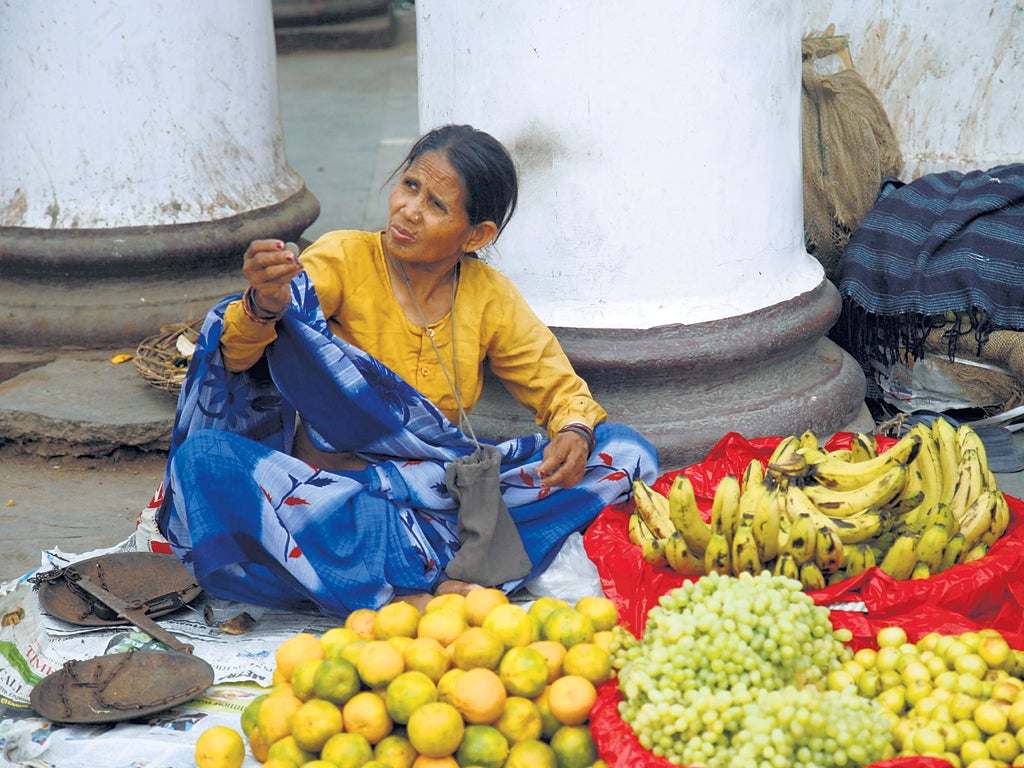
As he neatly halved oranges and fed them into a hand-operated juicer set upon a wooden cart, Ram Naresh pondered his own precise position within the multi-tiered Indian economy.
Some days, he confided, he made up to 200 to 250 rupees (£3.30) in straight profit and while he regularly sent money back home to his parents in the state of Uttar Pradesh, he did not yet have a wife or family to support. His rented room was located in what many would term a slum, but twice a week he could afford to eat more than just vegetables. "But I don't consider myself a poor man because I have enough to make ends meet," he said.
For millions of Indians, Mr Naresh would be considered comfortably off. But what exactly does it mean to be poor here? The Indian government has sparked an increasingly vexed debate by trying to fix the official poverty line at just 32 rupees (42 pence) a person per day in cities, and 26 rupees a day in rural areas. While remarkably low, this figure marked an increase on an earlier proposal by the government.
For Mr Naresh and his customers yesterday lunchtime in a neighbourhood of south Delhi, the government's suggestion that an individual can "adequately" get by on so little was laughable. Subash Basu, a driver employed by an international organisation, said: "I need at least 300 rupees, for myself, my wife and child. And that is not including rent, or education. What they are saying is just not possible."
In the 60 years since independence, India has failed to throw off the spectre of poverty and hunger. Today, amid all the talk of a new "Shining India" and a growth rate of more than 8 per cent, the truth is that hundreds of millions live lives of utter hardship. While there has been the highly publicised emergence of a small middle-class, India is failing to deliver to the vast bulk of its people on indicators such as malnutrition rates and maternal mortality.
The Washington-based International Food Policy Research Institute last year placed India 67 out of 88 countries listed in its global hunger index. It is not uncommon for local Indian newspapers to report people dying or being close to death from starvation.
The fixing of a poverty line is hugely important because it is used to determine who is eligible to receive items from a public distribution system which provides subsidised food and fuel for the poor. Those who have below poverty line (BPL) status are eligible for more. "This debate has a momentous bearing on the future of the distribution system, as well as on the proposed National Food Security Act," said Jean Dreze, a Belgian economist who has written widely on development and poverty in India.
Aside from scorn from the country's poor, the government's submission on the BPL drew an angry response from those involved in trying to ensure food security for the nation's still growing population of 1.2 billion people. In an open letter to Montek Singh Ahluwalia, deputy chairman of the planning commission which came up with the 32-rupee figure, activist Aruna Roy and other members of the Right to Food campaign urged him to withdraw his claim.
"The campaign challenges you and all the members of the commission to live on 25 or 32 rupees a day until such time that you are able to explain to the public in simple words the basis of the statement that this amount is normatively 'adequate'," they wrote. "If it cannot be explained then the affidavit should be withdrawn or else you should resign."
One of the challenges facing economists and politicians in India is that there is no single agreed measure of precisely how many people are living in poverty. According to the government, using its own measure, around a third of the population is living below the poverty line. But others suggest the percentage is much higher. In 2005, the World Bank suggested the global poverty line should stand at $1.25 (80p) a day. By that measure, many more Indians would be classified as living in poverty.
Meanwhile, in 2007 the National Commission for Enterprises in the Unorganised Sector, a government-sponsored study group, suggested that a remarkable 836 million Indians survived on 20 rupees day. When viewed like that, the government's claim that a family of five could get by on 4,824 rupees per month (which works out as 32 rupees a day) may not be so extraordinary.
What is certainly true is that people manage to somehow survive on tiny amounts of money. Ratan Lal Sharma, who makes deliveries using the same bicycle-cart he has owned for more than 25 years, estimated his daily wage as 150 rupees. The 54-year-old, who is married with four children, two of whom have married and left home, said he received a BPL ration card two decades ago. "There is no way a person can live on 30 rupees," he said. "If it had not been for the ration card we would have all starved to death."
Prahalad Singh, an activist and academic from the city of Jaipur, said that despite so many people being affected by poverty, most educated and middle-class Indians failed to be moved by the issue. "People are shocked but they don't want to do anything about it," he said. "There has been this recent campaign against corruption because that strikes a chord, but for doing away with poverty there is no such thing."
Belatedly, the government has had to backtrack on its proposal. Yesterday, Mr Ahluwalia and the Rural Development Minister, Jairam Ramesh, said that a new economic survey was currently underway, using a variety of measures, and that this would be used to decide who was eligible for subsidies.
The new Food Security Bill due to be introduced later this year will also extend the number of those eligible for help. "The allegation is being made that the... commission is trying to understate poverty," said Mr Ahluwalia. "This is simply not true."
The cost of living
26 Rupees (34 pence) a day – the poverty line recommended by the government for rural areas
29 Rupees (38 pence) – the cost of a litre of milk
32 Rupees (42 pence) – the suggested poverty line for cities
67 Rupees (88 pence) – the price of a litre of petrol
43,479 Rupees (£572) per year – the per capita income for 2009-10, according to Indian government figures
Join our commenting forum
Join thought-provoking conversations, follow other Independent readers and see their replies
Comments