Caught in the crossfire of war against the Taliban
Pakistan's military offensive has driven thousands of refugees to the frontier town of Dera Ismail Khan. Omar Waraich witnesses their plight
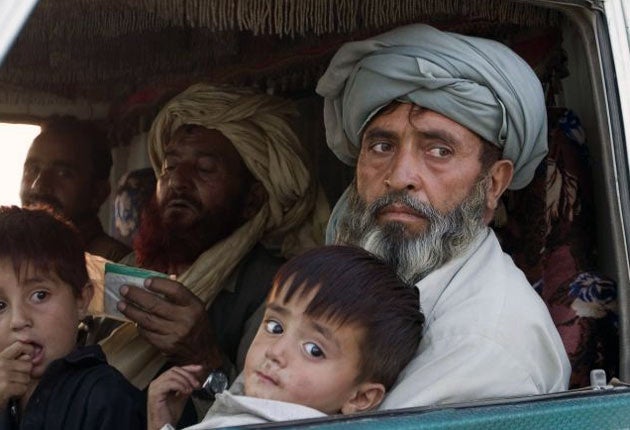
Gul Hassan is incandescent with rage. As the Pakistan military mounted its most ambitious anti-Taliban offensive yet, the farmer and his family were not ready. "Bombs were falling all around us," he recalls, gesturing animatedly. "We were very scared. We didn't know what was going to happen to us."
Soon after dawn, Mr Hassan and his extended family began a perilous three-day journey down from the militant-controlled mountains near Shakai in South Waziristan. After enduring hours of foot-slogging, all 33 members of the family somehow managed to pile into a single truck. Scenting opportunity, the driver charged £350, all the cash they could muster, for the journey.
Now, they are among more than 100,000 bedraggled refugees who have shambled their way down to this wild and dusty frontier town in the faint hope of finding comfort. As the army pushes deeper into South Waziristan, encountering fierce resistance from an estimated 10,000 Taliban guerrillas along the way, a fresh humanitarian crisis is slowly unfolding.
Outside a crowded registration centre on the edge of the town, rowdy clashes suddenly erupt. Angry tribesmen thrust towards the doors, waving fists in the air. The police reply with long bamboo shafts crashing down on their heads.
Aid workers have started registering new arrivals and issuing sanitation kits. But fresh supplies of food have yet to arrive. On Wednesday, registration forms ran out, forcing the centres to close down for three days. There are no plans to set up camps, so the refugees have no option but to settle down with families in the area.
Dera Ismail Khan is no stranger to an influx of Mehsud tribesmen. Each year in October, the snow-capped peaks of South Waziristan are abandoned for the warmer town in the plains. But as with the Swat refugee crisis earlier this year, tribal hospitality can exact a toll.
"My family here already has 12 people staying with them," fumes Mr Hassan. "Some are sleeping outside. There's electricity and water sometimes, but then sometimes not."
Up to 300,000 refugees from the Mehsud area of South Waziristan are expected to descend on this and other towns nearby. But not everyone welcomes their presence. Tensions are rising in what is at the best of times an ethnic and sectarian tinderbox.
"It changes the dynamic," says Faysal Ali Khan, head of Fida, the main refugee support group in the area. "Dera Ismail Khan is already cash-strapped, there is a shortage of schools and water. There is a lot of crime. Some of the locals are growing resentful. They say that troubles will follow the Mehsuds down from South Waziristan." Over the past 18 months, the town has seen a steep rise in sectarian attacks. Members of the Shia community have been repeatedly targeted. Billboards mourning their martyrs now hang in neighbourhoods as fortifications are being raised outside mosques braced for attack.
The army is taking no chances, either. Throughout the day, khaki- painted jeeps bristling with guns and mounted by camouflaged soldiers speed through the town. Nearby civilian cars sharply veer off to the side and judder to a halt. If the soldiers sense a threat, residents say, they will not hesitate to shoot.
As militants have crept into the town, its many prominent politicians have fled. Even Maulana Fazlur Rehman, the leader of Pakistan's largest Islamist party and once considered the "godfather of the Taliban" dares not return. And with good reason: in 2007 a Taliban rocket whistled into the top floor of his house.
The Sipah-e-Sahaba, an outlawed anti-Shia Punjabi terrorist group, has a heavy presence in the area. The traffic of young, impressionable madrassa recruits trekking up into the mountains for training went little noticed for years. But this month, as gunmen laid siege to the army's headquarters in Rawalpindi and security installations in Lahore, the Taliban's deep reach into Pakistan's heartland has been brutally driven home.
The Pakistan army command's calculation is that by striking at what is described as the militants' "centre of gravity" in South Waziristan, their capacity to lash out violently across the country will be sharply diminished. But three earlier offensives in the same territory ended without a result, and there are grave doubts about the army's prospects now. The terrain is inhospitable to any army, let alone one trained to fight Indian forces across the plains of Punjab, while it could hardly be more suitable for the hardened guerrillas. And winter snows loom just weeks away.
As the militants have turned on their masters, the army has taken a firm line against its former clients who now pose a deadly threat. But it is still prepared to work with "lesser-evil" militant groups with whom it shares an enemy. In targeting the Baitullah Mehsud network, the army has reached out to rivals within the tribe and rival tribes in the area.
The Abdullah Mehsud group bears both a personal and tactical animus towards the successors of Baitullah, who was killed by a US airstrike in August. The slain Taliban commander was responsible for killing two of its leaders. And while Baitullah fought mainly in Pakistan, their guns are trained across the border on US and Nato troops.
"We are with Pakistan," says Haji Banat Khan Mehsud, a gold-turbaned and luxuriantly bearded elder of the group. "We have given the army and the government a lot of intelligence," adds Mr Mehsud. "We have sources there, we know the area."
Another militant leader, Turkistan Bhittani, is said to have led the troops into South Waziristan and has mustered a militia to fight alongside them. "The government said to us that the army will do its operation, then it will be up to us Mehsuds to finish the job."
Join our commenting forum
Join thought-provoking conversations, follow other Independent readers and see their replies
Comments