Chinese pupils prepare to sit the exams that will decide their fate
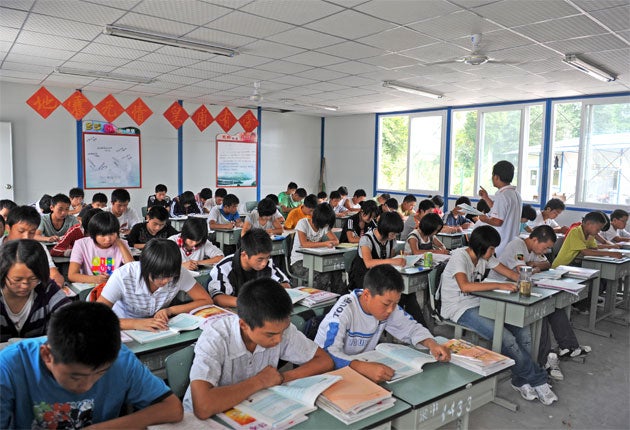
You can hear a pin drop, the clock is ticking down, and your future depends on the Chinese characters you are putting to paper in front of you. College entrance exam time in China, which began yesterday, brings the kind of pressures that would break most children, in Britain and elsewhere. Fail these exams and a secure place in the New China is lost.
Outside the exam hall gates, mothers wait for exams to end, having visited temples of Confucius, the site of examinations in imperial times, having burnt incense, lit candles, made offerings and prayed for success. Many will have spent a hefty £20 on a tablet on which they have written a note saying: "Please help my child pass the exams."
The exam is called the "gaokao" and it decides whether or not a student gets into college. Nearly 70 per cent get through, but the slide down the academic food chain for those who fail can be intense. Earlier this week two students from Hebei province committed suicide, overwhelmed by the pressure to perform. The temptation to cheat for some is too great.
It is common for families to book a hotel for the duration of the exams, in quiet roads away from traffic, patrolled by police officers who understand the need to keep the streets clear and quiet. Any motorist beeping their horn near an examination centre risks becoming the centre of a riot.
The one-child policy of birth control means that many of the candidates sitting these exams are only children, bearing a weighty burden of expectation from aunts and uncles, grandparents and cousins. The family needs them to get into Tsinghua or Peking University in Beijing or Fudan in Shanghai to secure the family's future.
Because of the declining birth rate and the increase in the numbers going overseas, the number of mostly sixth-formers sitting the exams has fallen significantly. This year, there are 9.57 million students sitting the three-day exam, 650,000 fewer than last year. It is the second straight year of decrease, according to the Ministry of Education. The peak was in 2008, when 10.53 million sat the exam.
"It mirrors the decreasing birth rate caused by the one-child policy," Wang Guangzhou, a researcher in demography at the Chinese Academy of Social Sciences, told the China Daily.
The ability of an increasingly wealthy Chinese middle-class to send their children abroad, coupled with, to some, the perceived superiority of education outside of China, has also contributed to the falling numbers taking the exam. Data shows that about 220,000 students went to study overseas in 2009, 50,000 more than in 2008.
"Chinese parents have more choices and are able to make their own judgement on the education quality of Chinese and foreign universities," said Wang Huiyao, vice-chairman of the China Western Returned Scholars Association. Some of the scholarships on offer are remarkably attractive. Shanghai's Fudan has promised 50,000 yuan (£5,000) to applicants who are in the top five in their provinces.
Such lures also bring in the cheats, and over the years there have been some inventive ones. One student suffered a perforated eardrum after he lost a tiny listening device, measuring just 3mm across, inside his ear.
Another student needed an operation to have a hearing device removed while a student who had strapped an electronic recording device to his body was taken to hospital after it exploded.
In one exam hall in Wuhan, examiners found more than 100 devices to help the students cheat, including more conventional items for the would-be cheat such as laptops and mobile phones, as well as tiny transmitting devices hidden in vests, wallets and the waistbands of trousers.
Some universities have installed cameras and mobile-phone blocking technology inside exam halls to stop people using technology to cheat.
Join our commenting forum
Join thought-provoking conversations, follow other Independent readers and see their replies
Comments