Creating glaciers out of thin air
Chewang Norphel has an ingenious solution to the droughts in his Himalayan homeland
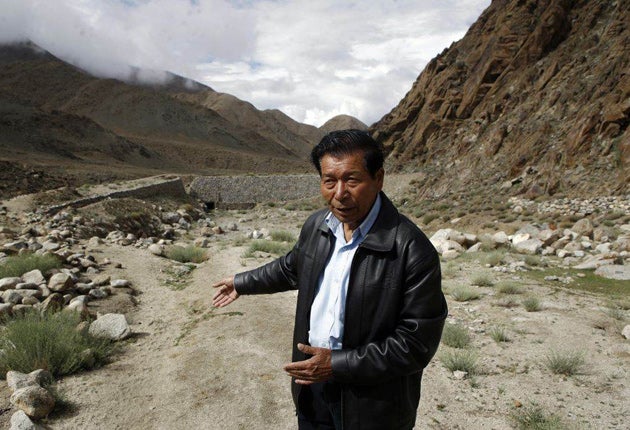
At times, the moonscape land of Ladakh can appear as dry as a desert. In this most northerly part of India, tucked high in the Himalayas, there is virtually no rainfall and almost 75 per cent of the local farmers rely on meltwater from the glaciers to irrigate their once-a-year crops.
It was in Ladakh, confronted by receding glaciers – currently at the centre of an increasingly bitter dispute between scientists and Delhi – that Chewang Norphel, a government engineer, hit upon an idea to use nature to give the locals a helping hand with growing more food.
Seeing how much fresh water was wasted during the winter – as villagers left their taps running to prevent them freezing solid – and noticing the way that they stored snow on shaded areas of the mountain, he decided to create his own artificial glaciers.
That was more than a decade ago. Now, with funding from the Indian army – which is keen to maintain the support of local people in a strategically sensitive area close to the border with China – Mr Norphel has created 10 artificial glaciers and is planning more.
Crucially he has constructed them at lower elevations than the naturally occurring glaciers so that they melt at least a month earlier, providing the farmers with an opportunity to produce a second harvest of wheat, barley, peas and potatoes.
Such has been his success that to local people and environmentalists, he is known simply as Mr Glacier.
"I am a civil engineer by training and I was working in rural development. I had to visit every village and I noticed that all their problems were related to water," Mr Norphel said. "I thought about how to solve the problem. There was a pipe near my house that provided water for a village. During the winter we had to keep it open to stop it freezing. I thought that if we could hold that water it would all turn into ice."
The engineer set about building a system of pipes with holes in them that diverted water to a shaded part of the hillside and slowly reduced the volume as the water froze to ice. Over the years he has fine-tuned the design of the glaciers and their location on the hillsides.
Natural glaciers, he explained, begin to melt in June or July but by locating his artificial constructions 4,000ft lower down the valley, he is able to ensure they melt in May, which is typically when farmers finish sowing their crops.
Last year his teams built three glaciers for Stamko, one of many villages that have suffered from a drastic lack of water for farming. "There are a total of 113 rural villages in Ladakh and 80 of them depend on the glaciers for irrigation," he said.
The magical but fragile eco-system of Ladakh and its traditional inhabitants are threatened most directly by the ironic combination of droughts and floods. Mr Norphel, 74, is certain of several things: that the glaciers are retreating more quickly than before; that the region receives less snowfall and moisture than it did when he was younger; and that the region is progressively getting warmer. The engineer's instincts are supported by a survey recently conducted by Geres India, a rural development organisation based in Ladakh. It found a remarkable rising trend of average temperatures by 1C for winter and 5C for summer between 1973 and 2008.
During the same period, rainfall and snowfall had shown a clear declining trend. "Altogether snowfall has come down by almost 60 per cent in the past 50 years," the group's spokesman, Tundup Angmo, told Reuters.
Yet India's Himalayan glaciers are currently the focus of heated debate. This week the Intergovernmental Panel on Climate Change (IPCC) admitted that a claim included in a 938-page scientific report that all of India's glaciers would disappear by 2035 was incorrect, after it emerged it was based on an unsubstantiated media report. The IPCC expressed its "regret [for] the poor application of well-established IPCC procedures in this instance".
India's environment minister, Jairam Ramesh, often attacked by activists, seized on the admission. "The health of the glaciers is a cause of grave concern, but the IPCC's alarmist position that they would melt by 2035 was not based on an iota of scientific evidence," he told reporters. Mr Ramesh's ministry recently published a study paper which claimed that the Himalayan glaciers, which give birth to several key river systems including the Indus, Ganges and Brahmaputra, which provide water to hundreds of millions of people, had not retreated abnormally.
Yet Mr Norphel is under no doubts about the reality of what is happening to the environment in which he grew up and where he is now trying to use nature to help itself. "When I was small, if there was a foot of snow it would last for six months. Now it will melt in a week," he said. "That is the result of climate change."
Join our commenting forum
Join thought-provoking conversations, follow other Independent readers and see their replies
Comments
Bookmark popover
Removed from bookmarks