Death toll grows as India goes to war over cut-price land deals
Housing boom for nation's growing middle-classes drives villagers from their farms

For free real time breaking news alerts sent straight to your inbox sign up to our breaking news emails
Sign up to our free breaking news emails
For more than a day, nobody bothered to tell Ombati Devi that her husband was dead.
When he failed to return home on the day farmers were protesting in their village Bhatta-Parsaul, she was told he had been wounded but that he had been taken to hospital where he was receiving treatment. The following evening the police arrived at her home, revealed the truth and took her to the mortuary where she was confronted with the sight of his corpse, caked with dried blood and ruptured by three bullet wounds. "He got injured in the crossfire while he was trying to flee the trouble spot," she said, her voice breaking off.
Her husband, Rajpal Singh, a farm-hand in these twin villages east of Delhi, was the latest of a number of people to be killed or injured in land disputes that have erupted across the length and breadth of India. As state authorities push the pace of industrialisation and private developers look to buy up agricultural land to build new towns and resorts for a newly wealthy upper-middle class, so clashes have become common. At proposed steel factories in Orissa, nuclear plants in Maharashtra and road projects in Mangalore, clashes have broken out when the authorities have sought to force people to part with their land.
Mr Singh was one of four people killed on 7 May, two of them police officers, when farmers held a protest over the amount they were paid for their land by local authorities who are building a new, 110-mile expressway alongside the Yamuna river to Agra, the city famous for the Taj Mahal. As in similar protests elsewhere in the country, the farmers complained that, while they were forced by the government to sell their land in return for a modest sum in compensation, the land was subsequently sold on to private developers for 10 or 15 times the amount.
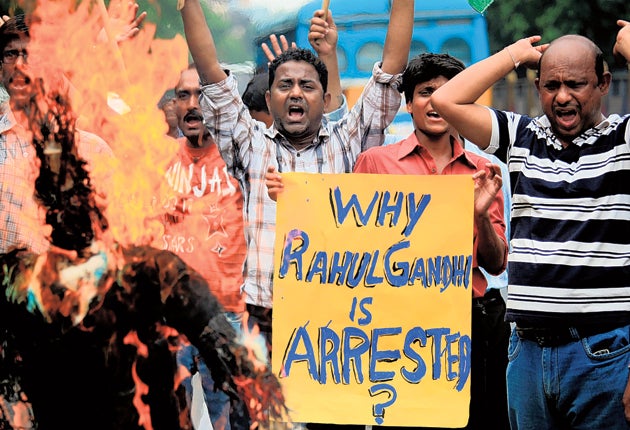
What turned Mr Singh's death into a national issue was that the incident was leapt on by Rahul Gandhi, son of the assassinated former premier Rajiv Gandhi and a man widely expected to himself become prime minister at some point. Mr Gandhi first showed a fleetness of both mind and foot by leaping on the back of a motorbike at dawn and evading policemen who had established a cordon around the village so that he could meet the farmers last week. He joined in the protest and was briefly arrested. He subsequently let matters get away from him by claiming people there were being raped and murdered. "There is a large 70ft [mound of] ashes there with dead bodies inside. Everybody in the village knows," he said.
The state government in Uttar Pradesh, where these villages are located, has denied the accusations and said forensic tests on the ashes have revealed they contain no human remains. Mr Gandhi, whose mother, Sonia, heads the ruling Congress Party, has since had to retreat from the allegations. In truth, his decision to seize on the issue may have at least partly been inspired by state elections scheduled for next year and his desire to score political points against UP's chief minister, Mayawati, who heads a rival party.
The irony is that the Congress-led government has for several years been promising to introduce new legislation to oversee the sale of land for public projects. Yesterday, Mrs Gandhi again repeated the vow, telling party colleagues: "We will soon bring a bill in parliament on land acquisition."
Transfers of land are currently controlled by a land acquisition act dating from 1894. According to the act, the authorities can enforce the sale of land for projects in the "public interest". Originally this meant roads, dams, hospitals and other such projects, say experts. But, increasingly, the authorities have used the law to force farmers to sell land for all manner of projects.
"The way forward is that the government should acquire land only in matters of high public interest. It should not be used to get land for general development," said Mukul Rohatgi, a Supreme Court lawyer who has worked on many land dispute issues. "The law should also not allow the industrialisation of fertile land. We must not forget that at heart we are an agrarian society. We have more than one billion people."
Many of the land acquisition disputes have taken place close to the nation's cities, which are continuously growing and where new townships are springing up on the peripheries. East of Delhi, in the Greater Noida region, new apartment blocks are going up at a phenomenal pace, set alongside newly built roads that for now have little traffic.
A number of the residential projects are being built by the Jaypee Group, which is also heading up the Yamuna Expressway. A company spokesman failed to respond to questions about the dispute, as did the Yamuna Expressway Industrial Development Authority, a body set up by the UP government to oversee the road project.
For the people of Bhatta-Parsaul who find themselves at the centre of India's latest seething land dispute, it is a time of anxiety. In the aftermath of the protests, police reportedly tore through the narrow lanes of villages, setting alight hayricks, destroying property and beating people. Several villagers displayed washing machines and radios that had been smashed and broken. Dozens of local men are apparently on the run, fearful of being arrested.
"I have three sons. All of them have run away," said a sobbing 65-year-old woman called Sirdari. Another woman, Sukbiri, said her son and daughter-in-law had fled. "My daughter has also gone. They are scared of the police," she added.
The family of Rajpal Singh says they have received no word from the authorities. His brother, Hazira Lal, along with other relatives insisted Mr Singh had not even been taking part in the protest, but was instead gathering cattle fodder nearby. "We have received no compensation payment," he said. "None of Mayawati's people have come."
Rahul Gandhi: The scion at the centre of a storm
Rahul Gandhi, son of Sonia and her late husband Rajiv, grandson of Indira Gandhi and great grandson of Jawaharlal Nehru, is a man with many expectations upon his shoulders. Currently general secretary of the ruling Congress Party, he has spent much effort democratising its youth wing while avoiding taking up a cabinet position. Most assume it is only a matter of time before he becomes prime minister.
While few doubt that should he want to become premier the position would be available to him, there have been questions about his impact on the campaign trail. Particularly in the state of Uttar Pradesh, he has had varying success.
Many believe he must soon make up his mind. Will he become the latest in the Nehru dynasty to run the country, or will he decide it is not something he wants?
Subscribe to Independent Premium to bookmark this article
Want to bookmark your favourite articles and stories to read or reference later? Start your Independent Premium subscription today.
Join our commenting forum
Join thought-provoking conversations, follow other Independent readers and see their replies