Disgraced and vilified, Suharto dies aged 86
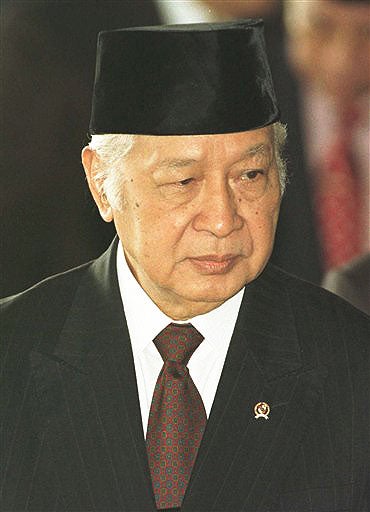
Indonesia's former dictator Suharto, an army general who crushed Indonesia's communist movement and pushed aside the country's founding father to usher in 32 years of tough rule that saw up to a million political opponents killed, died today. He was 86.
"He has died," Dr Christian Johannes said that he died at 1.10pm local time.
Finally toppled by mass street protests in 1998, the US Cold War ally's departure opened the way for democracy in this predominantly Muslim nation of 235 million people and he withdrew from public life, rarely venturing from his comfortable villa on a leafy lane in the capital.
Suharto had ruled with a totalitarian dominance that saw soldiers stationed in every village, instilling a deep fear of authority across this Southeast Asian nation of some 6,000 inhabited islands that stretch across more than 3,000 miles.
Since being forced from power, he had been in and out of hospitals after strokes caused brain damage and impaired his speech. Blood transfusions and a pacemaker prolonged his life, but he suffered from lung, kidney, liver and heart problems.
Suharto was vilified as one of the world's most brutal rulers and was accused of overseeing a graft-ridden reign. But poor health — and continuing corruption, critics charge — kept him from court after he was chased from office by widespread unrest at the peak of the Asian financial crisis.
The bulk of political killings blamed on Suharto occurred in the 1960s, soon after he seized power. In later years, some 300,000 people were slain, disappeared or jailed in the independence-minded regions of East Timor, Aceh and Papua, human rights groups and the United Nations say.
Suharto's successors as head of state — B.J. Habibie, Abdurrahman Wahid, Megawati Sukarnoputri and Susilo Bambang Yudhoyono — vowed to end corruption that took root under Suharto, yet it remains endemic at all levels of Indonesian society.
With the court system paralyzed by corruption, the country has not confronted its bloody past. Rather than put on trial those accused of mass murder and multibillion-dollar (euro) theft, some members of the political elite consistently called for charges against Suharto to be dropped on humanitarian grounds.
Some noted Suharto also oversaw decades of economic expansion that made Indonesia the envy of the developing world. Today, nearly a quarter of Indonesians live in poverty, and many long for the Suharto era's stability, when fuel and rice were affordable.
But critics say Suharto squandered Indonesia's vast natural resources of oil, timber and gold, siphoning the nation's wealth to benefit his cronies and family like a mafia don.
Jeffrey Winters, associate professor of political economy at Northwestern University, said the graft effectively robbed "Indonesia of some of the most golden decades, and its best opportunity to move from a poor to a middle class country."
"When Indonesia does finally go back and redo history, (its people) will realize that Suharto is responsible for some of the worst crimes against humanity in the 20th century," Winters added.
Those who profited from Suharto's rule made sure he was never portrayed in a harsh light at home, Winters said, so even though he was an "iron-fisted, brutal, cold-blooded dictator," he was able to stay in his native country.
Like many Indonesians, Suharto used only one name. He was born Mohammad Suharto on June 8, 1921, to a family of rice farmers in the village of Godean, in the dominant Indonesian province of Central Java.
When Indonesia gained independence from the Dutch in 1949, Suharto quickly rose through the ranks of the military to become a staff officer.
His career nearly foundered in the late 1950s, when the army's then-commander, Gen. Abdul Haris Nasution, accused him of corruption in awarding army contracts.
Absolute power came in September 1965 when the army's six top generals were murdered under mysterious circumstances, and their bodies dumped in an abandoned well in an apparent coup attempt. Suharto, next in line for command, quickly asserted authority over the armed forces and promoted himself to four-star general.
Suharto then oversaw a nationwide purge of suspected communists and trade unionists, a campaign that stood as the region's bloodiest event since World War II until the Khmer Rouge established its gruesome regime in Cambodia a decade later. Experts put the number of deaths during the purge at between 500,000 and 1 million.
Over the next year, Suharto eased out of office Indonesia's first post-independence president, Sukarno, who died under house arrest in 1970. The legislature rubber-stamped Suharto's presidency and he was re-elected unopposed six times.
During the Cold War, Suharto was considered a reliable friend of Washington, which didn't oppose his violent occupation of Papua in 1969 and the bloody 1974 invasion of East Timor. The latter, a former Portuguese colony, became Asia's youngest country with a U.N.-sponsored plebiscite in 1999.
Even Suharto's critics agree his hard-line policies kept a lid on Indonesia's extremists. He locked up hundreds of suspected Islamic militants without trial, some of whom later carried out deadly suicide bombings with the al-Qaida-linked terror network Jemaah Islamiyah after the Sept. 11 attack on the U.S.
Meanwhile, the ruling clique that formed around Suharto — nicknamed the "Berkeley mafia" after their American university, the University of California, Berkeley — transformed Indonesia's economy and attracted billions of dollars in foreign investment.
By the late 1980s, Suharto was describing himself as Indonesia's "father of development," taking credit for slowly reducing the number of abjectly poor and modernizing parts of the nation.
But the government also became notorious for unfettered nepotism, and Indonesia was regularly ranked as one of the world's most corrupt nations as Suharto's inner circle amassed fabulous wealth. The World Bank estimates 20 percent to 30 percent of Indonesia's development budget was embezzled during his rule.
Even today, Suharto's children and aging associates have considerable sway over the country's business, politics and courts. Efforts to recover the money have been fruitless.
Suharto's youngest son, Hutomo "Tommy" Mandala Putra, was released from prison in 2006 after serving a third of a 15-year sentence for ordering the assassination of a Supreme Court judge. Another son, Bambang Trihatmodjo, joined the Forbes list of wealthiest Indonesians in 2007, with US$200 million (¤136 million) from his stake in the conglomerate Mediacom.
Suharto's economic policies, based on unsecured borrowing by his cronies, dramatically unraveled shortly before he was toppled in May 1998. Indonesia is still recovering from what economists called the worst economic meltdown anywhere in 50 years.
State prosecutors accused Suharto of embezzling about US$600 million (¤408 million) via a complex web of foundations under his control, but he never saw the inside of a courtroom. In September 2000, judges ruled he was too ill to stand trial, though many people believed the decision really stemmed from the lingering influence of the former dictator and his family.
In 2007, Suharto won a US$106 million defamation lawsuit against Time magazine for accusing the family of acquiring US$15 billion in stolen state funds.
The former dictator told the news magazine Gatra in a rare interview in November 2007 that he would donate the bulk of any legal windfall to the needy, while he dismissed corruption accusations as "empty talk."
Suharto's wife of 49 years, Indonesian royal Siti Hartinah, died in 1996. The couple had three sons and three daughters.
Join our commenting forum
Join thought-provoking conversations, follow other Independent readers and see their replies
Comments