Face to face with Pakistan’s most wanted
Robert Fisk becomes the first Western journalist to interview Hafiz Muhammad Saeed, the man accused of masterminding the Mumbai massacre
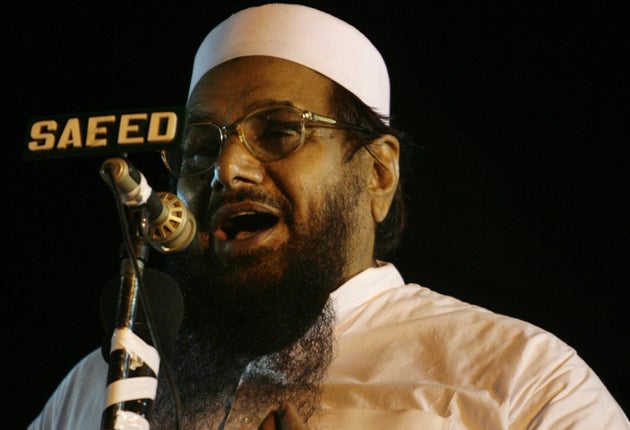
As Pakistani ministers and the country's army chiefs lobbied the Obama administration in Washington this week for increased military funding for the fight against Al Qa'ida militants, the top man on the US, UN and EU most wanted list in Pakistan moved freely in the streets of Lahore.
In his first interview with a western newspaper, Hafiz Muhammad Saeed – suspected of organising the slaughter of 166 Indians in Mumbai in November 2008 – denied responsibility for the bloodbath and told The Independent that he had won his court battles to remain a free man. Saeed, bearded, bespectacled and claiming to have no links with Lashkar-e-Taiba – the "Army of the Righteous", which is blamed by the Indians and Americans for the Mumbai killings – is guarded in Lahore by two Pakistani policemen.
He said he believed in the Lashkar group's "fight for freedom" in Kashmir, adding that US and Nato troops "must leave" Afghanistan. He blamed "Indian propaganda" for the accusations against him – a claim unlikely to move his enemies in the US, India and other nations – and said that he condemned the Mumbai killings. Saeed said he runs a well-funded charity called the "Group of Preaching" which rescued more than a hundred victims of the Kashmir earthquake.
But his outspoken remarks are likely to cause friction in Washington where Hillary Clinton, the Secretary of State, this week hailed the dawn of "a new day" after "years of misunderstandings" in the relationship between the US and Pakistan. The country's Prime Minister, Foreign Minister and army chief of staff have been trying to persuade President Obama's administration that they are resolute in their domestic as well as their international battle against "terror".
At their high-level "strategic dialogue" which also involved Mrs Clinton and the US Defence Secretary Robert Gates, President Obama is reported to have specifically asked for the arrest of Saeed. Condemning Pakistan for supporting members of Lashkar after the Mumbai attacks, Gary Ackerman, the anti-Pakistani chairman of the US House subcommittee on the Middle East and South Asia, described the group as "a bunch of savages" that needed to be crushed.
In the latest Indian file on the Mumbai killings, handed over to Pakistani Secretary of State for Foreign Affairs Salman Bashir during his recent visit to Delhi, the Indians also demanded "strict action" against Hafiz Saeed and his extradition to India with 34 others on Delhi's wanted list.
But Mr Bashir described the evidence against Saeed as "mere literature". Lashkar are also held responsible by India, the US and the UN for a long series of massacres: at Chittisinghpura in 2000 when 35 Sikhs were killed; at the Red Fort in Delhi the same year; at the Delhi parliament the following year;, at a Delhi market in 2005, when 31 people were killed; in Uttar Pradesh in 2006 - where 37 civilians lost their lives; and train bombings in Mumbai in 2006, which left 211 dead.
The US is currently supplying Pakistan with aid worth $1.5bn a year. But at the Washington talks, Islamabad asked for a further boost in financial assistance for the country's power generation system and water supplies, as well as military equipment and mass funding for the Pakistani army, navy and air force. Islamabad believes that its long and bloody battles against the Taliban – both the Afghan and the Pakistani variety – have earned it substantial financial rewards from Washington. Most of its army have been moved from the Kashmir border with India to the western battles against the Taliban – to the delight of the Americans and the Indians. But Lashkar remains the enemy within which can strike again at Indian targets.
Hafiz Saeed remains unmoved. Insisting he has no connection to Lashkar, he said that his charity had hundreds of offices across Pakistan. "They make me out to be the biggest and most evil terrorist," he laughed. "Do I look like one to you?"
He said he had visited Afghanistan, but only to observe the situation, never to fight. He had met Osama bin Laden once, he said, on the Haj pilgrimage to Mecca in the 1980s, praying near him and then speaking to him – but only "briefly".
Many Pakistanis believe that Saeed is controlled by the country's formidable Interservices Intelligence (ISI) organisation, and the armed policemen outside his temporary office in Lahore may be part of that protection. A senior ISI officer travelled to the Washngton talks.
Join our commenting forum
Join thought-provoking conversations, follow other Independent readers and see their replies
Comments