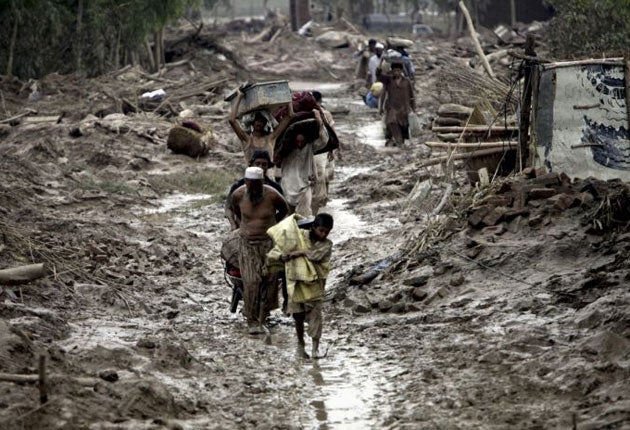
Islamist charities, some with suspected ties to militants, stepped in today to provide aid for Pakistanis hit by the worst flooding in memory, piling pressure on a government criticised for its response to the disaster that has so far killed more than 1,000 people.
The floods that ravaged the northwest and displaced more than a million people are testing an administration heavily dependent on foreign aid and that has a poor record in crisis management - whether fighting Taliban insurgents or easing chronic power cuts.
Islamist charities believed to have ties with militants may gain support if their relief efforts pay off, as they did after a 2005 earthquake in Kashmir that killed some 75,000 people.
"We have lost everything. We only managed to save our lives. Nobody has come to us," said Mihrajuddin Khan, a school teacher in Swat Valley. "We are being treated like orphans, animals."
Rescuers are struggling to distribute relief to tens of thousands of people trapped in the submerged areas, where destroyed roads and bridges make access difficult.
Salman Shahid, spokesman for the Falah-i-Insaniat Foundation (Foundation for the Welfare of Humanity), said the Islamist group had set up 13 relief and six medical camps, and a dozen ambulances are providing emergency treatment. Several other Islamist groups are also helping out with the relief effort.
Falah-i-Insaniat is believed to have ties to Jamaat-ud-Dawa charity, which the U.N. Security Council banned last December for its alleged links with Lashkar-e-Taiba (LeT), the group blamed for the 2008 attack on the Indian city of Mumbai.
"We're very much there. We're the only group that is providing cooked food to trapped people and those laying on the roadside," Shahid told Reuters from the group's headquarters in Lahore. "Our volunteers are evacuating people."
Some analysts expressed doubts that Islamist groups and their militant wings could capitalise on the disaster because army offensives have weakened them.
But some analysts said the Islamists' relief camps in the flood-hit areas had set a dangerous precedent.
"It is very likely that they will exploit the governance vacuum, in the wake of this tragedy, to fuel their own recruitment," said columnist Huma Yusuf.
A similar dynamic happened after the 2005 Kashmir earthquake, she said, when extremist groups gained immense popularity from their relief efforts. Pakistan is fighting insurgents from al Qaeda and the Taliban in the northwest.
Authorities are expecting the death toll to rise, as more of the heavy monsoon rains lashing the area for the past week are forecast. Pakistan's National Disaster Management Authority said more than 29,500 houses were damaged and a key trade highway to China was blocked by flooding.
"Our main challenge of getting a clearer picture is access," said Nicki Bennett, senior humanitarian officer at United Nations Office for the Coordination of Humanitarian Affairs.
Officials said it was too early to estimate the damage the floods had caused to the overall economy, but the rains have so far spared the main agricultural heartland in the Punjab.
"The entire infrastructure we built in the last 50 years has been destroyed," said Adnan Khan, spokesman for the provincial Disaster Management Authority in Khyber-Pakhtunkhwa.
The disaster management authority said tents and hygiene kits have been delivered. Helicopters and boats have been dispatched.
But analysts say the government really lacks the resources to take on a disaster of this scale, leaving the military in charge.
More than 30,000 Pakistani army troops have rescued some 19,000 people from marooned areas so far. Some army bases used to strike at militants in Nowshera, some 100 kms (62 miles) northwest of the capital Islamabad, have been flooded.
The government's failure to help victims reinforced the long-held view that Pakistan's civilian authorities are ineffective, leaving the military to act at troubled times.
The government of President Asif Ali Zardari has limited control over the military. It has also been relatively ineffective in tackling corruption and reforming the economy.
"What we have seen is their almost total paralysis and they have not been able to mobilise the resources," said Riffat Hussein, a defence expert at Quaid-e-Azam University.
Many in the path of the floods scrambled to save their livestock. One man swam across heavy currents with his chicken tied around his neck. In one town, there were more than a hundred bloated buffalo carcasses, raising the spectre of disease.
Join our commenting forum
Join thought-provoking conversations, follow other Independent readers and see their replies
Comments