Fukushima disaster now on a par with Chernobyl
Japan yesterday raised its assessment of the Fukushima plant accident to the same level as history's worst nuclear crisis, admitting that "large volumes" of radioactive substances are being released in the surrounding area.
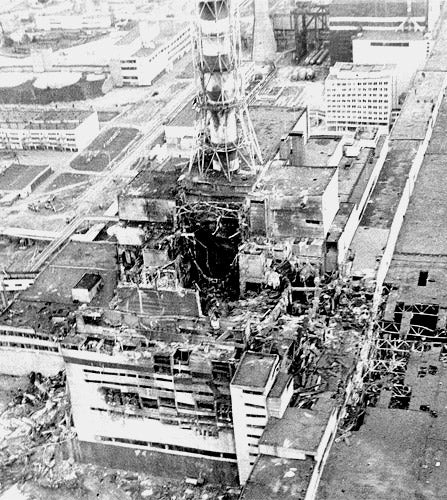
The decision to raise the crisis level from five to the maximum seven on a table set by the International Nuclear Event Scale puts the situation at the stricken Fukushima Daiichi complex in the same category as the Chernobyl disaster of 1986.
Japan's Nuclear Safety Agency said that reactors 1, 2 and 3 had so far leaked just "one-tenth" the volume of radiation as Chernobyl. "It is totally opposite to Chernobyl," insisted the agency's spokesman, Hidehiko Nishiyama, who said there have been no deaths at Fukushima from short-term exposure to radiation.
A total of 29 deaths are attributed to immediate lethal doses of radiation at the facility in the former Soviet Union, as well as thousands of cancer-linked deaths from long-term exposure. Official UN figures put the death toll from the Chernobyl disaster at 9,000. Greenpeace and other groups say it is as high as 200,000.
The plant's operator, Tokyo Electric Power Co, admitted yesterday, however, that with engineers still battling to bring the plant under control, "Our concern is that it could eventually exceed Chernobyl." Some experts were taking that startling statement as a warning that discharges from the plant may be higher than admitted.
In a press conference, the Agency said their calculations showed that between 370,000 and 630,000 terabecquerels (a trillion becquerels) of radioactive materials have been spewed out of the plant – as much as one-tenth of the total contained in its damaged reactors.
Mr Nishiyama said that reactors have been damaged but not destroyed by a series of hydrogen explosions, in contrast to the Chernobyl crisis, which was detonated when its single reactor exploded. Environmentalists are pointing, however, to the much greater population density in the greater Tokyo region: 800-1,200 per square km, compared with 80 in the Ukraine, and 40 in Belarus.
Although health risks outside the immediate vicinity of the stricken nuclear complex are still thought to be low, fears of accumulated radiation forced the government this week to widen the 20-km evacuation area. The move means that residents in some municipalities outside the 20-km zone will be "instructed" to leave in a month.
The Prime Minister, Naoto Kan, said that responsibility for paying compensation to farmers, fishermen and thousands of people forced to evacuate from the prefecture rests with Tepco. "We will not forsake the victims of the nuclear incident," he said in a live TV press conference.
Another strong aftershock yesterday forced engineers battling to cool reactors at the complex to pull out for the second day in a row. Mr Kan insisted that radiation emissions are declining and that the plant is moving toward stability, "step by step". He urged Japanese people to show support for the victims of the quake and tsunami by buying products from the disaster regions. "I was born in 1946 when the smell of war was still in the air," he said. "Japan stood up from the burned-out ruins of war and achieved a reconstruction that amazed the world. We must renew that determination."
Join our commenting forum
Join thought-provoking conversations, follow other Independent readers and see their replies
Comments