Gambling epidemic snares Burma's poor
People living on just $3 a day spend half of their incomes on illegal wagers
As the clock ticks towards noon, the Sky Cafe in Rangoon's shabby Daubon Township starts to fill up. Young women carrying babies, men from the bicycle repair shop across the road, and old ladies smoking cheroots take their places on the small plastic chairs. By 11.55am, the wooden shack is packed, and a waiter revs up the generator to power the big TV in the corner. In an atmosphere of anticipation, the crowd is waiting for the Bangkok stock exchange price at its lunchtime close.
These are not people who have ever owned shares in anything. They are day labourers, hawkers, and low-ranking civil servants with earnings of around $3 (£1.80) a day. Their interest is not in the performance of the stock market, but in the random, final two digits of the share price, on which most bet at least half of their daily wages.
Gambling is an epidemic spreading unchecked among Burma's poor. This is a country with no political freedom, few economic choices and little hope. Its military leaders have kept democracy leader Aung San Suu Kyi locked up for most of the last 20 years, and have presided over an economic slump while neighbouring countries have prospered. In the crowded townships of the former capital Rangoon, in decaying market towns and impoverished rural villages, everyone, it seems, is trying to bet their way out of a miserable existence.
Kyaw Kyaw works for his family business, repairing motors and generators on the ground floor of their house. For him, betting is something to look forward to: "Twice a day I have hope." The 35-year-old gambles on the "two digits" lottery both lunchtime and evening, giving a dollar each time to the saleswomen who go door to door taking bets. These women take a 10 per cent cut and hand the bets over to the bigger bookmakers. Kyaw Kyaw has a one in 99 chance of winning, and if he does, he'll get 80 times his stake. Like all Burma's small-time gamblers, he loses nearly every day. But the wins are what he remembers. "When I win I'll go out and buy lots of food, and we'll cook for my family and my friends," he said.
While the two digits they bet on are random and completely unpredictable, punters spend hours studying the form. Kyaw Kyaw's 81-year-old grandfather, sitting cross-legged on his wooden bed, studies printouts of the last months of numbers with studious concentration. He is looking for patterns, sequences and if he thinks he's found a good one, he may place a bigger bet than usual. Other gamblers consult Buddhist monks, astrologers or their dreams.
At the Sky Cafe, the stock price flashes up on Thai TV, beamed in by an illegal satellite dish on the roof. There is a lone whoop from the back, but no one else seems to have won. The crowd murmurs with quiet disappointment. "They don't believe it, they always think they're going to win," says my translator, who has brought me here from central Rangoon in a wooden-floored 1950s bus.
Burma's addiction to gambling has a price. While the ruling generals enrich themselves by selling off the country's gas, timber and rubies, their mishandling of the economy means those at the bottom of society have nothing, perhaps just a bamboo shelter with a tarpaulin roof. There is no social safety net, nothing to stop a family from going under when the betting losses add up.
"When they've lost everything they must give up their house, take their children out of school and send them to work. Often they will end up begging," said a Burmese aid worker who runs self-help groups for poor women living in shanty towns. "Last week I saw a woman begging, holding a child. My friend told me she used to own a house, a good house, but because of the lottery she lost everything. She became a beggar. Sometimes they sleep in the market." As the poor lose, Burma's bookmakers are getting richer. Although this is an illegal business, and anyone caught gambling or taking bets could receive a prison sentence of between three months and two years, a bribe will see off most policemen – who also expect a cut if someone in the neighbourhood wins big.
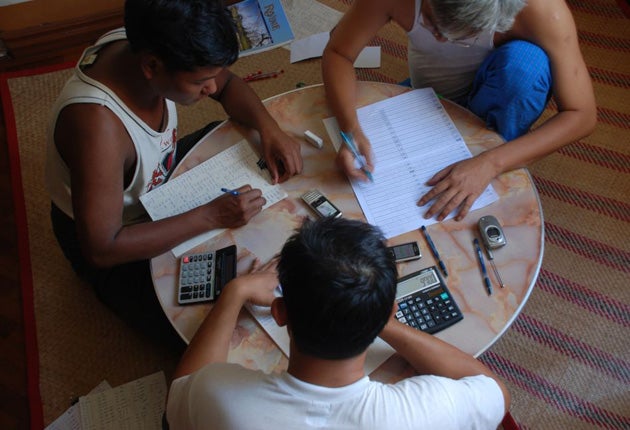
In a comfortable, breezy apartment with a parquet floor and expensive teak furniture, three men in white vests and chequered longyis sit around a table , scribbling down numbers as the bets come in via mobile phone. Running the operation is a 47-year-old doctor who can earn far more as an illegal bookmaker than tending to patients in a Rangoon government hospital, where the standard salary for a general practitioner is $80 a month.
When the Bangkok exchange closing price is called through, he throws his hands up and smiles. "I've lost," he says, "11 lak [around $1,000] this week." But some weeks he makes double that amount, twice his annual doctor's salary. "This job gives me freedom," he says.
Economic woes: A struggling nation
9.4 per cent: Proportion of the population who are unemployed
32.7 per cent: Proportion of population who live below the poverty line
$1,200: GDP per capita
27.3 per cent: Rate of inflation
61: Male life expectancy
66: Female life expectancy
47.61: number of infant deaths per 1,000 live births
Source: CIA World Factbook
Join our commenting forum
Join thought-provoking conversations, follow other Independent readers and see their replies
Comments