Historic step for women in India as parliament gives them third of seats
After a 14-year campaign, the male-dominated upper house votes overwhelmingly for more female MPs

For free real time breaking news alerts sent straight to your inbox sign up to our breaking news emails
Sign up to our free breaking news emails
Indian politicians took an important step on the path to making history when they overwhelmingly voted to reserve a third of all legislative seats across the country for women.
In what Prime Minister Manmohan Singh described as an "historic step forward toward emancipation of Indian womanhood", the upper house of the country's federal parliament voted 186-1 to set aside the seats in the national and state assemblies. Having overcome more than a decade of opposition, the politicians thumped on their desks to celebrate the passage of the bill.
Mr Singh, head of the Congress Party-led ruling coalition, added: "It is a momentous occasion in the long journey of empowering women that began at the dawn of freedom .... It is an historic occasion, which calls for celebration."
Even though two of the most influential figures in the history of India since its independence from Britain in 1947 – Indira Gandhi and her daughter-in-law, the current Congress Party leader, Sonia Gandhi – have been women, the country does not do well when it comes to gender equality in politics. With only 21 women in the 233-member upper house, representing around 9 per cent, and 59 in the 545-member lower house, a percentage of under 11 per cent, India ranks 99th in the world in terms of female representation among MPs.
Pakistan and Bangladesh, both neighbours of India, perform markedly better, according to the study by the Inter-Parliamentary Union, a Switzerland-based organisation that works to promote democracy. The UK stands 62nd in the list.
Mrs Gandhi, the widow of the former prime minister Rajiv Gandhi, who was assassinated in 1991, and reportedly one of the driving forces behind the measure, last night told an Indian television channel: "I am relieved ... very happy.
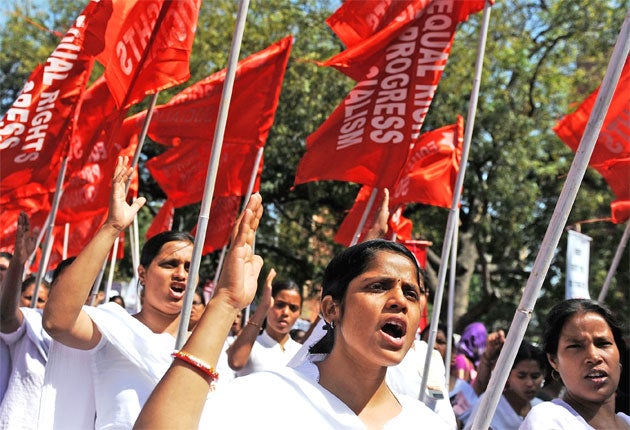
"In politics, there are always some risks but the larger picture has to be kept in mind. The support of my party and especially of the women kept me going." Outside the parliament building in Delhi, activists and female politicians celebrated and shouted: "We have made it!"
The passage of the bill, which was first proposed in 1996, has been difficult and faced opposition from many political leaders who believed their male-dominated parties would lose seats.
Other parties have opposed the move because they did not think the legislation went far enough and argued that seats should also be reserved for people from lower castes and ethnic minorities.
On Monday, International Women's Day, a vote on the bill was blocked by unprecedented scenes in the upper house when opponents of the measure snatched copies of the proposed legislation and tore them up.
Yesterday, proceedings were again halted when seven lawmakers, who had been suspended for their behaviour the previous day, refused to leave the chamber. They were eventually removed by marshals.
Other opponents boycotted the vote, including the Trinamool Congress party, one of the government's most influential allies and whose leader, Mamata Banerjee, is the railways minister. Her party said that the Congress had not properly consulted its allies before proceeding. However, the bill had powerful champions. Brinda Karat, the leader of the Communist Party, said it would change the country because women are "still caught in a culture prison".
Activists hope that, if the bill is now passed in the lower house as expected, the legislation will inspire Indian women, who, as in many parts of South Asia, still suffer high levels of discrimination.
On Monday, a UN report said 96 million women across Asia have "disappeared" because of a gender gap that deprives them of access to healthcare and good nutrition, including about 43 million in India. A traditional preference for male children, especially in the north of the country, has lead to huge problems of female foeticide, so much so that there are markedly more men than women in some regions. This has led to a shortage of potential brides and trafficking of women from other areas. Girls are also less likely to have access to education and, as a result, the national literacy rate for women stands at less than 55 per cent, while for men it is 77 per cent.
Mr Singh acknowledged these problems yesterday. He told politicians: "We have also to recognise that our women have faced enormous difficulties.
"Our women faced discrimination at home, there is domestic violence, they face discrimination in equal access to education [and] healthcare. There are all these things. All these things have to end if India is to realise its full potential."
Having been passed by the upper house, or the Rajya Sabha, the legislation will now head to the lower house, the Lok Sabha, where it is expected to pass comfortably because of support for the measure from both the government and the main opposition party, the Bharatiya Janata Party (BJP).
It will also have to be agreed to by 15 of India's 28 states before it can finally become law.
Subscribe to Independent Premium to bookmark this article
Want to bookmark your favourite articles and stories to read or reference later? Start your Independent Premium subscription today.
Join our commenting forum
Join thought-provoking conversations, follow other Independent readers and see their replies